Malcolm Gladwell’s Stunning ‘Oops’ Moment
August 11, 2014 § 3 Comments
Malcolm Gladwell was on the BBC recently picking his Desert Island Discs. For the most part, it’s hard to argue with Gladwell’s choices, given his age and his Canadianness. I’m about a decade younger than him, and his choices look like the selections of someone’s cool older brother c. 1989, there’s BIlly Bragg, and Gillian Welch. Brian Eno’s there, so is Marvin Gaye. Gaye actually appears twice, with Gladwell choosing the classic deep cut, ‘Piece of Clay.’ But he also picked Gaye’s rendition of The Star Spangled Banner, which was allegedly the reference point for Bleeding Gums Murphy’s 45-minute version on The Simpsons. But, none of this really matters so much as Gladwell’s sheer, utter ignorance in introducing The Star Spangled Banner.
He claims that the American national anthem is an ‘insight into the heart of the American soul.’ Why? Because ‘[t]hey’re blowing stuff up. This is their national anthem, it’s about rockets and bombs.’
Gladwell is referring to the first verse of the song:
Oh, say can you see by the dawn’s early light
What so proudly we hailed at the twilight’s last gleaming?
Whose broad stripes and bright stars thru the perilous fight,
O’er the ramparts we watched were so gallantly streaming?
And the rocket’s red glare, the bombs bursting in air,
Gave proof through the night that our flag was still there.
Oh, say does that star-spangled banner yet wave
O’er the land of the free and the home of the brave?
See? There’s the red glare of the rockets, bombs bursting in the air? All that nasty stuff, this deep insight into “the heart of the American soul.” Except. Gladwell is so wrong it’s embarrassing. The Star Spangled Banner is about the British attempting to level Baltimore the night of 13-14 September 1814 during the War of 1812. The author of this song was a lawyer named Frances Scott Key, who was stuck on a British frigate that night, watching the British attempt to reduce Baltimore’s defences to rubble. He was there because he had negotiated a prisoner swap with the British. The next morning, he was shocked to see Old Glory in the ‘dawn’s early light.’ Somehow, Fort McHenry survived the night and the flag still flew.
Scott was so overcome with emotion, he wrote The Star Spangled Banner almost on the spot. He set the lyrics to a common British drinking song that every American knew. Understand the irony: The Star Spangled Banner arose from the War of 1812, when the enemy was the British. It also had three more verses that, thankfully, have long since been forgotten.
There are many problems with The Star Spangled Banner. The major one is that anthem singers in the United States think that they must stretch their vocal chords to the breaking point (or quite often beyond) in singing the song. Interestingly, when the campaign to make the song the official American national anthem picked up steam in the era around the First World War (it finally happened in 1931), newspaper editors complained the song was ‘unsingable.’
But this is all beside the point of Gladwell’s stunning mis-step here, as he descends down into stupid, knee-jerk anti-Americanness. He should know better.
Why We Need Feminism. Still.
June 23, 2014 § 5 Comments
I am blessed with three insanely wonderful, talented, beautiful nieces, they are really amazing, and I don’t get to spend enough time with them. The oldest of the three, Haley, is in a rock band in Norway, Slutface. The band just released a new single, “Angst,” which, aside from being catchy as all get out, struck me for its lyrical content. Haley sings about female objectification, dumb boys, and misogyny. It kind of took me by surprise, because you don’t really hear lyrical content of this sort in pop music today. Listening to the song, I thought back to a recent exchange I had on Twitter. I posted something hashtagged #yesallwomen, and a troll responded that it was campaigns and hashtags like this that led to women being sexually assaulted and raped. Yes, seriously. In his delusional little world, rape and sexual assault didn’t happen until social media appeared on the scene. He was, as you would imagine, hyper-aggressive about making his point, too.
When this current trend of feminist hashtags and campaigns on Twitter and social media exploded last year, I was kind of surprised. I came across the account @everydaysexism and was gobsmacked. Women were documenting their experiences of being catcalled and harassed walking down the street. I was shocked. I though this kind of shit ended thirty years ago. I asked the women in my life, and they confirmed that this was indeed their daily experience. It angered me.
Back in the day, every woman I knew had been raped or sexually assaulted, so perhaps I should not have been surprised. “The day” was the early 1990s. But I seriously thought things had got better since then. I’m not sure why I thought this. I am a professor, everyday in the hallways, across campus, and even in my classroom, I see examples of sexism and outright misogyny. Almost all advertising is based on the objectification of women to sell everything from cars to beer to razor blades to men. In the post-Britney Spears, “post-feminist” world, this kind of objectification has become part of the day-to-day. And for many of my female students, the very word “feminism” is a bad one. I can’t tell you how many times I’ve had a student say, “I’m not a feminist, but…” and then go on to make a very basic feminist point.
That depresses me. As does this picture.  We ALL need feminism, for the reasons outlined above, and for the reasons this woman points out in the picture.
Sexism and misogyny isn’t funny. Women don’t need to learn how to “take a joke” when men say stupid shit to them. Men need to stop being pigs. It’s that simple.
The Suburbanisation of Punk and Hip Hop
April 23, 2014 § Leave a comment
Questlove, the drummer and musical director of the hip hop band, The Roots (and frankly, if you don’t know just who in the hell The Roots are by now, I’m not sure there’s any hope for you), is writing a six-part series of essays on hip hop, its past, present, and future at Vulture. Not surprisingly, Questlove makes an eloquent argument in part one about the ubiquity of hip hop culture and the dangers that poses to Black America in the sense that if the powers that be wish to quash it, the ubiquity of it is all-encompassing and a quashing would be similarly so. But he also points out the dangers of the all-encompassing nature of hip hop culture.
I like Questlove’s point about the ubiquity of hip hop culture, which means that it’s no longer visible, it’s just everywhere. He also notes that it’s really the only music form that is seen to have this massive cultural phenomenon attached to it: food, fashion, etc. He says that this applies to pretty much anything black people in America do (he also wonders what the hell “hip hop architecture” is, as do I). But I think this goes beyond black America, such is the power of hip hop and the culture that follows it.
There is a relatively long tradition of white rappers, from 3rd Bass and the Beastie Boys up to Eminem and others, and the vast majority of white rappers have deeply respected the culture. More than that, as a white kid growing up in the suburbs in the late 80s, I was totally into hip hop, as were all my friends. This could get stupid, as when guys I knew pretended that life in Port Moody was akin to Compton, but, still. My point is that hip hop music, fashion, and culture has permeated the wider culture of North America entirely (something I don’t think Questlove would disagree with, but it’s irrelevant to his argument).
The only other form of music that has an ethos and culture that follows it, really, is punk. Punk and hip hop are spiritual brother movements, both arise from dispossessed working class cultures. Both originally emerged in anger (think of the spitting anger of Grandmaster Flash and the Furious Five in “The Message” or the Sex Pistols in “Anarchy in the UK”) and were heavily political and/or documented life on the downside. But, both also went viral, both exploded out of their original confines and went suburban and affluent.
Punk and hip hop are the two musical forms that informed me as a young man, they continue to do so as I hit middle age. But punk and hip hop are both deeply compromised by sinking into the affluent culture of middle class suburbia. The anger is blunted, the social message is reduced, and it becomes about “bitches and bling,” whether in hip hop (pretty much any song by Jay-Z) or punk (pretty much any song by The Offspring, Avril Lavigne, Blink-182, or any pop-punk band you hear on the radio). And then these counter-culture voices become the culture, and, as Questlove notes, they become invisible in their ubiquity. But more than that, the ethos they bring is divorced from their origins.
Questlove talks about the social contract we all subscribe to. He references three quotes that guide his series (and, I would guess, his life in general). The first comes from 16th century English religious reformer, John Bradford, who upon seeing another prisoner led to the gallows, commented, “There but for the graces of God goes John Bradford.” The second comes from Albert Einstein, “who disparagingly referred to quantum entanglement as ‘spooky action at a distance.'” Finally, Ice Cube, the main lyricist of N.W.A. (yes, there was once a time, kids, when Cube wasn’t a cartoon character), who, in the 1988 track “Gangsta Gangsta,” delivered this gem, “Life ain’t nothing but bitches and money.” Questlove also notes that Cube is talking about a world in which the social contract is frayed, “where everyone aspires to improve themselves and only themselves, thoughts of others be damned. What kind of world does that create?”
And herein lies the rub for me, at least insofar as the wider culture of hip hop and punk and their suburbanisation. If you take the politics and intelligence out of punk and hip hop, you’re left with the anger, and a dangerous form of nihilism. We’re left with Eminem fantasising about killing his wife and his mother. Charming stuff, really.
This is not to say there is no place for bangers in hip hop culture, nor is to say there’s no place for the Buzzcocks (the progenitors of pop-punk in the late 1970s), it just means that this is a many-edged sword.
Hip Hop as Public History?
February 11, 2014 § Leave a comment
Last week, the National Council on Public History (NCPH) asked on Facebook if the Facebook movies, celebrations of FB’s 10th anniversary, was public history. Um, no. They are no more public history than those wordle things were a few years back, images and video clips chosen by an algorithm programme designed to grab what in people’s timelines was most liked, most viewed, etc. In other words, it was rather random.
But, this got me thinking about curation, narrative, and how it is we decide what is and what is not public history. And this went on as I listened to Young Fathers, an Edinburgh, Scotland hop hop band comprised of three men of Nigerian, Liberian, and Scots heritage. Their music is a complex mixture of trip-hop, hip hop, with hints of indie rock. But the music is also full of African and American beats and melodies.
Hip hop, as everyone knows, is a music form that developed in the Bronx in New York City in the late 70s, it is an African American music form that has been globalised. It has also been adapted wherever it has gone; at its core, hip hop is poetry, set to a beat. Echoes of hip hop can be heard soundtracking everything from suburban teenagers’ lives to the Arab Spring to the struggle for equality on the part of Canadian aboriginals.
I’m a big fan of UK hip hop, I like the Caribbean and African influences on the music. Artists such as Roots Manuva, Speech Debelle, and cLOUDDEAD have long incorporated these influences into their music.
So, as I was listening to Young Fathers whilst pondering public history, I was rather struck by the idea of hip hop, at least in this particular case, as public history. Young Fathers have appropriated an American music form (one member lived in the US as a child), and then remixed it with a UK-based urban sound, and added African beats and melodies, to go with the occasional American gospel vocal. In short, these artists have curated their roots into their music, and presented it back to their audience. It’s the same thing Roots Manuva has been doing for the past decade-and-a-half with his Jamaican roots.
What, of course, makes Young Fathers and Roots Manuva different than the Facebook algorithms is that the music of these artists is carefully constructed and curated, they are drawing on their roots and background to present a narrative of their experiences in urban subcultures (whether by dint of music, skin colour, or ethnic heritage). So, in that sense, I would submit that this is a form of public history.
Bono Vox, Corporate Stooge
June 26, 2013 § 2 Comments
In today’s Guardian, Terry Eagleton gets his hatchet out on Ireland’s most famous son, Paul Hewson, better known as Bono, the ubiquitous frontman of Irish megastars/corporate behemoth, U2. Eagleton is ostensibly reviewing a book, Harry Browne’s, Frontman: Bono (In the Name of Power), which sounds like a good read. Eagleton’s review, though, is a surprisingly daft read by a very intelligent man, one of my intellectual heroes.
He takes Bono to task for being a stooge of the neo-cons. For Bono sucking up to every neo-con politician from Paul Wolfowitz to Tony Blair and every dirty, smelly corporate board in the world in the line of his charity work. Eagleton even takes a particularly stupid quote from Ali Hewson, Bono’s wife, about her fashion line, to make his case. Now, just to be clear, I think Bono is a wanker. I love U2, they were once my favourite band, and The Joshua Tree is in my top 3 albums of all-time. But Bono is a tosser. He can’t help it, though, he’s like Jessica Rabbit, he was just made that way. Eagleton, for his part, essentialises the Irish in a rather stupid manner as an internationalist, messianic people, and says, basically, Bono and his predecessor as Irish celebrity charity worker, Bob Geldof, were destined to be such. Whatever.
I’m more interested in Eagleton’s critique of Bono as a corporate/neo-con stooge. It’s a valid argument. Bono has coozied up to some dangerous and scary men and women in his crusades to raise consciousness and money for African poverty and health crises. But, I see something else at work. A couple of years ago, there was news of a charity organisation seeking to use Coca-Cola’s distribution network in the developing world to get medicine out there. I thought it a brilliant idea, but, perhaps predictably, there was blowback. Critics complained that this would then give Coca-Cola Ltd. positive publicity and that it did nothing to stunt Coca-Cola’s distribution, blah blah blah. Sure, that’s all true, but perhaps it would be a good thing if needed medicines were distributed through Coke’s network, especially since Coca-Cola Ltd. was more than willing to help out? Maybe the end result justified the means?
And so, reading Eagleton on Bono today, I thought of Cola Life (the charity working with Coke). And I thought, it’s certainly true that Bono has worked with some skeezy folk. But, if the end result is worth it, what’s the problem? If working with the likes of Tony Blair (hey, remember when everyone loved Tony Blair?!?) and Paul Wolfowitz and Jeffery Sachs actually can lead to positive developments for Africa and other parts of the developing world, is it not worth giving it a try? Or is it better to sit on our moral high grounds in the developed world and frown and shake our heads at the likes of Cola Life and Bono for actually trying to work at the system from within for positive change?
I’ve always been struck by a Leonard Cohen lyric, the first line of “First We Take Manhattan”: “They sentenced me to twenty years of boredom/For trying to change the system from within.” Cohen there summed it up, working within the system for change and revolution is boring, it’s not glamorous, it’s not glorious. But my experience has taught me that it works, and more positive change can be affected through pushing from within the system than from without it. It doesn’t mean it’s always all that ethically clean, either, sometimes you have to get dirty to do a wider good, and I think that’s what Cola Life and Bono are doing on a much bigger, grander, and more impressive scale. And I think the Terry Eagleton’s of the world are living in the past, with their moralistic tut-tutting, all the whilst sitting on their hands and doing little to actually do something to bring about positive change.
Boston Strong?
June 25, 2013 § 1 Comment
The Boston Bruins lost the Stanley Cup last night in glorious fashion. Up 2-1 with 89 seconds to go in Game 6, they were that close to a Game 7 back in Chicago tomorrow night. Then disaster (or, from my perspective, glory) struck, and the Black Hawks scored twice in 17.7 seconds to win the game 3-2 and capture the Cup in 6 games. All throughout the playoffs, the Bruins and their fans have rallied behind the slogan “Boston Strong!” Before every home game, the Bruins brought out victims of the 15 April Boston Marathon Bombings as a sign of solidarity with the city, with the city’s recovery and, of course, to rally the Garden faithful.
On the whole, Boston has rallied behind the “Boston Strong” cry. Every time I step out the front door, I see it on t-shirts, ball caps, bumper stickers. It’s in the windows of businesses. And the Boston sports teams, most notably the Bruins, but also the Celtics and Red Sox (the Patriots aren’t playing now, of course, and no one cares about the Revolution) have harnessed this as well. The Celtics, during their brief playoff appearance, were selling t-shirts that declared “Boston Stands As One.” A woman behind the counter at the pro shop in the Garden swore the Celtics were donating to the One Boston Fund with proceeds from the shirts. The Bruins did the same thing. And all throughout the Bruins’ run to the Cup final, “Boston Strong!” meant cheering for the Bruins as much as a declaration of strength in the face of terrorism. This, of course, made it kind of difficult for me, as anyone who knows me knows that the only thing on God’s Green Earth I hate is the fucking Boston Bruins (sorry, Auntie (my great Aunt got mad at me for using foul language in an earlier blog post)).
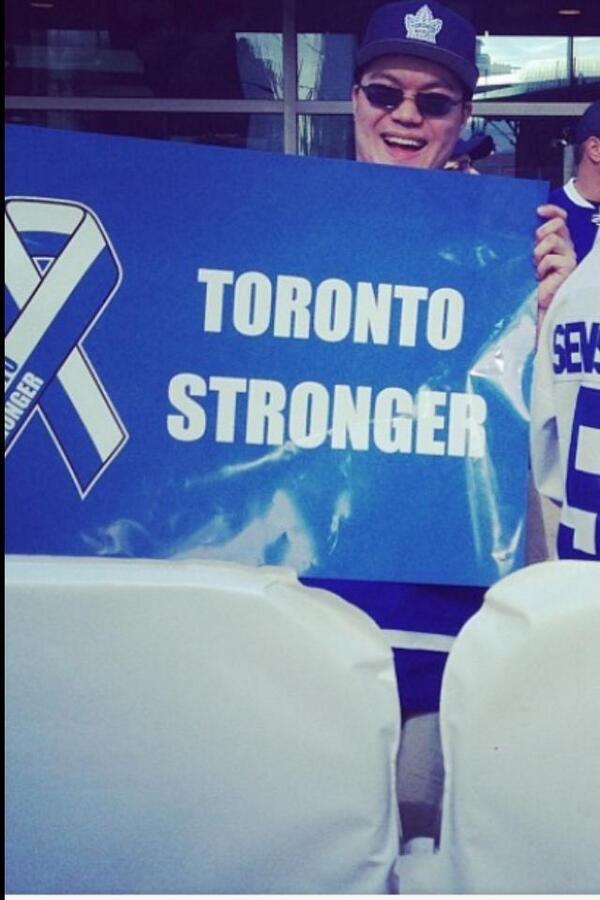 And then in the NHL playoffs, all holy hell broke lose. Some guy in Toronto, during the first round series, held up a sign that said “Toronto Stronger.” People in Boston were furious, and within minutes #TorontoStronger was the top trend on Twitter here. People not in Boston were furious, people in Toronto were furious.
It got worse in the Finals, a t-shirt company in Chicago began selling “Chicago Stronger” shirts. The response was predictable and it makes you wonder just what the guys at Cubby Tees (the company behind the t-shirts) were thinking? The t-shirts were quickly pulled from sale in response to the firestorm of protest, much of it, to be fair, from Boston.  Then the guys at Cubby Tees responded, offering some kind of apology that wasn’t really an apology, just a self-serving attempt to make themselves as the victims of the entire affair. But they kind of had a point, they argued that this is sports, and in sports, there are rivalries. And when there are rivalries, there is a competition of wit, idiocy (ok, I said that, they didn’t) and so on.
And yet, the kind of furor that erupted after the sign in Toronto and the t-shirt in Chicago was predictable. The guy in Toronto should’ve seen it coming, so, too, should have Cubby Tees. Both were in incredibly bad taste. The Boston Globe published an editorial comment a week ago decrying the co-opting of the “Boston Strong” slogan by sports fans (amongst others), claiming that it diminished from the slogan’s original point, which was “the victims of the bombing, now rebuilding their lives; the law enforcement efforts during the manhunt; the decision, by athletes and organizers, to run the Marathon in 2014.”
It’s hard to argue with that logic, but it’s also bad logic. The Boston Strong rallying cry has obviously spread to sports, and it’ll spread to music and festivals all summer long. And when the Dropkick Murphys play, whether in Boston or anywhere else, there’ll be people in the crowd chanting the slogan or they’ll have it on posters. Why? Because the Bruins and the Dropkicks are ambassadors of Boston. Both the punk band and the hockey team market a brand that makes Boston a tough, intimidating place (in reality, it’s nothing of the sort), and that’s an image that Bostonians like, and are proud to project around North America and beyond. The Bruins represent the city and the fans of the Bruins put their hopes, their energy, their money into supporting the team in cheering them on to victory. When the Bruins lost last night, Claude Julien, the coach, told reporters that he was disappointed in part because it would’ve been nice to bring the Cup back to Boston to help in the healing from the bombings.
It was always going to be the case that “Boston Strong” would become a rallying cry for Bruins’ fans. They’re Bostonians, and the Bruins are their team, their representatives. The Globe missed the point of professional sports; sports are meant as a distraction, as a means of turning our attention from reality. It’s worth noting that back in September 2001, the NFL season was meant to start the weekend after 9/11. Paul Tagliabue, the commissioner of the NFL at the time, immediately cancelled the games that weekend out of respect. It was the obviously correct choice to make. But then-president George W. Bush inveighed upon Tagliabue to reinstate the games, Americans needed the distraction.
Sports are more about identity as much as anything else for spectators and fans. And thus, it should be no surprise to anyone, lest of all the Globe that “Boston Strong” became a rallying cry for the Bruins, just as it was for the Celtics, as it is for the Red Sox, and will be for the Patriots when their season starts up in the fall.
Ten Thousand Saints and the Nostalgia of the Record Store
March 12, 2013 § 2 Comments
Last week I read Eleanor Henderson‘s excellent début novel, Ten Thousand Saints. This was a book I randomly came across, and, like most books I randomly come across, I was lucky. Ten Thousand Saints tells the story of Jude, a disaffected teenager in Burlington, Vermont (disguised as Lintonburg, for reasons I don’t quite understand since the rest of Vermont gets to keep its names), a sad sack little city about two hours from Montréal on Lake Champlain. Jude, I should also point out, is about a year older than I am. His best friend, Teddy, dies of an overdose on New Year’s Eve 1987, after he and Jude huff pretty much everything, including freon from an air conditioner, but Teddy also did coke for the first time, introduced to him by Eliza, Jude’s step-sister, who’s in town for a few hours from NYC. Teddy’s older brother, Johnny, also lives in NYC.
The novel then follows Jude, Johnny, and Eliza through the hardcore scene in the NYC underground in the late 80s (looking at Henderson’s picture on her website, she does not look the sort who would). Jude transforms from a pothead huffing high school dropout in Burlington to a straight-edge hardcore punk in NYC, frontman of his own band, the Green Mountain Boys (a clever play on their Vermont roots and Ethan Allen during the War of Independence). Henderson does a great job of illuminating the culture of the hardcore scene of the late 80s, both in NYC and around the rest of the East Coast, as well as issues of gentrification on the Lower Eastside of Manhattan, especially around Tompkins Park in Alphabet City, where Johnny lives, and around St. Mark’s Place, where Jude sometimes lives with his father.
Ten Thousand Saints made me nostalgic. At the other end of the continent, in Vancouver, I was starting to get into some of this music, if not yet the scene. Many of the bands Henderson references were in my cassette collection by 1989-90, a couple of years after Jude and Johnny were rocking out in the Green Mountain Boys. Though I cannot, for the life of me, figure out why the standard bearers of the straight edge scene in the late 80s, Fugazi, are not mentioned, though Ian McKaye’s earlier band, Minor Threat, are the gods of Jude, Johnny, and their crowd. What made me nostalgic was record stores. This is how Jude got into the scene in NYC in the first place, hanging around the record stores of the Lower East Side.
As I mentioned in my last piece here, on the Minutemen, Track Records in Vancouver was where I began to discover all these punk and hardcore bands in my late teens. Track stood on Seymour Street, between Pender and Dunsmuir, and as you went up the block, there was an A&A Records and Tapes, then Track, then A&B Sound, and then Sam the Record Man. Two indies and two corporate stores. And between the four of them, you could find anything you wanted and at a reasonable price. Zulu Records also stood on West 4th Avenue in Kitsilano, a short bus ride from downtown on the Number 4 bus. Of those stores, only Zulu remains. I’m in Vancouver right now, and I think I’m going to make my way over there today.
But it was in record stores that kids like me learned about this entire universe of punk and alternative music in the late 80s. In places like Track and Zulu, we heard the likes of Fugazi and the Minutemen, as well as the Wonderstuff and Pop Will Eat Itself and the Stone Roses playing on the hi-fi. This is where we could find the alternative press and zines, I found out about all these British bands from the NME and Melody Maker. You’d talk to the guys working in the stores (and it was almost always guys, rarely were there women working in these stores), you’d talk to the older guys browsing the record collections about what was good. Some of these guys were assholes and too cool to impart their wisdom, but most of them weren’t. And then you’d rush home to the suburbs and listen to the new music, reading the liner notes and the lyrics as you did.
For the longest time, I held out against digital music. I liked the physical artefact of music. I liked the sleeve, the liner notes and the record/cassette/cd. In part, I liked it because of the act of buying it, of going into the record store, even the corporate ones, listening to what was playing in the store, looking around and finding something. There’s not many record stores left. The big Canadian chains are all dead and gone. Same with the big American ones. In Boston, the great indie chain, Newbury Comics, isn’t really a record store anymore. The flagship store on Newbury St. has more clothes, books, movies, and just general knick knacks than music. Montréal had a bunch of underground stores up rues Saint-Denis and Mont-Royal, but they’re slowly dying, too. And here in Vancouver, the only one I know of is Zulu (though I’m sure there’s more on the east side, on Main, Broadway or Commercial).
I miss the community of music, it just doesn’t exist anymore. I suppose if I wanted to, I could find it online, discussion groups and the like. But it’s not the same. There’s no physical artefact to compare and share. There’s just iTunes or Amazon.
“We Jam Econo” D Boon and the Minutemen
February 8, 2013 § 1 Comment
While laid up sick this week, I finally got to see “We Jam Econo: The Story of the Minutemen,” about the iconic punk band, the Minutemen. The Minutemen came to an untimely end on 22 December 1985 when frontman and guitarist, D Boon, was killed in a car accident just outside Tucson, Arizona, as he and his girlfriend made their way to visit her family for Christmas. The other two members of the Minutemen, bassist Mike Watt and drummer George Hurley, were devastated, of course. To this day, everything Watt produces is dedicated to D boon’s memory.
 I first got into the Minutemen a few years later, around 1990 or so when I got my hands on fIREHOSE’s 1989 album, fROMOHIO. This was the band that Watt and Hurley formed in the aftermath of D. Boon’s death with Ed Crawford. I was drawn to the mixture of Crawford’s jazzy guitar, combined with Watt’s amazing bass sounds. But, what attracted me the most was Hurley’s drumming. I honestly don’t think there’s another drummer I’ve ever heard that touched Hurley, except for maybe Jimmy Chamberlin in the Smashing Pumpkins. But as I obsessed about fIREHOSE, I was directed towards the Minutemen by one of the guys who worked at the old Track Records on Seymour Street in downtown Vancouver.
The Minutemen blew my mind. D. Boon’s was already legendary. Vancouver had been central to the development of North American punk in the late 70s, and the city’s biggest band, DOA, had shared several bills with the Minutemen down in California. Track Records even had a Minutemen poster on the wall. I quickly became obsessed with the Minutemen’s 1984 double album, Double Nickels on the Dime. I loved Watt’s explanation of how this title came about; it was a response to Sammy Hagar’s complaint that he couldn’t drive 55. Apparently ‘double nickels” means 55mph, the speed limit in those days.
Every time I listen to the Minutemen these days, I just get incredibly sad. D Boon has been dead for longer than he was alive by this point, he was 27 when he died 28 years ago. Watt has aged, he still makes incredible music. But, simply put, and as trite as it sounds, D Boon never got a chance to age. His music always had a sneer in it, but what I loved most was always his political bent. He was a good working class boy (as were Hurley and Watt), and the politics of the working classes pervade his music. I was always drawn to this as a working class kid myself. In fact, this is what drew me to punk in the first place, it was a working-class movement. D Boon sang about how the working classes got screwed, his music reflected his own values of hard work, something instilled in him by his mother, who had died young herself, in 1978. More than that, D Boon was articulate, he didn’t look like a dumb punk trying to find big words when he spoke, he sounded like a smart working class dude. I liked that most about him. Too many other working class punks sounded like stupid mooks when they spoke (I’m looking at you, Hank Rollins).
But the Minutemen weren’t just anger. Their music was smart, a mixture of punk, funk and jazz, anchored by the incredible skill of Hurley. This jazz and funk influence (especially through Watt’s bass) added a level of fun and bounce to the music that other punks lacked. And Watt and D Boon were also just as influenced by The Who and Credence as anything else. These influences made them probably the most musically and technically proficient punk band of the era. They also mellowed as they got older, as both D Boon and Watt grew into their talent. This is what makes Double Nickel so sad for me (to say nothing of Three Way Tie (For Last), their last album, which came out a week or two before D Boon died). The Minutemen were evolving away from punk, they still sounded so unlike anything else out there. They weren’t becoming a basic rock band, they were far too smart for that.
Watt carries this spirit on in everything he does. His bass guitar was instrumental to the Minutemen’s sound. This is precisely what makes it all so sad, I always imagine what Watt would sound like if he and D Boon and George Hurley were still making music together. The Rolling Stone review of Three Way Tie (For Last) prophecies that “You can bet that in ten years there’ll be groups who sound like the Minutemen — maybe they’ll even cover their songs.” In 1996, no one sounded like the Minutemen. In 2006, no one sounded like the Minutemen. And in 2016, no one will sound like the Minutemen. They were a unique, one of a kind band.
This last clip comes from an interview the Minutemen did in the early fall 1985, just a few months before D Boon checked out.
The “Curation” of Southie and the General Over Use of the Term
December 10, 2012 § 4 Comments
We were in Southie yesterday, the former Irish-Catholic working-class neighbourhood of Boston. Southie is undergoing massive yuppification these days. The working classes are being squeezed out, and the yuppies are moving in. This was clear as we took the #9 Broadway bus from Copley Square into Southie. The bus is the great equaliser of Boston society; in some parts of the city, it’s the only time one sees large numbers of minorities. We got off the bus at the corner of West Broadway and A Street, on our way to a yuppified Christmas foodie craft fair at Artists for Humanity on West 2nd Street. In a lot of ways, Southie looked to me like a combination of parts of the Plateau Mont-Royal and Pointe-Saint-Charles back home in Montréal. The architecture was Plateau-like in terms of post-industrial spaces and housing, but the people looked like they could be in the Pointe. There was a curious mixture of the down and out, the working-classes, hipsters, and yuppies of every skin colour.
Gentrification is a creeping problem in pretty much every North American and European city, and much has been written about this, including on this very blog (like, here, here, here, here, here, here, and here, for starters). But what struck me the most was Social Wines, a wine and beer emporium in a spanking new building on West Broadway at A Street. Social Wines offers its clientele “Curated Craft Beer and Spirits.” Now, I must confess, this is my kind of store: it focuses on smaller, indie breweries and vineyards. I like giving my money to these kinds of companies, rather than the Molsons, Budweisers, and massive vineyard conglomerates of the world. But curated? What the hell does that mean?
According to the Meriam-Webster dictionary on-line, a “curator” is “one who has the care and superintendence of something; especially : one in charge of a museum, zoo, or other place of exhibit. To “curate” is: “to act as curator of a museum or exhibit curated by the museum’s director.”
Of late, hipsters and academics have abused the term “curate” like it’s nobody’s business. It is one thing, in the field of Public History and its corollaries, to write of the ways in which museums and the like have “curated” items. That is the proper use of the term. But when editors of edited collections of academic papers start referring to themselves as “curators” and not “editors,” well, then we have a problem. Meanwhile. Hipsters. On any given day, one can go to PitchforkMedia and see articles about this or that music festival that has been “curated” by someone. The most egregious example of this is the All Tomorrow’s Parties festival, which takes place in merry olde England, with branches occurring in the US, too. Each year, ATP is “curated” by a guest musician, one of stature and great fame. What that means is that someone is in charge of deciding who should play, and the list of artists reflects the curator’s tastes. Yup, deciding who should play a music festival is curation.
And so now we have a hipster beer and wine store in Southie that offers us “curated” booze. What, exactly is curated? The collection of booze on sale. See, the old ma and pop liquor store down the street just orders in booze that they figure their clientele will enjoy. But, not hipsters, they lovingly and carefully “curate” the collection of booze on sale at Social Wines. I don’t know about you, but I feel a lot better knowing that rather than having some old geezer just randomly order wines and beers that may or may not be any good, we have the fine folk at Social Wines to very carefully curate their collection.
My problem with the use of this term? It’s very simple. It’s pretentious. And nothing quite says “I’m a wanker” like declaring that you curated your liquor store. I applaud Social Wines’ mission. Hell, next time I’m in Southie, I may even stop in and peruse their collection of wines. But the use of this term by book editors, musicians, and liquor store owners also seriously devalues the meaning of the word in its true professional sense.
Professional curators, those who work in museums and art galleries, do not just collect stuff they like to display. They are responsible for the content of exhibits, and they are required to carefully make decisions on what is appropriate and what is not, to carefully arrange the displays, to negotiate with sponsors, and so on and so forth. There is a reason why curators go to school to learn how to properly curate. Musicians and liquor store owners do not.
Le Reigne Elizabeth
October 19, 2012 § Leave a comment
The Queen Elizabeth Hotel on blvd. René-Lévesque has fascinated me ever since I was a kid. Structurally and aesthetically, it is one of the ugliest buildings in the downtown core of Montréal. Built in a neo-brutalist style usually reserved for university campuses, the Queen Elizabeth is nonetheless the swishest hotel in Montréal. It is also the largest hotel in Montréal and Québec, with over 1,000 rooms. The other thing that has fascinated me since the mid-70s is the name of the hotel. How does a hotel in the middle of Montréal, the metropole of Québec, end up being named after the Queen? Better yet, what’s with the incongruity of the name in French, Le Reigne Elizabeth, with the masculine article there before the feminine monarch?
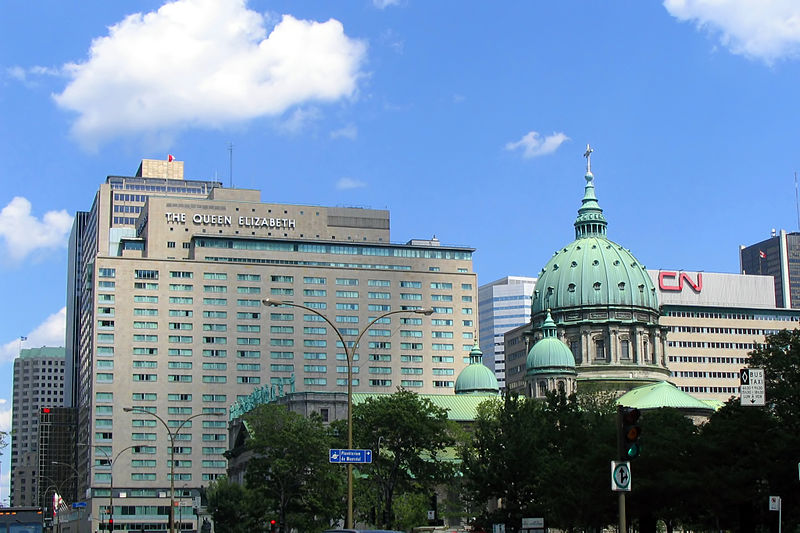
When the hotel was first proposed back in 1952, there was an upsurge of love for the monarch in English Canada. Queen Elizabeth II had just ascended the throne, and around the former British Empire, people were gaga over the queen, somewhat like people are currently in a tizzy over the former Kate Middleton. However, the 1950s also saw the rumblings that led to the eruption of the Quiet Revolution in Québec in 1960. There was an upsurge of québécois nationalism in the city and province as well. Indeed, nationalists argued that the Canadian National Railways should name the new hotel after the founder of Montréal, Paul de Chomedy, sieur de Maisonneuve. Nonsense, responded the CNR’s president, Donald Gordon: Canada is a Commonwealth nation, and the head of the Commonwealth is Queen Elizabeth II. Since he was the one building the hotel, he won the debate.
As for the masculine article in the hotel’s French name, well, it turns out that refers to the implied ‘hotel’ in the name, and hotel is masculine. There you have it.
 The Queen Elizabeth Hotel, of course, has lived up to its reputation. The Queen herself has rested her head on its pillows four times, and her son, Prince Charles, has also visited. The NHL entry draft was held there pretty much every year until 1979. But, of course, the most famous event to have occurred in the Queen Elizabeth is the “bed-in” of John Lennon and Yoko Ono, 26 May-2 June 1969. Lennon and Ono had been denied entry to the United States, because Lennon had a cannabis conviction from 1968. A bed-in was planned for New York City. So now the plan had to be changed, and so Lennon and Ono bedded down in the Queen Elizabeth for their second Bed In for Peace (the first had been in Amsterdam 25-31 March). During the Montreal bed-in, the anthem “Give Peace a Chance” was recorded by André Perry.
 Matthew Barlow