Filming Griffintown
June 10, 2012 § Leave a comment
Two months ago, I posted this about film-maker Scott MacLeod‘s fundraising attempts for a documentary on Griffintown. I’m happy to report he raised enough money and all systems are go. Today, I will be meeting up with Scott and his crew for a bit of filming before Ireland takes on Croatia in its first match of Euro 2012. I am slated to discuss the destruction of Griffintown in the 20th century, due to both bureaucratic inertia on the part of Hôtel de Ville, and depopulation due to deindustrialisation in Griffintown. Of course, all the Lachine Canal-side neighbourhoods of Montréal experienced deindustrialisation, but Pointe-Saint-Charles, Little Burgundy, Saint-Henri, Côte-Saint-Paul and the like didn’t become ghost towns like the Griff. The difference? A combination of local populations resisting deindustrialisation and depopulation (the Pointe, in particular, was home to a radical, populist resistance), as well as political support. Griffintown got none of that. The city abandoned Griffintown, left it to die.
Fast-forward 50 years and now there is nothing the Ville de Montréal loves more than Griffintown. You can practically see the dollar signs in Mayor Gerald Tremblay’s eyes whenever someone mentions the word “Griffintown.” All the city can see is the tax dollars that will come in from all the condo dwellers there once Devimco and a handful of other developers are done with the neighbourhood. Did I say neighbourhood? Oops, sorry. To me, neighbourhood means a form of community, there is common cause amongst neighbours. In some cases, this is organic, in other cases, communities can be planned to encourage neighbourliness. The re-jigged Griffintown, however, is not one of those. No parks, no schools. None of that. Can’t have that, that’d steal space from condos!
So we are going to get a district of high rise condominiums, populated by harried, busy urban dwellers with no real, organic chances for community living, unless they seize the chances themselves. Maybe they’ll become the condo dwellers here in the Pointe, many of whom have joined the casseroles protests, such as they exist in the Pointe, and have joined the community gardens, and have joined the old populist community organisations of the Pointe? Or maybe they won’t. I’m not optimistic, because the Pointe already had this community-based model when the condos went up and when we gentrifiers moved into remodelled tenements. The Griff has none of that.
But don’t tell Gerald Tremblay. Actually, go ahead, he’s not listening anyway.
Adding to the Wasteland of Griffintown
April 13, 2012 § 1 Comment
I have taken to going through Griffintown on my morning run of late, in part because it gives me a chance to keep an eye on the redevelopment there. I come up from the Lachine Canal to de la Montagne, to Ottawa, over to Peel and then down Wellington back down to the Canal, which gives me a quick tour through the heart of old Griffintown, past the old ruins of St. Ann’s Church, by the recently sold Horse Palace, past the Merciers’ old home and Fire Station No. 3.
A condo tower is going up at the corner of de la Montagne and Ottawa, there is work going on around the Horse Palace, there is a new condo bloc at the corner of Ottawa and Murray. And another development is underway on the northeastern corner of Peel and Wellington. And then, of course, across Wellington, between Young and Shannon is Devimco’s massive construction site. Buildings have come down and holes have been dug for Devimco.

And Devimco has moved its condo sales office. It was once located up the block on the eastern side of Peel near Ottawa, but now it sits proudly, if not somewhat barrenly, on the southeastern corner of Peel and Wellington. I did find myself wondering if the sales people are still promising potential buyers that the CNR would move its railway, as the viaduct is across the very narrow Smith street from the site of Devimco’s condo towers.
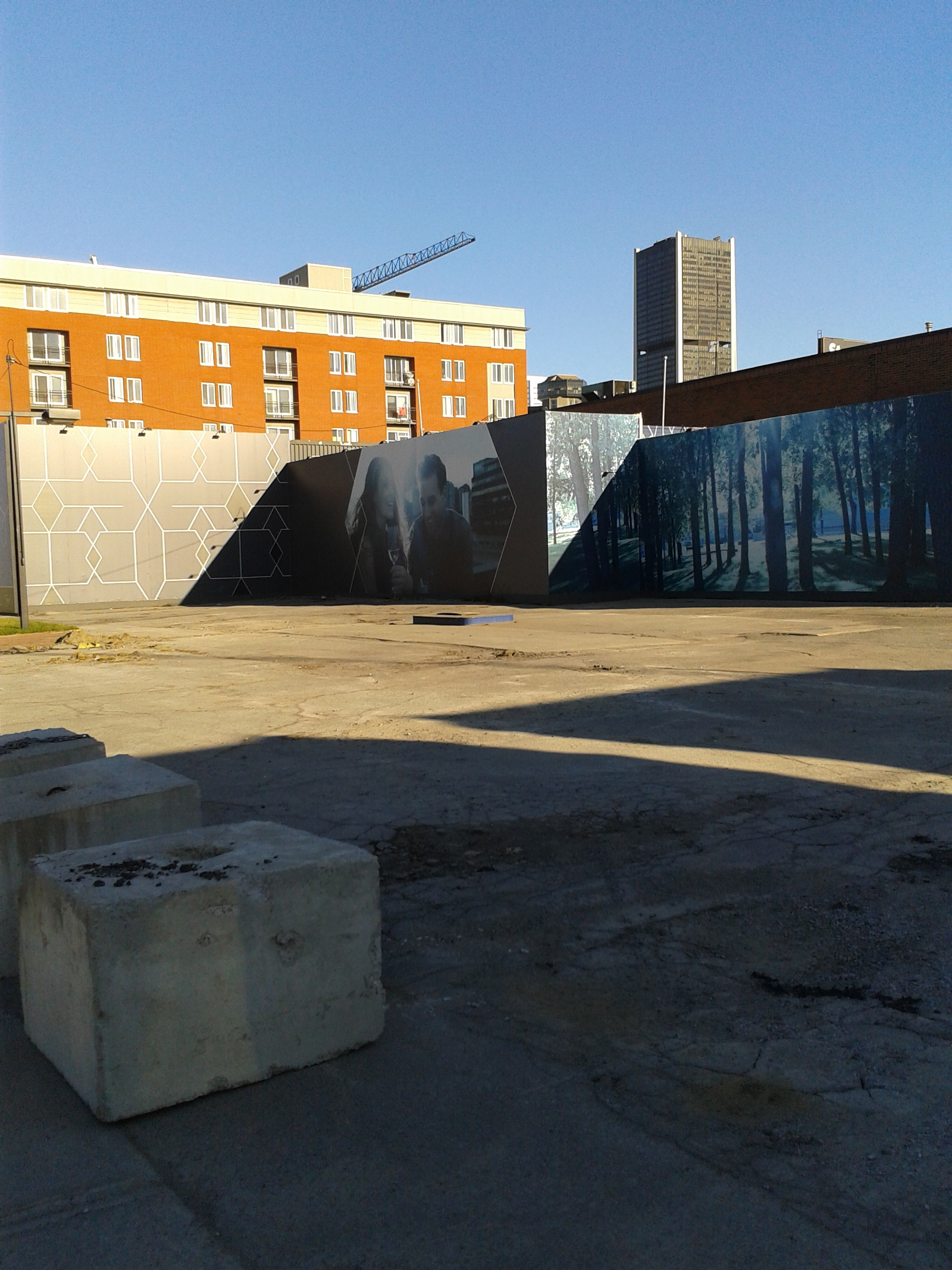
At any rate, the old sales office is now just another wasteland on Griffintown’s landscape, yet another lot of urban refuse, but this time created by the very company which proposes to rejuvenate and renovate the Griff. Ironic, I thought.
In Griffintown/Dans L’Griff
April 2, 2012 § 1 Comment
In Griffintown/Dans L’Griff will be a documentary about Griffintown, made by my friend, film-maker G. Scott MacLeod. Scott’s most recent film, a short entitled The Saga of Murdo MacLeod has been received rapturously by Montrealers at its various showings around town, most recently at Ciné-Gael, Montréal’s Irish film series, which is celebrating its 20th season this year.
Scott is proposing to do a short documentary on Griffintown through the eyes of Claude and Lyse Mercier, amongst the last generation of Griffintowners. Claude and Lyse, as you might guess by their names, are NOT Irish! Shock! Indeed, they are French Canadian, a voice that has long been lost in the stories and memories of the Griff (as my forthcoming book, The House of the Irish: History, Memory and Diaspora in Griffintown, Montreal, will tell you). Almost all the attention on the Griff’s history has been focused on the working-class Irish Catholics, leaving out the other residents there: French Canadians and Anglo-Protestants, and Scott’s about to address this lacuna.
Scott and I have had a lot of conversation about Griffintown, over Thai food and as we’ve wondered the streets of the neighbourhood both of us are so hell-bent on preserving the memory of. And while books are great (especially mine!), a documentary, graphic evidence of what once was, is a brilliant addition to the growing corpus of Griffintown memories.
The trailer for the film is below, but I urge you to click on this link, which will take you to Scott’s indiegogo page, where he is attempting to raise money to help with the costs of film-making. Any amount will help, but Scott is offering 3 levels of support. 20$ gets you a thank you in the end credits and a copy of the DVD, 100$ gets you into the end credits and a DVD, and 1000$ makes you a producer, and you also get a copy of the DVD.
On Living in a Gentrifying Neighbourhood, Part 3
March 3, 2012 § 11 Comments
There is an SAQ outlet at the corner of Centre and Charlevoix here in Pointe-Saint-Charles. For those of you non-Quebecers reading this, SAQ is the Société des Alcools du Québec, the state monopoly, the liquor store. The SAQ here in the Pointe is a tiny one, a little boutique, but very busy and the staff there are friendly, helpful, and very knowledgeable. But the SAQ is closing it down as of 30 March this year because, it alleges, the outlet is unprofitable. If that outlet is unprofitable, I am the King of Siam. What is at work here is the SAQ forgetting its mandate as a state monopoly, which is not just to make money hand-over-fist, but to provide a service.
So the people of the Pointe, as mobilised as ever, are protesting the closure of our SAQ outlet. There was a march to our MNA’s office on rue Saint-Jacques yesterday to protest. Why are people protesting? That should seem to be obvious, quite frankly. But the SAQ at the corner of Centre and Charlevoix is in many ways an anchor of the commercial outlets along the next few blocks of Centre. Kitty corner from the SAQ is Restaurant Machiavelli, a relatively upscale eatery. Next door over is Cari Mela, one of the handful of Indian restaurants in the Pointe, and probably the best. Cari Mela, Machiavelli, and the other Indian restaurants along Centre are all bring your own wine. This makes sense, given the SAQ down the block.
Centre has seen some rough times, but in the past few years there has been a slow regeneration and revival. There have been these new Indian restaurants opening. There is a mosque acros the street and up a block. A series of Bengal dépanneurs have popped up. And a series of coffee shops/casse croutes have opened up or have maintained. More recently, a trendy boutique restaurant, Ma Tante Quiche has opened its doors next to a laundromat, and there are rumours a boulangerie is opening up where the old video store was.
Losing an anchor like the SAQ will have serious ramifications for Centre as a commercial zone.
The CBC had a short story on its website yesterday about the protest, which will no doubt come to naught. The story itself is innocuous, but the comments on it are quite simply, jaw-droppingly stupid. Michael59 says the protest was a stupid joke because the next store is a few blocks away. mikeysm notes that the Pointe is a poor neighbourhood. HughNugent reports that most of his family grew up here and their response would be for us to get up off our fat arses and walk to the Atwater Market, where there’s a big SAQ outlet.
These comments reflect the general idea of the Pointe of a neighbourhood of poor folk, collecting welfare, and spending their banlieue money on lottery tickets. But there is obviously more than that. The Pointe is a diverse neighbourhood these days, and the clientele of the SAQ reflects this. There are people of all ethnicities and socio-economic classes at the outlet buying their alcohol, primarily wine, as that’s what dominates the shelves. Atwater Market is a good 15 minute walk from the corner of Centre and Charlevoix. It’s a lot farther away if you live further into the Pointe.
But beyond that, the general gist of these comments is that the people of the Pointe are fat and lazy and because they are such, they shouldn’t be wasting their money on alcohol to start with. I am very curious what the comments would be in response to a story about the closing of a busy SAQ outlet on, say, the Plateau, or the Mile End, or Outremont, or NDG or Westmount. I’d bet they would be asinine comments such as these.
Rural Palimpsests; Or, the Changing Rural Landscape
February 3, 2012 § 9 Comments

Drawing of the Old Hawley Town Commons
About 18 months ago, I wrote this piece about the old Town Commons in Hawley, Massachusetts. I was struck by the history of what could no longer be seen in Hawley at the Town Commons where, in the mid-19th century, there was a vibrant townsite. Hawley also stirred up my own memories of having lived in a ghost town as a teenager, on the old town site of Ioco, British Columbia, now a part of Port Moody, BC. But Ioco, which will eventually become condos, I’m sure, was a (sub)urban townsite. Hawley is a town a few miles west of the Middle of Nowhere.
 In urban centres, we see the ruins of past civilisations all around us, whether they are palimpsests of old advertisements on the sides of buildings, or the ruins of buildings, still dotting the landscape. Indeed, I wrote my doctoral dissertation and a book on a neighbourhood that was, at least when I started writing, a ruin: Griffintown, Montréal. A decade ago, the landscape of Griffintown was an urban ruin, the foundations of the old Irish-Catholic Church, St. Ann’s, poking through the grass of Parc St. Ann/Griffintown; the rectory of the French Catholic Church, Ste-Hélène still stands, but the church is long gone, just a few corner stones and the remains of an iron fence are left. But this is a city, and cities, we are constantly reminded by scholars, poets, novelists, film-makers, etc., are living organisms, built to be rebuilt, constantly evolving and changing. By definition, then, the rural landscape is unchanging and constant.
Don’t believe me? Spend a bit of time reading literature set in the countryside. Or watch movies. Read poems. The landscape of the country side is eternal and unchanging. Entire nations have been built on the mythology of the countryside (I’m looking at you, Ireland!). Here in Québec, Maria Chapdelaine, a major novel of the early 20th century nationalist school explicitly tied the virtue of the nation to the land. The anti-modernists of a century ago celebrated the unchanging “natural” landscape of the countryside as a tonic for the frayed nerves of modern man. In Canada, the Group of Seven built their entire careers/legends on representing Ontario’s mid-North back to us as the nation. Watch a Molson Canadian ad these days, and you’ll learn that Canada has more square miles of “awesomeness” than any other country on Earth. And all that awesomeness is somewhere in the wheat fields of Saskatchewan. But the rural landscape DOES change and evolve, as the Old Hawley Town Commons will tell you.
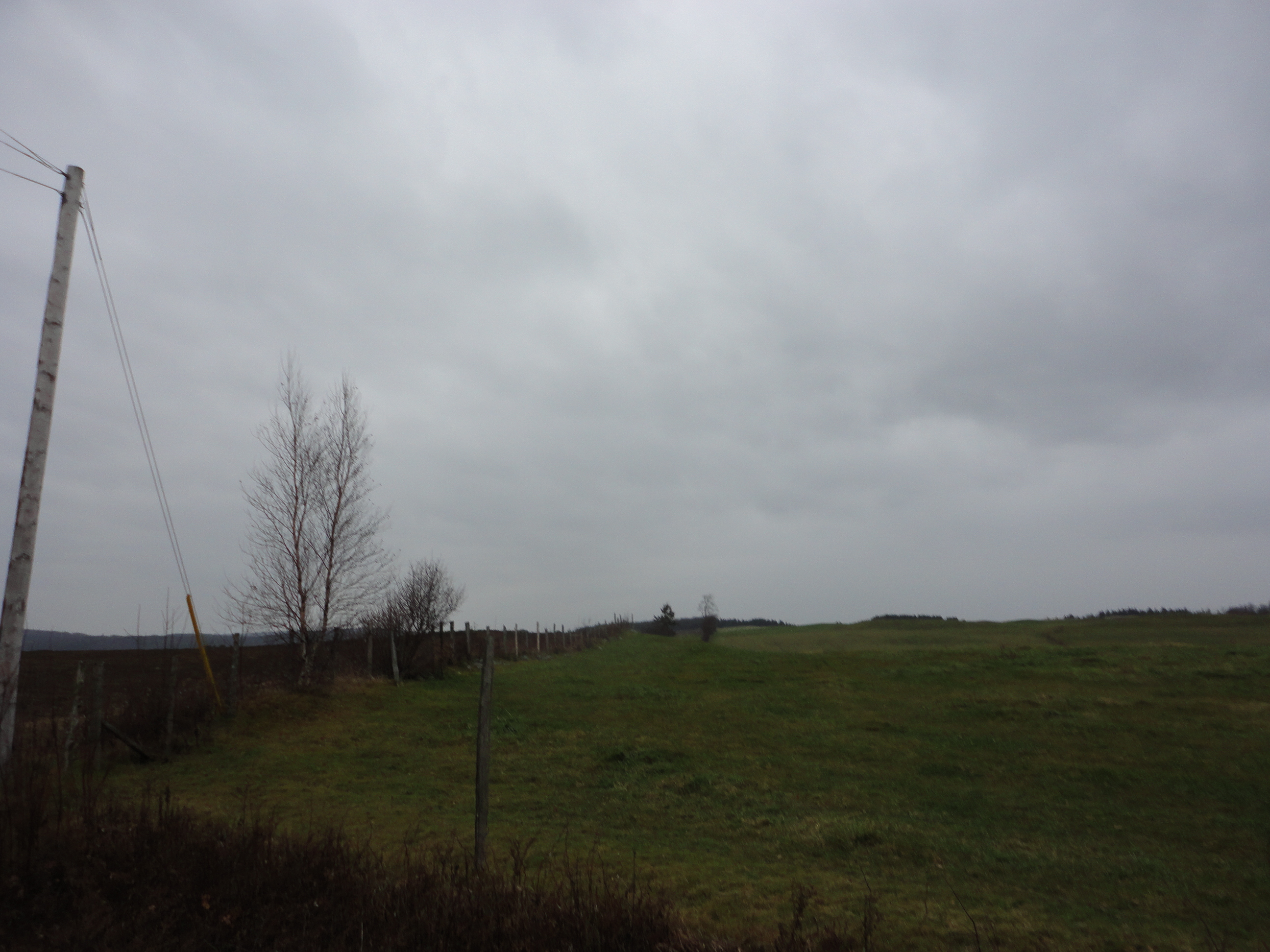
This is where Robert Corrigan was fatally beaten on 17 October 1855
This was brought all the closer to me in late November, when I travelled out to Saint-Sylvestre, Québec, which is located about 70km south of Québec City, in the Appalachian foothills. I was there because a long time ago, I wrote my MA thesis on the Corrigan Affair, which erupted in Saint-Sylvestre on 17 October 1855 when Robert Corrigan, an Irish-Protestant bully, was beaten to death by a gang of his Irish-Catholic neighbours. The mid-1850s saw the height of sectarianism in Canada and a murder case involving the two groups of Irish proved to be too much for many Anglo-Protestant Canadians to take and a national crisis broke out. By the time the Affair was over in 1858, not only had Corrigan’s murderers been acquitted of all charges, the McNab-Taché coalition government had fallen. All these years later, I had it in my mind that it was time to do something with the Corrigan Affair. I had done my best to avoid it after I finished my MA, I did attempt to write an academic article, but it seemed to me to be too good a story to be wasted in a journal article that no one would ever read. So I have decided to write a book that no one will ever read, but at least a book is a physical thing, something to offer tribute to this rather amazing story that erupted onto the front pages of newspapers across British North America from a rural backwater. So it was out to Saint-Sylvestre to meet Steve Cameron, a local man who has a deep interest in the Corrigan Affair and the history of the Saint-Sylvestre region in general.
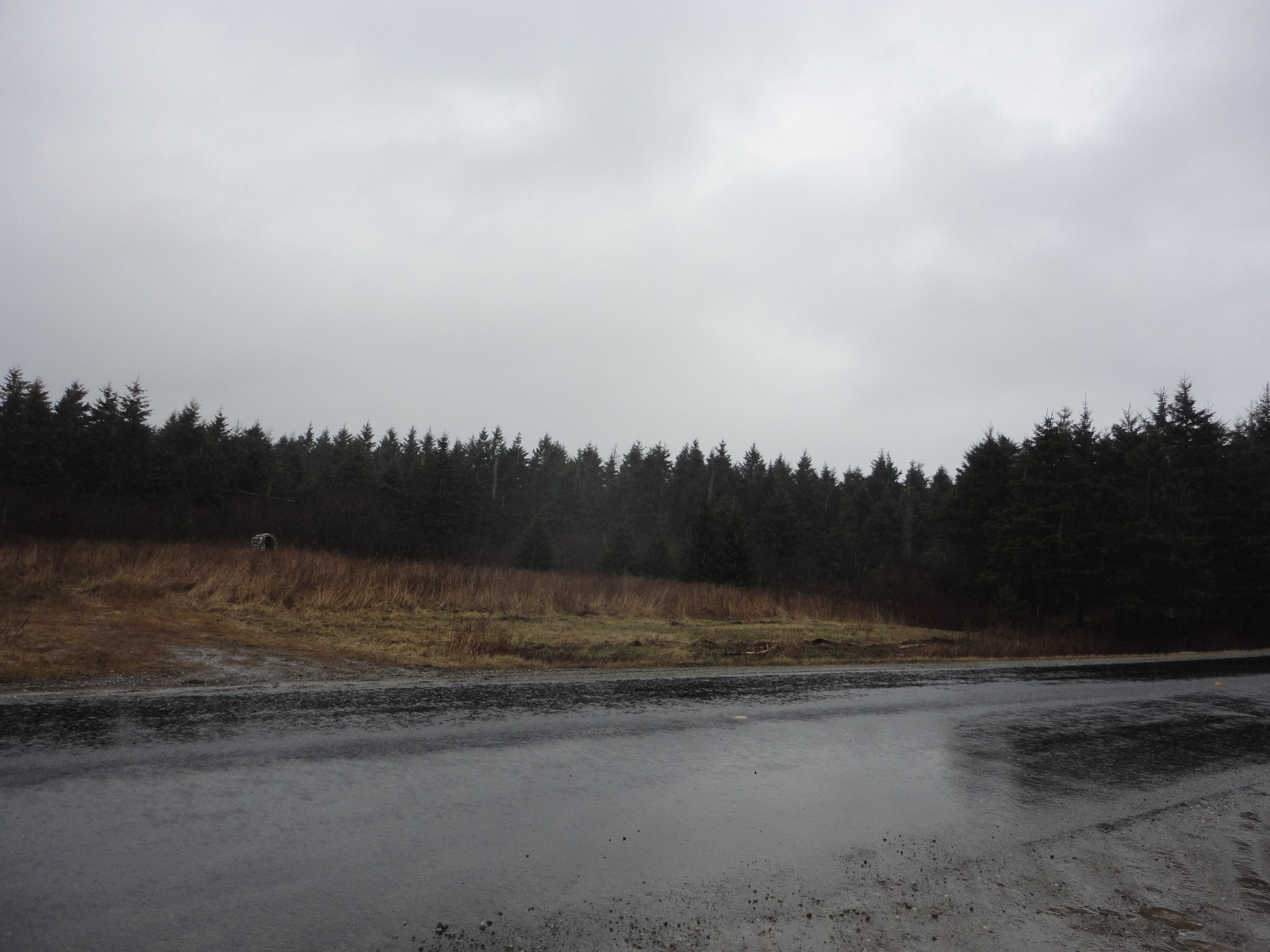
Corrigan's homestead, Saint-Sylvestre, Québec

Hugh Russell's farm
Steve offered to give me the grand tour of the landscape, where the Corrigan Affair took place. I don’t really know what I expected, but I certainly didn’t expect what I saw: the entire landscape of Saint-Sylvestre and the landscape of the Corrigan Affair is gone, completely changed in the 155 years since Corrigan’s death. He was beaten on the county fair grounds; the site where he was beaten is completely non-descript today, just a corner of a farmer’s field. Corrigan’s homestead is covered with scrub and a random cross someone threw up sometime in the past century. Where the farm of Corrigan’s friend, Hugh Russell was once located there is nothing but high tension electrical wires, forest, and a dirt road passing by in front. There is no evidence of human habitation ever having stood there. Where the Protestants had their burial ground here in the backwoods of Saint-Sylvestre/Saint-Gilles, there is nothing left but a stone wall, though the grave yard has been carefully and lovingly restored by Steve’s organisation, Coirneal Cealteach.

Old Anglican grave yard in the backwoods of Saint-Sylvestre
In short, the rural landscape is just as dynamic of that of the city. In Saint-Sylvestre, the mostly Irish-Catholic farmers were settled on poor farming land in a harsh and unforgiving landscape; their descendants left. And in their stead, nature reclaimed its place. When I first began studying Griffintown a decade ago, Talking Heads’ song “Nothing But Flowers” kept creeping into my head as I pondered the ruins of the churches, the trees growing in vacant lots and the vegetation in the cracks of the concrete. But “Nothing But Flowers” applies just as much to Hawley or Saint-Sylvestre or countless other rural landscapes once settled by humans who have long since moved on.
Globalised Montréal
May 12, 2011 § Leave a comment
In the past few years, there’s been a new trend in Montréal History and historiography that has seen us seek to place the city within a global context. This is a welcome change from our usual navel-gazing, as we sought to explain developments in Canada solely within a Canadian context. Certainly, the local context is important, but Canada did not develop in solitude. It was always a colony and nation tied into global political and economic currents, closely related to goings-on in Paris, London, and Washington. Indeed, scholars of Canadian foreign policy have long framed Canada within the North Atlantic Triangle, along with the UK and USA.
But, culturally and socially, while historians have noted the impact of British and/or American ideas in Canada, we have gone onto explain and analyse the Canadian context separate from the global. In Québec, though, perhaps due to political exigencies. Back in undergrad at UBC, Alan Greer’s masterful book, The Patriots and the People was the first study I ever read that attempted to internationalise Canadian history. In it, Greer re-cast the 1837 Patriote rebellions in Lower Canada within the revolutionary fervour that had swept Europe and the United States since the late 18th century. Seen in this light, the Parti Patriote wasn’t just a nationalist French Canadian political party, but part of an international of liberal revolutionaries that had corollaries in England, Ireland, France, the German territories, the Italian countries, the United States, and so on.
Greer’s book fit into the larger work of the revisionist Québec historians, who often sought to put Québec into a global context, both to explain the colony/province/nation’s development, as well as to give credence to Québec’s claims to nationhood. The goal was to present Québec as a nation commes les autres. Perhaps the book that had the greatest impact on me in this sense was Gérard Bouchard’s 2000 monograph, Genèse des nations et cultures du Nouveau Monde: Essai d’histoire comparée, in which Bouchard examines the development of Québec in relation to other “new world” cultures in Mexico, Australia, New Zealand, Canada, and the United States. Put this way, Québec’s (and Canada’s) development from the moment of European settlement is globalised and we realise that Canada (and Québec) is not really all that unique.
This tendency to internationalise Québec seems to be continuing with a younger generation of historians. My friend and colleague, Simon Jolivet, has just published his new book, Le vert et le bleu: Identité québécoise et identité irlandaise au tournant du XXe siècle. Simon and I did our PhDs together at Concordia, and in 2006, the School of Canadian Irish Studies there hosted a roundtable discussion that looked at connections between Ireland and Québec, in large part this grew out of the work our PhD supervisor, Ronald Rudin had done early in the decade. It was probably the most dynamic and informative conference I’ve been at, as ideas flew around the table. Both Simon and I gained a lot from that conference and it is clear in both of our work.
For my part, I am interested in the Irish in Griffintown, Montréal, over the course of the 20th century. What I look at is, of course, identity, but I’m interested in the shaping of a diasporic identity amongst the Montréal Irish, one that situates the Irish of the city within the global context of the Irish around the world, as well as the links (such as they were) with Ireland itself. To do so, I make use of post-colonial theory, which seems particularly à-propos for the Irish, descendents of a colonial culture in Ireland, living in Montréal, the largest city of the French diaspora and thus necessarily a post-colonial location.
And this is what Sean Mills picks up in his brilliant new book, The Empire Within: Postcolonial Thought and Political Activism in Sixties Montreal. Mills situates Montréal within that postcolonial framework, and examines the ideas of decolonisation and colonialism within activist circles in Montréal in the 60s. The activists were heavily influenced by what was going on in the world around them, in de-colonial movements in Algeria, Tunisia, and, especially, Cuba, as well as the Caribbean in the 50s and 60s. Certainly, they were well aware of their skin colour and Canada’s place as a first-world nation. But the ambivalence of Montréal (still the economic centre of Canada in the 60s) is something Mills excels at drawing out. As the decade went on, American activists, in particular African American activists like Malcolm X and Stokely Carmichael, became influential in the de-colonial struggle of the French Canadian majority of the city. This was further complicated by Montréal’s own black population, which also identified itself with the ideas coming out of the United States and the Caribbean. And as Montréal became a more complicated city, ethnically-speaking, to say nothing of the actions of the FLQ in October 1970, ideas of decolonisation lost their appeal.
Nonetheless, what is clear is that Montréal is a global city, one that takes its cue from its global connections as much as its local ones. Indeed, this is the basis of my next project about layers of diaspora on the urban landscape of the city. In the meantime, it also gives me a way to situate my own work on the Irish of Montréal in a larger global context.
Community in Pointe-Saint-Charles
April 29, 2011 § 3 Comments
Pointe-Saint-Charles has historically been an inner-city working-class neighbourhood. And a forgotten one, hemmed in by the industrial nature of the Lachine Canal and the Canadian National Railway tracks and train yards. The inhabitants toiled away for long hours for low wages, often without security of tenure at work. And then deindustrialisation hit the Pointe hard in the 70s and 80s. Suddenly, all the people who worked long hours for low wages couldn’t work anymore for any wages. And the Pointe’s unemployment rate shot up, reaching something like 33% by 1990. Even today, with creeping gentrification, the Pointe still has shocking pockets of poverty, high unemployment, and high reliance on social services. Each week, the food bank at St. Gabriel’s Church across the street from my flat has a long line outside it. The Mission du Grand Berger on rue Centre and the charity shop in the back of the towering Église Saint-Charles are going concerns. As is the pawn shop and the dollar stores on Centre. Wellington, the former commercial hub of the Pointe, looks like a ghost town.
In short, the Pointe is a classic, inner-city, downtrodden neighbourhood. And yet, it has one of the strongest senses of community I have ever seen in a city. And it is an inclusive community, one that welcomes all: French, English, working class, yuppies, immigrants. The lingering tension that hangs over the sud-ouest of Montréal between French and English doesn’t exist here. The tensions surrounding gentrification is also more or less absent. The block I live on is a dividing line between the yuppies and the working classes. I live on the north side, the yuppified side. And yet, everyone is friendly. This is seriously a place where you go into the dépanneur and end up having a 20-minute conversation with the shopkeeper and customers about the Habs. Where you know your neighbours.
The sense of community is deeply-rooted in the Pointe. One of the focal points is the Clinique communitaire de Pointe-Saint-Charles on rue Ash in the southern end of the neighbourhood. The Clinic was founded back in 1968 when a bunch of radical medical students from McGill came down here and were appalled by what they saw in terms of public health. My favourite story involved a young girl who said that when she went to the bathroom at home, she had to pound the floor with her shoes so that the rats didn’t bite her. So they did something. They weren’t entirely welcomed by the people of the Pointe, it must be noted. Instead of picking up their marbles and going home, instead they invited the community to get involved. The Clinic was a radical organisation, grassroots in nature, and the medical staff there made the connection between poverty, ill health, and mental health. The Clinic has had a psychiatrist on staff since 1970.

The Pointe Clinic predates Québec’s innovative CLSC (Centre local des services communitaire) system, a sort of front-line centre for health and other social services in the communities of the province. In fact, the Pointe Clinic was a model for Robert Bourassa’s Liberals when they created the CLSC system in 1974. The Pointe Clinic demanded that it’s autonomy be respected and the government left it outside of the CLSC system. Five years later, the Parti Québécois of René Lévesque was in power, and the government attempted to bring the Pointe Clinic into the CLSC system. Bad move, as the community mobilised and protested against the government’s decision. The government had no choice but to back down. Indeed, the Health Minister said: “Compte tenu de votre existence antérieure à l’implantation des CLSC, le ministère des affaires sociales a confirmé son intention de ne pas vous assimiler à ce type d’établissement mais bien de respecter la spécificité de votre organisme.”
And so the Clinic survived and thrived, as it continued to grow in terms of staff and importance in the community. Indeed, the Clinic is still run by members of the community, not the medical staff and certainly not the government. But this autonomy has not been easy to protect. Perhaps the greatest battle came in 1992, when Robert Bourassa and the Liberals were back in power. That year, the government proposed the Loi sur la santé et les services sociaux. As the Clinic explains on its website:
Le projet de loi C-120 menace la survie de la Clinique en la plaçant devant un choix qui n’en est pas un : soit la Clinique conserve sa charte d’organisme communautaire ‘privé’ et perd alors son permis de CLSC ainsi que le financement qui lui ai rattaché, soit elle devient un CLSC ‘public’ et renonce à sa charte et à son mode de fonctionnement communautaire.
Bad move, government. The community of Pointe-Saint-Charles mobilised on the streets. 600 people marched to protest the government’s plan. There was street theatre and delegations to the local and provincial politicians. Half of the adult population of the Pointe signed a petition protesting the government’s plans. The government had no choice but to back down.
A final battle in the middle of the last decade saw the Clinic brought within the larger system, but at the same time maintaining its autonomy. No one calls it the CLSC here in the Pointe. Instead, we all know it as the Clinique Communautaire de Pointe-Saint-Charles, or the Clinic.
A second branch was opened on rue Centre. One of the deepest ironies of a protest against the condofication of the neighbourhood came a couple of years ago when a condo development on Centre, next door to the CLSC went up in flames when it was still under construction. The developers returned, and rebuilt the condos. But those who suffered: the small drycleaner next door and the CLSC, which was closed for nearly a year as it attempted to recover.

The Clinic is a community centre in the Pointe, something for which the people here have every right to be proud. And because the people of the Pointe have been so successful in creating and protecting their clinic, the community here has been able to successfully protect itself from some forms of gentrification. I had the opportunity to spend a fair amount of time at the Clinic this winter due to some freaky health issues, and I was always blown away by the ways in which this community has mobilised to protect itself.
These days, the big issue is what is to become of the CNR yards at the southern end of the neighbourhood, the point for which Pointe-Saint-Charles is named. Rather than allow a bunch of condos be thrown up on the old rail yards , the Comité Action CN formed out of the Carrefour d’éducation populaire de Pointe-Saint-Charles on rue Centre to protect the community and to propose an alternative for the development of those lands. Last autumn, the Comité created a glossy publication, “Les terrains du CN de Pointe-Saint-Charles: Des proposition citoyennes.” Not wishing to be subject to expensive condos that will further alienate the residents of the neighbourhood and continue to put affordable housing out of reach, to say nothing of the pollution and noise caused by the construction condos on the site, the Comité proposes community gardens and a market, and to use the old buildings as a new community centre, as well as a housing co-operative. But before any of this happens, the Comité insists that the CN lands need to be decontaminated.

Too often I read of laments for community, or worse yet, the argument that community can only be forged by yuppies in their soul-less condos. Clearly, the Pointe says otherwise.
Les Expos, Nos Amours: Gone, but not Forgotten
April 25, 2011 § Leave a comment
Last October, as the Expos should have been winning the World Series, I wrote a piece at the National Council on Public History‘s blog, Off the Wall, about the strange marketing after life of Nos Amours. This provoked a steady stream of comments, both on that site and into my inbox, as well, to a lesser degree, here at Spatialities. One of my readers, Sarah, pointed out Montréal rapper Magnum .357′s track “Expos Fitted.
It seems that rap has emerged as a key component to remembering our long gone baseball team here in Montréal. Aside from Mag .357, Anakkin Slayd, who is more famous right now for his viral hit, “MTL Stand UP”, also wrote a song about the Expos, “Remember”.
Mon pays
February 5, 2011 § Leave a comment
My erstwhile colleague, Matthew Hayday, has written an interesting critique of John Furlong and VANOC’s attempts to use the Québécois singer Gilles Vigneault’s song, “Mon Pays” for the 2010 Olympic opening ceremony. Except that VANOC made no attempt to contact Vigneault for permission before planning the festivities and they were left holding the bag when Vigneault refused permission. As Matthew notes, quelle surprise, Vigneault is a well-known separatist and “Mon Pays” was the song people cried in their beer to after the 1980 Referendum loss for the “Oui” side.
Matthew goes on to note that Furlong demonstrated a total lack of understanding of Québec here. I have a few things to note in response.
First, Matthew is bang on, deciding to use a Vigneault song for Canada’s Winter Olympics is missing the entire point of Vigneault’s long career. Second, choosing a song that was recorded in 1966 shows a devastatingly pathetic grasp on pop culture in Québec.
But more to the point, the lack of understanding about Québec from some in the ROC is not all that shocking to me. I have been told many times that I speak “very good English” for a Quebecer. The most recent time being last summer when I was in Vancouver. Indeed, it is impressive an Anglo-Montrealer would speak English well.
Metropolitan Statistic Areas
October 16, 2010 § 3 Comments
As an addendum to Wednesday’s post on the old Town Commons of Hawley:
Usually, I study cities and the palimpsests of history upon them, the ways in which their histories are used by their publics and their powers that be, and historians as well. Hawley is about as rural a place you can get. But, Hawley (and all the tiny towns around it, none of which have much more than 1000 people in them) is included in something called the Springfield Census Metropolitan Statistical Area. The Springfield CMSA is home to over 680,000 people. Sounds impressive, no? But this is an artificial “Metropolitan” area, as are all such beasts. To wit, Springfield is actually home to about 155,000 people. Certainly, there are cities within the Springfield CMSA beyond Springfield, like West Springfield and Holyoke. But Hawley isn’t a city. And it’s not exactly near Springfield. It’s about 45 miles away, in fact.
Thus, the Springfield CMSA is an artificial catchment area. Officially, the US Office of Management and Budget and the US Census Bureau make use of CMSAs for policy making and the like. The basic idea behind the CMSA is an urban “cluster”, a region with a relatively high population density. The outlying areas are included if they have strong ties to the central urban centre. And this is where the Springfield CMSA doesn’t make a lot of sense. Hawley and the towns around it are not all that closely connected culturally or economically with Springfield. Instead, Greenfield in the Pioneer Valley and Pittsfield, in the Berkshires, are the urban centres that are tied to these towns. Northampton could also make a claim. It is to these places that the residents of Hawley, Charlemont, Plainfield, Ashfield, etc., commute if they commute. Rarely is it Springfield.
But this might also explain their inclusion in the Springfield CMSA, as both Greenfield and Northampton lie within it. And so the catchment area of Springfield just keeps spreading. Pittsfield is its own CMSA. But, still, it remains that deeply rural communities are artificially included in a statistical area that has little if any connection to them. Life in Hawley and life in Springfield are not even remotely related. Springfield, despite being a small city, is a downtrodden and gritty one. Hawley is a rural community nestled into the hills of Western Massachusetts.
Either way, while I can see the argument here, I do not see the statistical value of including Hawley with Springfield. They are 45 minutes and worlds apart from each other.
And it also speaks to the danger of trying to compare urban populations. For example, it is often said that Boston has a population over 5 million. That’s just not correct. The City of Boston has 650,000 people in it. Boston is the centre of Suffolk Co., which has a population of about 760,000. If you factor in the immediate suburbs of Boston, its population grows to about 1.5 million. But Boston’s Census Metropolitan Area is home to something close to 4.5 million people. However, Boston’s CMSA extends from New Hampshire in the north to include most of eastern Massachusetts, as well as ALL of Rhode Island, which itself includes the CMSA of Providence, the largest city in Rhode Island.
In other words, the Boston CMSA covers some 366 square kilometres, and includes regions that, like Hawley, are about as far from urban as you can get. In short, CMSAs are wildly inaccurate when it comes to measuring and comparing urban populations, especially when definitions of what constitutes a CMSA in the US is not all that consistent across the board, or when other nations use different defintions of what constitutes an urban area.
For example, in Canada, the equivalent is a Census Metropolitan Area, which is a statistical unit centred around a “large” city, of at least 100,o00 people. Montréal’s CMA is a much more sensible defintion of such a statistical area, as it includes the core city and the Île-de-Montréal, as well as the neighbouring Île-de-Jésu, which includes Laval, and the south shore, which includes suburbs such as Longeuil. And then it includes the expanded ring of suburbs that surround the Laval-Montréal-Longeuil nexus. And while there are rural areas included in this territory, especiallty to the north-west of the Île-de-Montréal, they lie between and betwixt bedroom communities and other regions that are clearly centred on Montréal.
But, either way, one cannot compare the Boston CMSA to the Montréal CMA because they are not similar birds. In fact, they might not be birds at all. To equate Montréal’s with Boston’s, one would have to include Sherbrooke, or Québec, or Ottawa within the Montréal CMA, much like Providence, RI, and Manchester, NH, are included within Boston’s.
 Matthew Barlow