Land & The Indigenous Population
June 21, 2017 § 3 Comments
Today is National Aboriginal Day in Canada. The point of this day is to recognize the contribution of the indigenous population to Canada, as well as to reflect on the cost of imperialism and Canada’s systemic attempts to remove the indigenous population from the national landscape. In Canada, it wasn’t as straight-forward as in the United States, where the government of President U.S. Grant and his successors used the US Army to clear the indigenous population off the Great Plains (and, of course, there’s Andrew Jackson’s Trail of Tears in the Southeast in the 1830s). In Canada, outright violence was relatively rare, though it did occur. Germs and disease did a lot of the work, to be fair. As did European expansion across the continent, which affected migration patterns, and populations, of the wild life the indigenous population depended upon. And then there were assimilative techniques, designed to make the indigenous population into good (white) Canadians. The basic legislation covering the government’s interaction with the indigenes, the Indian Act, is the base line here. But then there were things like the residential schools, a horror in and of their own right.
In short, Canada has historically abused and committed violence upon the indigenous population. And it’s not like it’s got any better in recent times.
Prime Minister Justin Trudeau came into office in 2015 on the promise of fixing all the ills of Canada’s toxic relationship with the First Nations. This was in the wake of the Idle No More movement that began in 2012. But Trudeau hasn’t really delivered (yet, I remain optimistic), other than an inquiry into the Murdered and Missing Indigenous Women. But even that seems in danger. More recently, Tragically Hip frontman, Gordon Downie, has become an ally of this movement. So, for better or worse, the issue of indigenous history and indigenous rights is, at the least, on the national radar.
But twice in the past week, I have been told on social media that the indigenous population didn’t hold land in the way we conceive of land-holding and therefore, their claims to any land in Canada is null and void. In short, as one interlocutor on Twitter said, ‘The Indians got conquered, they’re done.’ Another says that Canada was not founded by the indigenous population.
This reflects a story I read in the New York Times over the weekend about an élitist fishing lodge in Northern Quebec that is on unceded Innu territory. There, a group of Innu delivered a proclamation to the manager of the fishing lodge that, amongst other things, demanded the land be handed back. The Innu are essentially calling for Quebec to re-acquire this land along the Moisie River and give it back to them. They will then grant usage to the owners of this fishing lodge, wealthy Americans all of them. The president of the lodge, though, Donald C. Christ, a former partner at a prestigious New York law firm, however, states that, “‘I don’t think it will bring about any changes,’ he said. ‘There are many places in Canada where people are trying to undo history.'”
And this, I think, gets to the crux of the problem. Canada as the nation we know it now is based primarily on British common law and European notions of property ownership. Essentially, de Champlain, Cartier, et al. planted the French flag on the territory that became Canada and said this land now belonged to the King of France. Other territories were claimed via the British in a similar manner. And, of course, the French ceded their interest in the land after the Conquest in 1760. But, essentially, this argument states that history begins with the claiming of this land for European kings in the 16th-17th centuries. Prior to that, there was no history of the land, legally speaking.
In essence, then, the land that comprises Canada now was obtained via sleight-of-hand and imperialism, as a foreign system of land ownership was instantly enforced, one that was incomprehensible to the indigenous population. Not because of language barriers, though those existed, but due to cultural frameworks.
But the problem with this argument is that it’s wrong. In 1763, following the conquest of the French territories of New France, Great Britain suddenly controlled the Eastern seaboard and the interior of North America as far west as the Mississippi. And there were ongoing tensions in the Thirteen Colonies concerning land in the western expanses of the colonies. Thus, King George III issued the Royal Proclamation of 1763. Amongst other things, the Proclamation declares that the Crown must negotiate and arrange the sale of indigenous lands, through treaties, before it could be settled by Europeans.
In other words, George III recognized the sovereignty of the indigenous population of his territories in North America vis-à-vis the land. And, essentially, this extended to the point of contact between the indigenes and the British, at that moment, the land was recognized to be in the possession of the indigenous population.
Thus, in some parts of what is now Canada, treaties were struck between the Crown and the indigenous nations. Most famous of these are the so-called Numbered Treaties, that cover most of the land between Ontario and northeastern British Columbia. To call these fair trades, however, is a misnomer. The terms of treaty were usually imposed by the Crown (in right of Britain or the UK prior to 1867, and Canada after 1867). The First Nations had only so much room to negotiate better terms for themselves. And even after the treaties, Canada continued to whittle down indigenous land via land surrenders, some of them obtained through nefarious means.
In other parts of Canada, most notably the bulk of British Columbia, there are no treaties. The Royal Proclamation was, in essence, ignored. Thus, the Crown in Right of Canada, and the Crown in Right of British Columbia have, since the early 1990s, been engaged in a glacial-paced set of treaty negotiations with the First Nations of that province to settle land claim issues there.
At any rate, the claim that the advent of Canada negated the indigenous claim to the lands that now comprise the nation is fallacious. And unlike what Christ, the American lawyer seems to think, this is not the undoing of history. It is facing up to history and Canada’s imperialist past.
Publication: Griffintown: Identity & Memory in an Irish Diaspora Neighbourhood
June 12, 2017 § Leave a comment
At long last, my book, Griffintown: Identity & Memory in an Irish Diaspora Neighbourhood, is out from UBC Press. It is available in hardcover at present, though the paperback is coming in the fall.
 I am particularly pleased with the cover and design of the book. The artwork on the cover come from my good friend and co-conspirator in Griff, G. Scott MacLeod. He and I have worked on The Death and Life of Griffintown: 21 Stories over the past few years.
Griffintown has long fascinated me not so much for the history of the neighbourhood, but the conscious effort by a group of former residents to reclaim it, starting in the late 1990s. I identified three men who were central to this process, all of whom have left this mortal coil in recent years: The Rev. Fr. Tom McEntee, Don Pidgeon, and Denis Delaney. These men worked very hard to make the rest of Montreal remember what was then an abandoned, decrepit, sad-sack inner-city neighbourhood. That Griff is known historically for its Irishness is a tribute to these men and many other former residents, most notably Sharon Doyle Driedger and David O’Neill, who worked tirelessly over the late 1990s and 2000s to reclaim their former home. The re-Irishification of Griffintown is the central story in my book. But I also look at the construction of Irish identity there over the 20th century, and the ways in which the Irish there performed every-day memory work to claim and re-claim their Irishness as they confronted their exclusion from Anglo-Montreal due to their poverty and Catholicism.
The Irish of Griffintown were fighters, they were insistent on claiming Home, even as that home disintegrated around them, due to deindustrialization and the infrastructural onslaught wrought by the Ville de Montréal, the Canadian National Railway, and the Corporation for Expo ’67. But, at the same time, they also left, seeking more commodious accommodations in newer neighbourhoods in the sud-ouest of the city, and NDG.
That these former residents could reclaim this abandoned, forgotten neighbourhood as their own speaks to the power of these people. These people were working- and middle- class men and women, ordinary folk from all walks of life, who were determined their Home not be forgotten. They re-cast Griff in their memories without the help of the state, without the help, to a large degree, of institutional Montreal.
I cannot over-state the impressive feat of these ex-Griffintowners. It has been a lot of fun to both study this process and work with and talk with many of those involved in this symbolic re-creation of Griff, drawing on an imagined history of Ireland and their own Irishness in the diaspora. And I am mostly relieved that the book is, finally, out.
Mis-Remembering the Patriotes
May 22, 2017 § 2 Comments
Today is the Journée nationale des Patriotes in Quebec. The date commemorates the 1837 Patriote Rebellion in what was then Lower Canada, when a rebellion against the British Empire erupted in first, Saint-Denis, and then other nearby locales in November and December of that year. And while it started off well for the Patriotes, it did not end well, with the British routing them and then ransacking the village of Saint-Eustache before martial law was imposed on Montreal.
But the rebellion only tells a part of the story of the Parti patriote. The Patriotes, led by Louis-Joseph Papineau, were a group of middle-class radicals, largely based in the urban centres of Lower Canada (Quebec). They took their inspiration from the French Revolution, and from the wave of liberal radicalism across the Western world, from France to the United States. They were frustrated with the corrupt politics of the Governor and his cadre.
From the early 1830s on, they formed the majority of the colonial legislature, which met in the capital of Quebec. The Patriotes sought, essentially, responsible government. They demanded accountability from the legislature and the governor. And they demanded economic development for the disenfranchised, disgruntled French Canadian majority of Lower Canada, as well as the working-class, predominately Irish, in Montreal and Quebec.
In other words, the Patriotes were not a French Canadian nationalist movement. I read an article in the Montreal Gazette yesterday that encapsulated my frustration with the memory of the Patriotes and 1837. The article was a discussion about what to call today in Quebec. The journalist noted that in the Montreal suburb of Baie d’Urfé, the citizens wish to call it La journee nationale des Patriotes/Victoria Day. This is not, obviously, an actual translation. The article then tours around the West Island and some off-island suburbs of Montreal that have a large Anglo population. The results are more of the same. And then there’s the title of the article, “Our Annual May Long Weekend Is Here. But What Should We Call It?” This, of course, is typical West Island Anglo code for their exclusion from the nation/province of Quebec, at least officially.
This is also a mis-remembering of the Patriotes. And not just by the West Island Anglos, but by almost every single Quebecer, whatever their background. And it is one that is rooted in our education system, not just in Quebec, but nationally. I learned, in school in British Columbia, that the Patriotes were only interested in French Canadians and were nationalists. When I taught in Quebec, my students had learned the same thing. I remember reading Allan Greer’s excellent book, The Patriots and the People, in grad school and being surprised at what I read.
Greer, in addition to noting the multi-ethnic background of the Patriotes, also is the one who made the argument that what 1837 was was a failed revolution in Quebec. That had the Patriotes succeeded, Quebec would’ve looked politically more like France or the United States. Indeed, it is in the aftermath of 1837 that the Catholic Church in Quebec came to be so powerful, as it became a member of the state in the province/nation, and gained great political, moral, economic, social, and cultural power over Catholic Quebecers, both English- and French- speaking, until the Quiet Revolution of the 1960s.
To return to the multi-ethnicity of the Parti patriote and its supporters, Papineau’s lieutenant was Edmund Bailey O’Callaghan, who was the member of the legislature for Montreal West. O’Callaghan succeeded the radical Dr. Daniel Tracey as the MLA for Montreal West and the right-hand seat at Papineau’s table. Both were Irishmen. Tracey died treating his compatriots in the fever shacks on Pointe-Saint-Charles during the cholera epidemic of 1832. Montreal West was the riding that contained Griffintown and other Irish neighbourhoods in what was then the west end of Montreal (now it’s the sud-ouest). The Griffintown Irish were radicals. They kept voting for Tracey and O’Callaghan over the wishes of their more genteel compatriots.
And then, there is the simple fact of the Brothers Nelson, Robert and Wolfred. They were the sons of English immigrants and members of the Anglo Protestant Lower Canadian bourgeoisie who were also major players within the Patriote movement. Wolfred led the rebels at the first battle of the Rebellion, at Saint-Denis on 23 November. This was the battle the Patriotes won. Robert, meanwhile, was amongst a group of Patriotes who were arrested and then freed in the autumn of 1837, which caused him to flee to the United States, where he was further radicalized. He led the 1838 Rebellion, which fizzled out pretty quickly. Both Nelsons survived the rebellions. Wolfred went on to become the Mayor of Montreal in the 1850s. Papineau, for his part, returned to the legislature after being granted amnesty in the 1840s.
Indeed, the major impetus for the formation of the St. Patrick’s Society of Montreal on 17 March 1834 was exactly this: the radical nature of the Griffintown Irish was hurting the larger ambitions of the Irish-Catholic middle class of the city. In those days, Montreal was not all that sectarian or linguistically divided. It was class that cleaved the city. Thus, the middle-class Anglo-Protestants, French Canadians and Irish all formed a community within the larger city, give or take the radicals. And they stood in opposition to and apart from the working classes, who tended to be more radical. Thus, the St. Patrick’s Society was created to separate the middle class Irish from these radicals. The Society was originally non-sectarian, it had both Catholics and Protestants within its ranks. It was not until the sectarian era of the 1850s that the Protestants were ousted.
It does all of us a dis-service to so clearly mis-remember the Patriotes. While Papineau is commemorated on streets, schools, highways, buildings, and a métro station in Montreal, the Nelsons, Tracey, and O’Callaghan are not. They have been removed from the officially sanctioned story of the Patriotes, let alone the 1837-8 Rebellions. Meanwhile, the Anglo community of Quebec seems to prefer to forget about the existence of these men entirely, to say nothing of the ancestors of many of us who voted for Tracey and O’Callaghan in Griffintown. Remembering the Patriotes for what and who they were would help with the divide in Montreal and Quebec.
Mis-Remembering the Civil War
May 15, 2017 § Leave a comment
While it is easy to forget foreign wars, it is not so easy to forget wars fought on one’s own territory. Reminders are everywhere — those statues, those memorials, those museums, those weapons, those graveyards, those slogans. While one may not remember history, one cannot avoid its reminder. — Viet Than Nguyen.
Nguyen wrote this about Vietnam, and how reminders of the Vietnam War are all over the Vietnamese landscape. But this is true of any war-marked landscape, any territory haunted by war. It is true of the landscape I live in, the American South.
Driving to Chattanooga last week, I saw, but didn’t see, the half dozen or so Civil War memorials that dot the landscape off I-24. I saw, but didn’t see, the National Monument atop Lookout Mountain just outside of the city (from here, Union artillery bombarded Confederate-held Chattanooga). I am sure I’m not the only one who experiences this. We historians like to talk about memorials, about their power and all of that, but most memorials are simply part of the landscape, no longer worth remarking upon.
Most of the Civil War memorials were erected in the half century or so following the war, and thus, have had another century or so to blend into the background. My personal favourite of these memorials is one that lies within a chainlink face, on the side of a hill, above a hollow, hard up against the interstate.
The Civil War was obviously fought on Southern territory, as it was the Confederacy that tried to leave the Union. And it remains the most mis-remembered of all American conflagrations, of which there have been many. Americans in the North and the West think the Union went to war to end slavery. And many Americans in the South (by no means all, or, even a majority, I don’t think) think that the war was fought for some abstract ideal, like states’ rights. Both are wrong. The Confederacy seceded due to slavery, as the Southern states felt the ‘peculiar institution’ to be under attack by Northerners. But this is not why the North went to war in 1861; the Emancipation Proclamation didn’t come about until 1862, enacted on New Year’s Day 1863. Prior to that, the Union was fighting for, well, the union.
To return to the landscape of the South, with its battlefields, its many monuments, and to the parts of the landscape still physically scarred by the war, over 150 years ago, there is this constant reminder. This, I would like to humbly suggest, is why the Civil War has remained such a bugaboo for the South.
I oftentimes get the feeling that the larger country would like to just forget the Civil War ever happened, to move on from it. Maybe this is not true for all Americans, particularly African Americans (given slavery ended with the defeat of the Confederacy in 1865). But, it is certainly a trope I notice in my adopted country. But for the South, it couldn’t forget the war even if it wanted to.
Both the Union and Confederate armies marched up and down Tennessee, between Nashville and Chattanooga, along the railway that runs between the two cities. That railway runs next to I-24 for much of that stretch, at most a few miles apart. There are a series of battlefields between the two cities and, of course, the fall of Chattanooga in Autumn 1863 is what allowed the Union Army of General Sherman to march into Georgia and towards Atlanta.
It is hard to forget and move on from a war when there are reminders of it in almost every direction. And mis-remembering the Civil War also serves a purpose beyond the macro political. For one, it removes the nasty part of the rationale for the war on the part of the Confederate States: slavery (this also, obviously, has a macro-political impact). This allows some Southerners to mis-remember the Civil War in order to claim their ancestors who fought in it, to celebrate those that came before them for defending their homes, family, and so on.
Nevermind the inconvenience of slavery, or the fact that these very ancestors in the Confederate Army were deeply resentful of being the cannon fodder for the small minority of the Confederate States of America who actually owned slaves. Nevermind that these ancestors recognized they were the pawns in a disagreement between rich men. Nevermind the fact that these ancestors didn’t own slaves. In fact, that makes it easier to claim and sanitize these men. They were innocent of the great crime of the Confederacy.
And thus, it is easy to take this mis-remembered vision of one’s ancestors fighting in the Civil War for the Confederacy. It is easy to forget that war is terrifying, and to forget the fact that these ancestors, like any soldier today, spent most of their time in interminable boredom, and only a bit of time in abject terror in battle. It is easy to forget all of this, and thus, it is easy to mis-remember the essential reason why this war happened: slavery.
The End of the New Deal?
May 8, 2017 § 2 Comments
I teach a lot of US History. And every semester, when we get to the Depression, my students are gobsmacked. It doesn’t matter where they’re from, New England or Alabama, or California or Virginia. It doesn’t matter if they’re Democrats or Republicans or disinterested in politics. It doesn’t matter if they’re Christians, Jews, Muslims, Buddhists, or atheists. To a person they are appalled and disgusted by the response of Herbert Hoover’s government to the Depression.
They don’t understand how the government of the United States, their country, could be so callous towards its citizens. How, they repeatedly ask, could Hoover sleep at night as people were starving and shivering in the streets? How could Hoover and a Republican majority in the House and Senate do nothing as people lost their jobs, their homes, their families?
And then, they read about FDR and the New Deal. And, to a person, they are excited to learn about the New Deal, about how it re-set the government and its relationship to Americans. They are happy to learn that their government responded humanely to the greatest crisis the United States has ever seen in a time of peace.
FDR’s administration did create a new deal between Americans and their government. Out of the Depression was created a government that provided a modicum of care and services to its citizens. Certainly, the so-called welfare state of the United States did not reach the levels it did in the United Kingdom, Canada, and many other Western democracies. But, it did give Americans a change to begin to get back on their feet, though they were certainly helped in this regard by the outbreak of the Second World War.
That Americans as a whole appreciated the New Deal is borne out in the fact that the President came from the Democratic Party from 1933-53 and 1960-69. In addition, the House remained Democratic from 1931 until 1995, with the exceptions of the 80th (1947-49) and 83rd (1953-55) Congresses. The Senate, meanwhile remained blue from 1933-1979, except for those same 80th and 83rd Congresses.
Even Republicans in office retained a respect of the New Deal, reflecting their constituents. A lot has been made of the Reagan Revolution and how it began the dismantling of the New Deal state, but that, in many ways, is overblown. The New Deal understanding of the relationship between state and society, for the most part, survived Reagan.
But it is under attack now. One of my students, during the first attempt to dismantle Obamacare in March, commented on the inhumanity of throwing 24 million people off health care rolls. Another one noted that this appeared to be a break down of the New Deal. This is when I felt like a proud professor, of course.
But they are right. Obamacare was a continuum of the New Deal’s promise to Americans. And while I, a Canadian, think Obamacare is stupid (I much prefer the single-payer system), it was a massive improvement over what came before it. And the American Health Care Act, which was passed by the House last week, is a return to pre-New Deal America. It is a return to Hoover-era politics, where Americans suffered as their government turned its back.
Governmental Power
February 22, 2017 § Leave a comment
Historians tend to take the long view of everything. We tend not to be make rash judgements of the world. We are just trained not to. And so, of late, I have been thinking of the longue durée of government and society. One of the truisms of history is that the government really has no bearing on the lives of the majority of any given state. Kings, queens, presidents, dictators, and prime ministers have come and gone and for the overwhelming majority of society, life carried on.
Sometimes the government’s policies came home, such as when a village’s young men marched off to war. Or a particularly oppressive government came to power and instituted surveillance. But even then, whether in medieval France or Ancient China, or Nazi Germany, for most people, the sun still came up, the fields still got tended, the factories still produced.
But all the while, something arose from Enlightenment thought. And this was the idea of the rationalization of government. By this, I mean the standardization of government and the state, and its attempts to impose itself in the lives of its citizens/subjects. Quite often, the growth of the state was met with resistance. In the early 1850s in rural Quebec, the guerre des éteignoirs broke out against the attempts of the Canadian government to impose a standardized, compulsory education on the children of the country. To call it a ‘war’ is a misnomer, it was a collection of violent acts of resistance. Still, it was a very dogged resistance. Yet, it was ultimately fruitless. State-sponsored education had arrived.
The mid-19th century was a period of massive state growth in Canada and the United States. Both nations got the idea from the British, where the growth of the state and government surveillance may have staved off the spread of the French Revolution to the British Isles. In the United States, of course, this process was both interrupted and sped up by the Civil War, as the federal state grew exponentially during the conflict, and has only continued to grow since.
This mid-19th century state building occurred through the imposition of the state into communities, through the construction of courthouses, post offices, and the like. And the buildings followed a standardized form, designed by the same architects. The Catholic Church had already figured out the value of standard design by this point, the state was a bit of a latecomer. But the effects were the same. Newly designed and constructed courthouses brought the state into a community. The uniformity of the buildings from one town to a next reinforced the impartial eye of the state. Back at the centre, the state also underwent tremendous growth, as new departments were created and new bureaucrats appointed to oversee this growth.
The process of the expanding state picked up from there, to the point now where it is nigh-on impossible to escape it. It is in our wallets in the form of our driver’s licenses and our Social Insurance/National Insurance/Social Security cards (to use the Canadian/British/American terms). It is on our cars as license plates and in the dashboard as registrations. It knows where we live. It knows where we work. It knows how much we work and how much we make. It knows intimate details of our lives.
You can see the effects of this and the various periods of state growth in any mid-size town to large city. For example, post offices tend to look the same, built either in the late 19th century or the mid-20th. Courthouses follow a similar plan, whether built in the late 19th century, the early 20th, or the late 20th, though they follow different plans based on era.
For example, Government Center in Boston is a massive neo-brutalist construction in the centre of downtown. Government Center houses Boston’s city hall, federal courts, state courts, and government offices at all three levels (city, state, federal). The building style is familiar.

Government Center, Boston
The same sort of neo-brutalism exists very far away from Boston, in a different country. Winnipeg, Manitoba’s city hall is also a neo-brutalist construction. And this architectural style is repeated for government buildings (and university campuses) in nearly every city I can think of in North America. The style is immediately recognizable as the state, whether it’s Winnipeg’s City Hall or the campus of the University of Massachusetts — Amherst. We see this style of architecture and we instantly know its purpose.
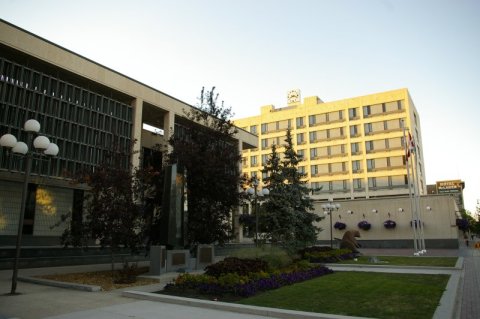
City Hall, Winnipeg
These buildings are designed to be immovable and permanent, to show us the permanence of the state, and the implied power behind it. These are overwhelming buildings. Standing in Government Center, Boston, or Nathan Philips Square, Toronto, is an exercise of feeling one’s insignificance in the face of the state. When I went for my interview to receive my Green Card at Government Center, I thought about this, how insignificant my individual power was in the face of the state. Whether we think about this implicitly or explicitly, it is there. And that is the point (just as Edwardian era bank buildings make their point)
So we are left to believe that the state is unmoving and immovable. And so it is. But, something else has happened in the wake of this massive growth of the state, as it has invaded our wallets, our dashboards, and more. The power of the state has continued to grow, its presence in our lives in inescapable.
And thus, now, when government changes hands through the democratic process and a new one takes control, whether it is in Olympia, the capital of Washington state, or Halifax, the capital of Nova Scotia, or Washington, DC, or Ottawa, there is a very real possibility that it will change the lives of the people of that state/province/nation. Major governmental policy shifts on everything from foreign affairs to net neutrality to consumer protection laws to immigration laws impacts nearly everyone.
And this is something to think about as we enter the era of the Trump Administration in the US.
Left Wing Nut Jobs
February 20, 2017 § 8 Comments
We tend to live in ideological echo chambers these days. This is as true of the left as it is of the right and of the centre. But something has shifted in recent months that I find rather interesting. Until 2015, liberals and lefties could, and did, say with smug superiority that they dealt in facts and reality and too many people on the other did not (the latter is proved by the ‘alternative facts,’ or lies, that come out of Whitehall in London and the White House in DC, for example).
But since the autumn of 2016, I have been harangued on Twitter by leftists who trade in alternative facts and lies themselves. In October, I found myself in the cross-hairs of the anti-Hillary Clinton left. I had been having a discussion with one of my tweeps about President Bill Clinton’s attempts to introduce universal health care coverage in the United States in 1992-94. This push was led, to a large degree, by Hillary Clinton. It failed for a multitude of reasons, but the simple fact of the matter is that Mrs. Clinton and her husband attempted to introduce universal health care to the US.
During this discussion, I got attacked, in increasingly vicious language, by two leftists who apparently believed that Mrs. Clinton is the face of evil incarnate. They accused me of lying, and, of course, being a Clinton apologist, amongst other things. Not all that interested in this argument, I posted a link to the Wikipedia page explaining this (note that ‘Hillarycare’ also redirects to this page). Sure, it’s Wikipedia, but it gives a general idea of what happened. Not good enough for one of my accusers. She pointed out Wikipedia is ‘not a primary source.’ No, it’s not. But there is a whole bibliography leading to such sources. So, instead, she sent me links to heavily redacted documents and heavily edited YouTube videos of Mrs. Clinton’s speeches on the matter, including one video that showed her in four different outfits. None of this changes historical fact.
In December, it was British leftists who insisted that white people had been slaves in the United States. This isn’t really anything new, the Irish have been claiming they were brought here as ‘slaves,’ but now this was expanded to include the Scots, English, and Welsh. And they did not mean what people usually get confused, which is indentured servitude. They meant that white people were chattel slaves like Africans. In this case, though, they provided no sources, just their beliefs. And, as one pointed out to me, she was entitled to her opinion. Sure. She is. But she’s still wrong. And I have the realities of history behind me on that one.
And then, a couple of weeks ago, the subject was the Civil War in the US. The Republican Party tweeted a Happy Birthday to the first Republican President, Abraham Lincoln, claiming that Lincoln united the country. Whatever one thinks of Lincoln as president, and I consider him one of the best presidents all-time (and it’s not just me, as my new favourite Wikipedia page shows), he did not unite the country. Lincoln’s election was the excuse used for Southern secession. So, in the midst of a conversation with a tweep, also an historian on this matter, I got harangued by a lefty.
He insisted that slave owners ‘were killing in the name of slavery from 1856 on.’ He wasn’t wrong. And I could point to events such as Bleeding Kansas in 1854. But, that doesn’t change the simple historical fact that Secession began with Lincoln’s election.
In all three cases, my credentials as an historian were challenged. I have been called a ‘Professor of Bullshit,’ a ‘Doctor of Horseshit.’ I have been called a fascist, and a genocidal apologist (of what genocide, I’m not sure, I’m presuming she meant the genocide of white people sold as slaves in the 18th and 19th century). In all three cases, lefties have based ‘arguments’ on ‘alternative facts,’ or, what I would call bullshit. But all the weight of historical reality meant nothing to them. They didn’t like the facts, so they decided they weren’t true.
This is deeply disturbing.
Literature as History
February 16, 2017 § Leave a comment
 I am reading Matthew Beaumont’s Nightwalking: A Nocturnal History of London. This nocturnal history of London was constructed through literature. He relies on everything from Geoffrey Chaucer to Charles Dickens to William Shakespeare, amongst others to reconstruct the nocturnal London, though he focuses particularly on the 16th and 17th centuries. The Amazon reviews are about what you would expect, especially the negative ones. They castigate Beaumont for writing ‘history’ using ‘literature.’ And you can see the logic here. Literature isn’t history, it’s make-believe. It’s fiction. And I can certainly hear some of my professors saying the exact same thing.
I use fiction a fair lot when teaching. I assign ‘history’ for my students to read besides the textbook, but I also make wide use of fiction. This is true both in the case of literature and film. So how is literature history, you ask?
Literature is a reflection of the time in which it is written. This is true of historical fiction and non-historical fiction. The historical fiction of our era is a reflection of our attempt to find a way through changing and complex times. It is a reaching back for something simpler (as we imagine the past to be), or for an explanation of the world through the past. Literature, like film, reflects the mood of the times, the neuroses we, as a society, carry. What fascinates, puzzles, and frustrates us. It is, in many ways it is the id to our rational ego.
So Beaumont reconstructs a history of London through fiction, and in so doing, he discovers what London’s nighttime meant to writers in their time and their place in London’s past. Chaucer’s 14th century London is a very different beast from Shakespeare’s 16th and 17th century version, just as his is different from Charles Dickens’ 19th century London, which is different from Zadie Smith’s 20th and 21st century London. But each of those authors reflect the city as it was in those times and those places.
And while their stories may be fictitious, the city they are set in is not. Each of these authors takes great effort to reflect London, the London they knew, to their reader. And this is the point of using literature as an historical text. Fictitious as the stories may be, their settings are not.
And so Beaumont’s nocturnal journey through London after dark is, in fact, a history.
Writing the History of the Trump Era
February 14, 2017 § 4 Comments
A couple of weeks ago, I was asked how future historians will be able to tell our history? We live in what is allegedly a post-fact era. First things first, whatever you want to call it, post-fact, post-truth, alternative facts, these are all just lies. I have already commented on this. Nonetheless, whether this is just a re-labelling of lying, we are still in this cultural moment. Every day the Trump administration deals in what White House Counsel KellyAnne Conway calls ‘alternative facts.’ What is the truth now, my interlocutor wanted to know?
I have been asked this question in a variety of ways in the past year and it is a real challenge we face. But we don’t face in terms of future historians, academics and journalists are already facing the problem. Michael A. Innes, a good friend of mine, has been thinking about this of late too. He notes that
Media outlets come in all shapes and sizes. Some are loud and boisterous, while others are more stoic. “Newspapers of record” are a recognized form of the latter. Some try to report what happened, while others try to convince readers why and how they happened. Media output, in other words, can serve more than one purpose, and only one of them is to provide researchers and analysts with a source of evidence needed to determine the factual basis of past events: what happened, when it happened, who was involved, what they said about what happened and so on. Reconstructing past events is a tricky business, and some media environments are so highly politicized – the rhetoric so overheated and contentious – that verifiable facts are almost impossible to discern from the collection of color and misdirection in which they’re embedded.
Indeed. The reconstruction of the past is indeed a tricky bit and I will go further than Innes and argue that it is an inherently political act. This is true whether it’s on the minor scale, such as I did in reconstructing a version of the history of Griffintown, Montreal (and yes, I am enjoying linking my own book). But it’s also what societies and cultures do anyway.
When we reconstruct the past, we do so from a variety of sources, including printed records, including government documents, diaries, published work, literature. We also use film, TV shows, documentaries, and music. We use oral sources, both those already collected and ones we collect. And we also make use of the digital: Twitter, Facebook, Reddit, blogs, etc. We have to make decisions in what gets included in our reconstructed histories.
Historians, we tend to go further than journalists. Innes notes that some media outlets report on what happened, whilst others focus on why and how they happened. And quite often the latter try to convince you of the version of events they are pushing. This is the difference between, say, The New York Times and Breitbart, or the CBC and FoxNews. The Times and the CBC deal in facts in reporting the news, and editorials are clearly labelled. In the case of Breitbart and FoxNews, there is a blurring of ‘news’ and editorials.
When I teach, I always remind my students that we are more interested in the how and the why of history, we need to move beyond facts and into interpretation. How do we do that? Logic and reasoning. We use other scholars as guides. We read what other historians have written on the subject, or an analogous subject. We consider their interpretations based on the evidence. We agree or disagree. Or we agree and see another possibility. And so on.
Back in Grade 2 or thereabouts, my teacher introduced us to the who, what, when, where, why and how? The key questions for all situations. So in writing history, we begin with the who, what, when, and where. We establish the facts. And we establish these from our sources. Even in this post-fact era, there are still facts. They still get reported, they’re still plain to find in doing research. And from there, we ascertain the why and the how.
So how do we source that in the post-truth world? Innes notes the guerrilla archiving of data, creating an archive of truth and records of the real world to counter the post-factual. But there are other, more simpler ways we do this through the ‘reading’ of our sources, whether they are government documents, newspapers, novels, films, music, Twitter, and so on. When we read these sources, we do so within a cultural context, of course. And we do tend to have strong bullshit detectors.
My MA thesis tells the story of the Corrigan Affair, which erupted in Sainte-Sylvestre, Quebec, in late 1855 when neighbourhood bully, an apostate, Robert Corrigan, was beaten to death by a gang of his Irish-Catholic neighbours at the county fair. When his murderers evaded capture for the next six months, all hell broke loose in a highly sectarian Canada. Anglo-Protestant politicians and newspapers were beside themselves over the fact that these Irish-Catholic ‘hooligans’ managed to evade the state’s attempts to bring them to justice. They did so through the help of their neighbours and an intimate knowledge of geography of the Appalachian foothills of southern Quebec.
The local Anglican priest in Saint-Sylvestre, Rev. William King, was ground zero for the ‘alternative facts’ of the Corrigan Affair. In daily dispatches to government ministers and the Quebec City press, Rev. King constructed an alternate reality where the Irish-Catholics of Sainte-Sylvestre were parading around openly armed and threatening Anglo-Protestant, beating them nearly to death for fun. He told of marauding gangs of Irish-Catholics breaking into homes in the middle of the night and tearing homes to pieces and beating the men and boys of the house. Rev. King’s invented reality was accepted verbatim by government ministers and the Quebec City press.
So how did I find out what happened in Saint-Sylvestre in the fall and winter of 1855-56? I reconstructed events through a mixture of sources, both government and official and vernacular. I relied on petitions from the Irish-Catholics of Saint-Sylvestre, who claimed to be brutalized by the Orange Order. I relied on the French Canadian press of Quebec, which watched both sides with bemusement. I read the depositions of the French Canadians of Saint-Sylvestre, who were similarly bemused by their neighbours’ actions. and from these varying sources, I reconstructed the events of the Corrigan Affair. I learned to tell fact from fiction, or at least something that looked more likely to have occurred than not.
And this is what historians will do when they tell the story of our time. They will look at the lies that are produced at the White House and then compare that to what other sources say about what is going on, including the media, but also our Twitter feeds, our Facebook posts, our Reddit commentary. Maybe even blogs like mine.
We will continue to examine history as we always have, sifting through varying and contradictory versions of events to reconstruct what actually did happen. And, of course, being a public historian first and foremost, I will be fascinated by the myth-making at the White House, and the puncturing of that myth by the rest of society, about the hows and whys we choose to remember this time.
Punk as the Establishment
February 10, 2017 § Leave a comment
When Joe Corré, son of Malcolm McLaren and Vivienne Westwood, torched his Sex Pistols memorabilia in November, I was left very conflicted as an ageing punk and a public historian. I felt equally conflicted when I learned that British Conservative Prime Minister Theresa May wears Vivienne Westwood designs. Or, rather, I was horrified at that, so I pondered Corré’s argument the more. And I wrote a post for the National Council on Public History‘s blog, History@Work. It got published today.
 Matthew Barlow