Radicalism and Diaspora in Canada
January 15, 2010 § 2 Comments
Yesterday, the ring-leader of the Toronto 18, Zakaria Amara, apologised to Canadians for his role in plotting to blow up U-Haul trucks outside of the Toronto Stock Exchange, the Toronto CSIS HQ, and a military base just outside the city. It is worth noting that the Toronto 18’s goal was specific, to convince the Canadian government to pull out of Afghanistan. Amara said that he “deserves nothing less than [Canadians’] complete contempt.” At least according to The Globe & Mail, he went onto to explain how it was he was radicalised in suburban Mississauga.
Starting off by quoting the Quran, in hindsight, [Amara] said his interpretation of Islam was “naïve and gullible,” and that his belief system made worse by the fact he had “isolated himself from the real world.”
Today he told the court he has been rehabilitated by his time awaiting trial in jail – mostly through his interactions with fellow prisoners who challenged his hate-filled ideology. He promised he would change from a “man of destruction” to a “man of construction.
He also apologised to Canada’s Muslim community, noting that he had brought unwelcome attention and scrutiny.
The Globe also reports on Amara’s accounting of his radicalisation in suburban Mississauga, a multicultural locale with a population larger than all but a handful of Canadian cities (Toronto, Montréal, Vancouver, and Ottawa-Gatineau), one that sounds not all that dissimilar than what Marisa Urgo describes in Northern Virginia, a suburb of Washington, DC. As she notes, Northern Virginia has produced a fair number of radicalised young men. Mississauga, on the other hand, has not, other than the Toronto 18. In Mississauga, Amara isolated himself from all but a small handful of radicals, and they fed off each other.
In prison, Amara claims to have seen the light, befriending a former stock broker who worked at the very exchange Amara had planned to blow up. He, a Sunni Muslim, also befriended both a Jew and a Shi’a Muslim. In his radical era, Amara had nothing but contempt for Jews and Shi’a. But now, he says, he’s seen how wrong he was.
Amara’s psychiatric examination in prison suggests that he became radicalised as a means of escapism, the drudgery of life, of having had to drop out of university to help support and raise a daughter, as well as the pain from his parents’ divorce.
One thing that strikes me the most, though, about the discourse surrounding the Toronto 18, is this horror that Canada might have produced radicalised terrorists from a diasporic community. Canadians seem genuinely befuddled that this could happen in his multicultural nation where immigrants and their progeny are generally welcomed (not that there isn’t racism in Canada, there is. A lot).
But, this is where being an historian is kind of fascinating. As I have argued over at the CTlab, historians get to take the long-view, we see context, and depth. We don’t, or at least we shouldn’t, engage in knee-jerk reactions. And so, I would like to point out that this isn’t the first and only time that diasporic radicals have trod on Canadian soil.
Indeed, the neighbourhood I study, Griffintown, here in Montréal was once one of the hottest of hotbeds of radicalism, in the 1860s, 150 years ago. Then, it was the Fenians, a group of Irish nationalists who were always more successful in the diaspora than in Ireland itself. Indeed, their plan wasn’t all that different than that of the Toronto 18. The Fenians in the United States and Canada dreamed of seizing and conquering Canada and holding it as ransom against the British in return for Irish independence. And Griffintown was the centre of Fenianism in Canada.
The Fenians met secretly around Griffintown and Pointe-Saint-Charles, plotting how to act as a 5th column when their American brethren invaded, and how they would then take over the country. The Griffintown Fenians were also the ones responsible for the first political assassination in Canadian history (there have been only 2 in total), that of Father of Confederation and Member of Parliament for Montréal West, Thomas D’Arcy McGee on 7 April 1868 on Sparks St. in Ottawa. McGee had been a radical in his youth in Ireland, a member of the Young Ireland movement there in the 1840s, but, after relocating to Montréal, he had become convinced of the Canadian cause, and during the particular contentious 1867 federal elections (the first Canadian election), McGee had outed the Fenians in the pages of The Gazette. Not surprisingly, this didn’t go over well, and the Fenians, acting, it seems, independently of their American counterparts, and Patrick Whelan shot him.
Then, as now, there was all sorts of anguish over the thought of terrorists (though this word wasn’t used for the Fenians) on Canadian soil. Anglo-Canadians couldn’t understand why the Irish would wish to carry their old world battles into the new Dominion, and they tended to see Irish-Catholics as a singular whole. Not unlike how Canadians in the early 21st century have responded to the Toronto 18, in fact. Not that this exonerates either the Fenians or the Toronto 18 as radicalised diasporic terrorists, but the long view is always interesting in and of itself.
Crime in the Big City
January 15, 2010 § Leave a comment
This is kind of bizarre and gruesome, but yesterday a body was found in a suitcase at the corner of rues de Bullion and Charlotte in that funky part of downtown, just off the Main, the legendary Lower Saint-Laurent. There are a bunch of rooming houses there. Anyway, the Montréal police, in all their brilliance, then announced that the body showed signs of violence. Really???? A body is stuffed into a suitcase and you might think that it got there by means of violence? Wow.
Certainly this was only part of the story, of course the cops knew more than they were saying, and no doubt this bit of intelligence came as an answer to a simplistic question from a reporter, and The Gazette ran with it. But, still.
Anyway, the Montréal police got their man, arresting a man in Ottawa today.
Transit-City
January 4, 2010 § Leave a comment
I just came across this blog, an appendage of the Transit City site. It’s a kind of French-language version of Geoff Manaugh’s BLDGBLOG, run by a chap named François Bellanger, a Parisian sociologist. OK, I must admit, M. Bellanger has entered my consciousness because he has made use of my review of Chip Jacob & William Kelly’s Smogtown: The Lung-Burning History of Pollution in Los Angeles in a post of his own. Tune in later, once I get a chance to read and digest more of Transit City, I’m sure it will become a mainstay.
U2
December 12, 2009 § Leave a comment
I just want to say apropos of nothing, that I am completely blown away that U2 would spend $3 million to build themselves a temporary outdoor stadium at the recently disused Hippodrome-de-Montréal. More than that, that they would offer tickets for as low as 30$. And even more than that, that this temporary stadium will seat up to 80,000 people and that U2 sold out two shows on 16-17 July 2010 in next to no time (and no, I don’t have tickets). As the Irish say in such moments, Jay-sus! Up to 160,000 people for two nights to see U2.
One of my students last week tried to argue that U2 were a spent force as a rock band. Apparently, dude was wrong.
I wish I could tie this to some commentary on the strength of the Irish diaspora in Montréal, or something like that. But sometimes, well, a cigar is just a cigar. So, instead, I present you with this video, tying U2’s classic “Sunday Bloody Sunday” back to its original meaning, Bloody Sunday on the Bogside in Derry, Northern Ireland, on 30 January 1972.
On the Mark
November 17, 2009 § Leave a comment
I’m not entirely sure where this site comes from, but The Mark is a new current events/news site heavy on the analysis, and staffed, it seems, by a group of scruffy urban hipsters. All power to them. This site is worth a read and following in the future.
At any rate, there is a section on The Mark that looks at the future of the city in the 21st century. It has become pretty much commonplace to refer to the 21st century as the urban century; the world’s population recently passed the tipping point and we are a predominately urban species now. Of course, in the industrialised west, this mark was reached in the 20th century. Canada, incidentally, was one of the first predominately urban nations in the world. The Mark’s section on the future of the city is hosted by former Vancouver Mayor, and Premier of British Columbia, Mike Harcourt, and has brought together a pretty impressive array of news and analysis on Canada’s cities, as well as analysis on our collective future. Worth checking out.
Bring on the Brand New Renaissance
November 17, 2009 § Leave a comment
For Canadian males of a certain vintage, being a fan of the Tragically Hip is compulsory for maintaining citizenship. It’s true, we can get deported for denouncing the Hip. At the very least, you can get mocked, made fun of, and ostracised for suggesting they’re not all they’re cracked up to be. Even a relatively innocuous statement like noting they’ve kinda fallen off in recent years can get you in trouble, as I learned a decade ago in Ottawa. But once, back in the 1990s, the Hip were it. They defined Canada, beyond hockey, beer, and healthcare. And they had a song called “Three Pistols,” ostensibly about the disappearance of iconic Canadian painter Tom Thomson in Algonquin Park in Ontario in 1917.
There is a line in that song about bringing on the brand new Renaissance, and this is what I thought about when I read an article in the The Times yesterday about all the money flowing out of Middle Eastern nations into sport, in particular, European sport. Brazil and England played a football friendly in Qatar this week (won, not surprisingly, by Brazil, 1-0). Manchester City FC is owned by Sheikh Mansour bin Zayed Al Nahyan of Abu Dhabi. A Middle Eastern consortium is also sniffing around Liverpool FC, which is buried under massive debt brought on by the club’s current American owners. And, as The Times points out, the Middle East is host to not one, but two Grand Prix races. Britain is in danger of losing its F1 race, and Canada actually did lose its last year, though it’s apparently returning to Montréal this coming year.
Bahrain, Abu Dhabi, Qatar, United Arab Emirates, and other small, wealthy Middle Eastern nations, no larger than an Italian city-state during the Renaissance, really, have sought to diversify their economies away from an over-reliance on oil money, and sport has become their ticket to diversification. All fine and good, no doubt (though there are all kinds of environmental issues involved in the over-development of these city-nations).
But what I find interesting about these Middle Eastern cities appealing to the Wayne Rooneys, Kakas, Tiger Woods, Robinhos, Lewis Hamiltons of the world is that it is entirely reminiscent, culturally-speaking, to the Italian Renaissance. In 15th and 16th century, cities like Florence (under the rule of the Medici), Genoa, Venice, and Milano, competed with each other, inviting famous artists and writers to take up residence. The artists would then be subsidised by the rulers, and charged with producing great art, including and especially public art, to be displayed on the public square, or in the church. Other installations and works of art were for the private collections of the likes of the Medici. But then these cities could use their great art, and the reputations of their artists-in-residence as a means of claiming greater prestige than their neighbours and rivals. This competition between Italian city-states drove the Italian Renaissance, which itself drove the Renaissance northwards and across Europe in the 15th and 16th centuries.
In the Middle East, rather than Leonardo, it’s Robinho called in. Sporting evens in the Middle East not only bring in scads of cash for the local economy, they bring in prestige. The F1 series is the most prestigious racing circuit in the world. And it stops in the Middle East twice, in Abu Dhabi and Bahrain. Drawing the greatest football team in the world (Brazil) to play a friendly against the resurgent English side also brings prestige, as does having Tiger Woods design a golf course, as he has done in Dubai.
Qatar is pondering a run at hosting the World Cup in 2022, whilst Dubai is measuring a bid for the 2020 Summer Olympics. Not surprisingly, these are the world’s two largest sporting events, and come not only with economic stimulus for the local economy, but prestige and honour as well.
The Times article rather overlooks the prestige factor here, focussed as it is only on the financial aspects of these sporting events. That is only part of it. The buying power of these Middle Eastern city/nations is only worth so much, the prestige and honour of hosting F1 races, international football friendlies, the World Cup, the Olympics is not to be overlooked, nor is the tourism money. People want to go to Dubai to play on Tiger Woods’ golf course.
[Cross-posted, in slightly different format, at Current Intelligence].
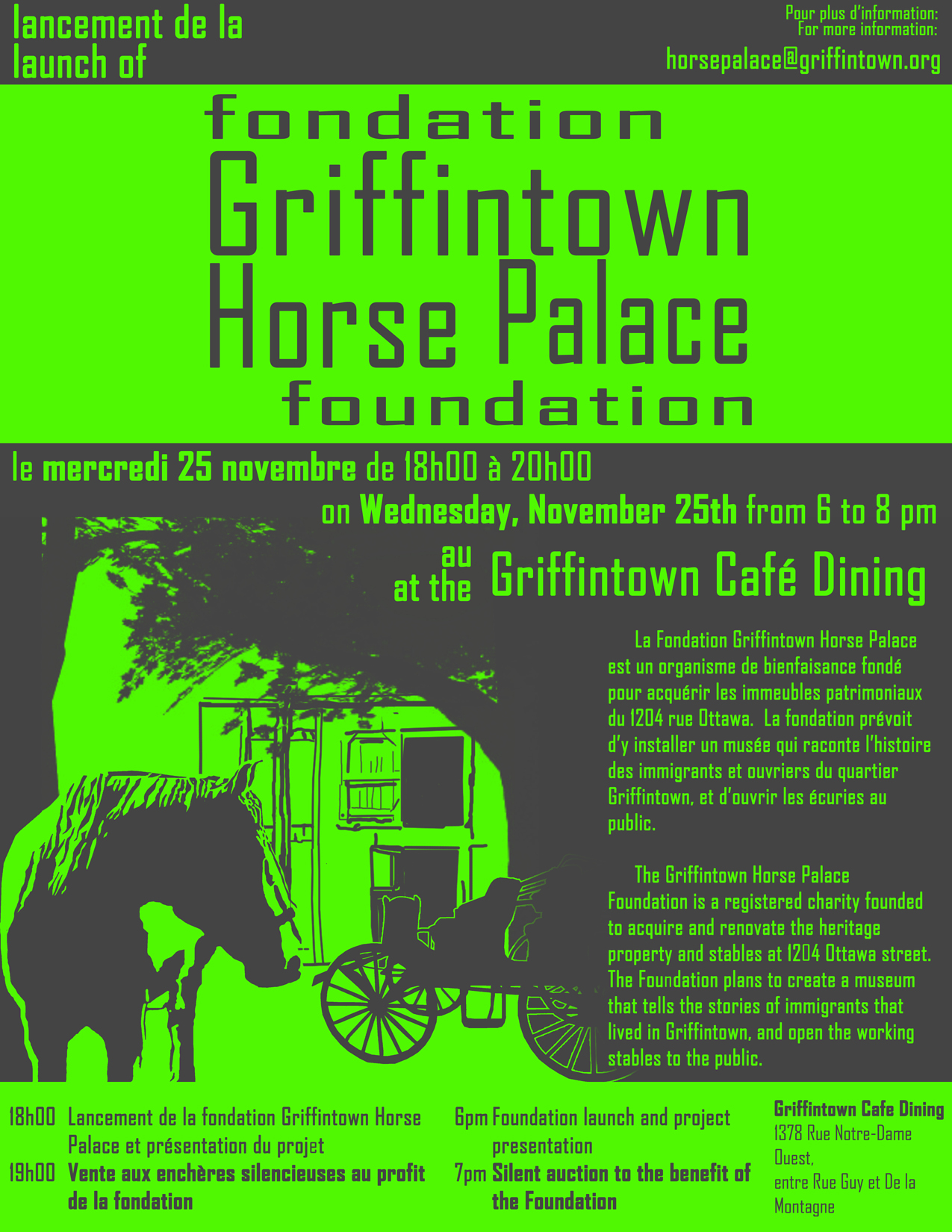
Griffintown Horse Palace Foundation Launch
November 15, 2009 § Leave a comment
The Griffintown Horse Palace Foundation is dedicated to purchasing and renovating Leo Leonard’s Horse Palace in Griffintown, to turn it into a museum along the lines of the legendary Tenement Museum on the Lower East Side of Manhattan (frankly, one of two museums I find interesting). The Foundation is holding its launch at Café Griffintown at 1378 rue Notre-Dame in the Griff on Wednesday, 25 November, from 6-8pm. Unfortunately, I cannot be there, as I teach a night class on Wednesday nights out at Abbott, but I hope this is a resounding success. For more information, contact the Foundation at horsepalace@griffintown.org.
Layers of Diaspora
November 15, 2009 § Leave a comment
Perhaps as a means of avoiding my current research project, which is to turn my dissertation into a monograph, I have been thinking about my next project, the one that will examine diaspora and its multiple layers on the urban landscape. Really, this is a mobile project, can be fit onto any large city with multiple diasporas, but Montréal is where the idea came from, and Montréal appeals to me because of the bifurcated nature of the host cultures here.
Back in the winter of 2006, I taught the History of Montréal, an upper-level course at Concordia. I think this is where this idea comes from for me, I taught that course as an ethnic history of the city. I traced the history of the landscape that is Montréal through the various ethno-religious groups that have called the area home, dating back to the pre-Contact Mohawk populations in the St. Lawrence River Valley, right through to the Vietnamese and various African and Arab diasporas today. As we moved through history, we dealt with the aboriginals, the Contact era, the French colonial culture here, then the onslaught of the British. This set the city up as a multi-layered, bifurcated location, French and English, the aboriginals more or less marginalised on reserves that ring the Île-de-Montréal. French and English were equal but different, though the British were dominant, they being the conquering colonial power.
It was into this milieu that the Irish arrived, becoming the first immigrant group in Montréal. Whilst the other groups, including the aboriginals, arrived at the location, they had done so as colonisers and conquerers, not as immigrants. The Irish set themselves up, established a model of negotiating space for themselves on the emergent urban landscape of Montréal. They found a niche for themselves in the Catholic Church (indeed, it is due to the Irish that there is an Anglo Catholic Church in Montréal today), established various community organisations, etc. Other immigrant groups that followed the Irish to Montréal all copied this model: Jews, Italians, Spanish, Portuguese, African Americans (and Canadians), Arabs, Africans, South Asians, Southeast Asians, etc.
So I visualise these waves of immigration on the urban landscape of Montréal as successive layers building the landscape. I think of this as an archaeology of diasporic Montréal, not unlike Pointe-à-Callière, the archaeological museum down in the Vieux-Port (and, I might add, one of only a very few museums that can hold my attention). But it is not as simple as this, as each successive wave of immigration didn’t further bury the French and British (though aboriginal culture in Montréal seems to have gone further subterranean over the past century, though that is due more to Canadian government policy than immigration), as both have managed to establish and maintain their hold on the city’s culture and landscape.
But, as these immigrant groups are Montréalised, Québcised, or Canadianised (depending on your politics), there is a sanding down of their edges, of their distinct voices, as they are made more and more part of the urban landscape of the city. For some groups, this is a simpler process, like the Irish in the 20th century (before they re-discovered their separate ethnic identity in the mid-to-late 1990s), due to skin colour, language, and/or religion. For other groups, it isn’t so simple, for religious reasons (Jews) or skin colour (Jamaicans, Haitians), or language, or a combination of all three (Arabs). Indeed, of all the constituent elements of “Angl0-Montréal” throughout the last half of the 20th century, only the old-stock Anglo-Irish fully subsumed themselves into this identity/community. Other groups, most notably Jews, maintained their separate identity, in many ways due to the fact that they were never fully welcomed into the Anglo-Irish core of Anglo-Montréal. Nevertheless, there is a process of acculturation and Canadianisation going on here.
But, however one thinks of this process of immigration, retrenchment, and acculturation, I do think that the layer metaphor helps to make sense of the city and its myriad diasporic populations, and the ways in which they interact and influence each other on the urban landscape of the city.
Canada and Its Inferiority Complex
October 6, 2009 § 8 Comments
Last week, I published a review of Canadian journalist John Lorinc’s new book, Cities: A Groundwork Guide, over at the Complex Terrain Laboratory. As much as I liked and enjoyed this book, I found myself wondering, though, as I read this book, was what is with Canadians’, or maybe just Torontonians’, obsession with Toronto?
Toronto is mentioned more than any other city in the world in Lorinc’s book. More than London, Hong Kong, Sao Paolo; more than Nairobi, and New York. Toronto is mentioned more than twice as often as Canada’s other 2 major cities: Montréal and Vancouver. Moreover, Montréal is usually, though not exclusively, mentioned in a negative light. Not Toronto.
We are a nation with an inferiority complex, that I can accept. Toronto’s wiki page, though, is kind of sad, as it has to point out that: “As Canada’s economic capital, Toronto is considered a global city and is one of the top financial centres in the world.” It is indeed a top financial centre in the world, somewhere around 20th. Great. Who cares, really.
Why can’t we just stand on our own merits and not have to defensively point out that we can play with the big boys? I liked Canada more when we were an unassuming nation, proud to be what we are, but not a neighbourhood bully or the whiny little brother of the USA. This inferiority complex is getting out of hand.
And whilst Lorinc, on the one hand, is showcasing Toronto for the domestic audience, it is kind of sad that it has to come at the expense of Montréal and Vancouver, and that Toronto is mentioned more often than any other city in the entire world. Years ago, the Vancouver band, Spirit of the West, wrote a song about this, called “Far Too Canadian;” times have changed, though, we are no longer content to be the unassuming, quiet Canadians. Now we’re becoming a bunch of loudmouths. I like the old way better.
 Matthew Barlow