The Young & The Expendable
March 13, 2010 § Leave a comment
Over at the Kings of War, Dave Betz has an interesting piece on the gender imbalance of children in many parts of Asia, based on an article from The Economist. Both Betz and The Economist bring up many issues and questions to ponder, but here I’d like to look at one, from an historical perspective. Betz ruminates on whether or not a surfeit of young men in a society (most particularly China) will lead to a rise of militarism in that culture and, ultimately, belligerance.
The Economist points out that “in any country rootless young males spell trouble.” Indeed. Society tends to be suspicious of young men in general. However, historically, there have been simple uses for such young men: the military or colonisation. Essentially, they were the cannon fodder, whether literally or figuratively. Societies never got too excited about their demise, either, at least not on the macro-level, there were always more where they came from.
The Ancient Greeks also found another use for rootless young men: they made excellent colonisers. So the Greek city-states would send out boatloads of young men, sending them across the Aegean Sea to Anatolia. Or up towards the Black Sea. If they were successful, and they established a colony, hey, great. Now there was a captive market for goods produced in the home city. If not, meh, so be it, there would be another boatload next year. This model was picked up again by Europeans in the Age of Expansion in the 15th and 16th centuries.
Across North America, bachelor cultures emerged. For example, in the inland woods of New France, the coureurs de bois spent their time carting furs from the hinterland, where they traded with the aboriginals, back to the colonial centre, such as Montréal or Detroit. But out in the woods, these guys lived life hard. Their work was insanely physical, carting the furs and other goods in their canoes, over portages, in and out of the water, most of which was insanely cold, and rafting down rapids. Priests in the back country were both in awe of these men’s physical strength and stamina, and terrified of them. Probably for good reason.
Along with their intensely physical work, the coureurs had a bachelor culture that reflected their hard lives. They drank heavily, sang songs, engaged in all kinds of physical tests of strength and stamina, including wrestling, fighting (boxing hadn’t been invented yet), and various other events that would put MMA to shame. Colonial officials echoed the priests’ fear of them.
The West, in both Canada and the United States, was also another bachelor culture. And whilst Hollywood has over-dramatised the violence in the American West, Canadian historians have under-represented the violence of the Canadian West.
The bachelor culture of the Western frontier was not all that different than the coureurs 3 centuries earlier: heavy drinking, braggadacio, and contests to see how was the “best” man. The best man was usually the one who could drink the most, make the most money, was physically the strongest, or who had the best luck with the ladies.
Long and short, young men have historically been the most rambunctious segment of society. But historically, societies have found an outlet for their bored, rootless young men, whether as cannon fodder or as explorers/colonists. What happens to these young men in Asia is something, as Betz notes, for us all to ponder. It is clear the issues run deeper than just simply a gender imbalance and too many young men for the young women.
New Project: Current Intelligence
March 11, 2010 § Leave a comment
The Complex Terrain Laboratory is being retired. Mike, Eric, et tout le gang from the Lab, have begun a new project, called Current Intelligence:
is a journal of opinion and analysis. Its editors and writers are preoccupied broadly with culture, politics and current affairs; narrowly with conflict,crisis, and the state of the world “out there”; and laterally with the intellectual concerns of those who research, teach, and write about the issues.
We went live on Monday, 8 March, and we will publish daily, Monday-Friday, with a quarterly print journal as well. Current Intelligence comes with its own set of sections:
- The Editor’s Desk: daily must-reads
- The Agenda: informed comment on headline issues
- The Big Smoke: reporting on London’s wealth of current affairs talk (starting in May, 2010)
- The Quiet American: analysis of foreign policy, military intervention, human rights & humanitarian affairs
- Letters From Abroad: dispatches from field researchers, expats and other travelers
We can even be found on Twitter.
So, come on over, grab a coffee and read what we’ve got to say. As for me, I’ll continue to offer my own particular position on issues that require a deeper, historical, long-view of understanding.
Modernist Architectural Behemothology
March 11, 2010 § 6 Comments
Years ago, I lived in Vancouver, perhaps once the greatest example of Modernist architecture in Canada, if not North America. Vancouver is the city that unleashed architect Arthur Erickson on the world. Sadly, Erickson died last spring. Yet, Erickson’s buildings live on in Vancouver, especially his modernist designs, most notably Simon Fraser University in suburban Vancouver (where I completed my MA), and the Canadian Embassy in DC.
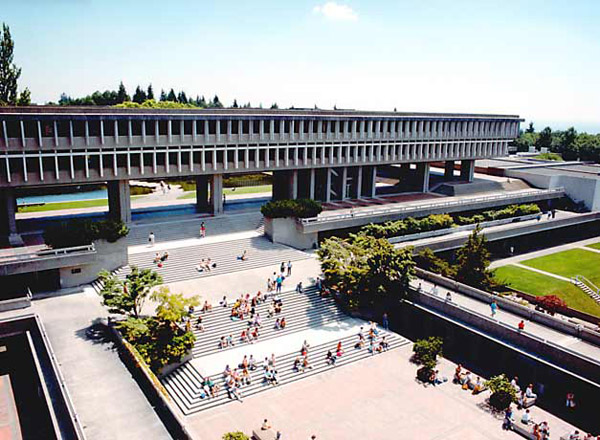

Indeed, one of my favourite architecture books is Rhodri Windsor Liscombe’s The New Spirit: Modern Architecture in Vancouver, 1939-1963. Modernist buildings haven’t really stood the test of time, I have to say, especially those designed to look like concrete bunkers, such as the Canadian Embassy. SFU is one of the most depressing places in the world on a cloudy, rainy day atop Burnaby Mountain. Unfortunately, it is often rainy and cloudy atop Burnaby Mountain. University campuses across North America are dotted with modernist buildings, as the great boom of construction on these campuses came at the height of modernism in the post-War era. In many instances, modernist behemoths look as if they were dropped into more classical settings, such is the case of Student Center Building at the University of Masscachusetts, Amherst. In the picture below, you can see those older, classic buildings scattered around the Student Center and the residence towers behind it.

So pervasive is modernist architecture on campuses that it is oftentimes pejoratively referred to as “Neo-Brutalist” architecture. Indeed, buildings such as the Student Center, or the entire Burnaby Mountain campus of SFU, re-enforce this. The buildings are concrete, massive, and imposing. Inside, there is a lot of dark browns, dark woods, and black. Gloomy is about the only way to describe these interiors.
Long and short, the term “Neo-Brutalist” quite often fits, not that there aren’t some beautiful modernist buildings to be found, such as Vancouver’s old BC Hydro Building, which has since been condofied, or MOntréal’s Palais de Congrès.


But, despite this, I can’t help but chuckle when I read stories like this one in the Globe & Mail yesterday, about the Public Safety Building in Winnipeg.

This particular behemoth, built in 1966, is a textbook case of Neo-Brutalist Behemothology. Frequently the several hundred employees of the Winnipeg Police Force are required to vacate the building because of noxious fumes that waft up into the building. This happens frequently, apparently. This time it required the Hazmat to come. The PSB is built out of
brittle Tyndall limestone, hasn’t held up against Winnipeg’s climate. Dozens of steel brackets cling to the building’s exterior like Band-Aids, preventing the facade from avalanching into the street. A $98,000 awning encircles the building, stopping pieces of the gaudy structure from braining pedestrians.
And this is the crux of the problem with many Neo-Brutalist behemoths, from SFU to Montréal’s legendary Stade Olympique, known in English as the “Big O”, or more fittingly, the “Big Owe,” as it took 30 years for the city to pay off its legacy from the 1976 Summer Olympics, by which time the Expos had decamped for Washington and the Alouettes had been re-born in McGill University’s quaint Molson Stadium at the foot of Mont-Royal. But the Big Owe and the PSB, and SFU, for that matter, all have something in common. The materials used to build them aren’t all that well-suited to the climate they are in. Hence, the PSB is falling apart, the Big O has had large slabs of concrete fall off it, and SFU, well, that much concrete in a rain forest isn’t the best idea, either.

But the bigger question is what to do with these buildings, especially those that are falling apart or being abandoned, as is the case with the PSB. Urban preservationists in Winnipeg argue that the PSB is worth saving,
According to University of Winnipeg Art Historian, Serena Keshavjee,
It’s not a love-hate relationship people have with these buildings; it’s just hate. People grew up with these buildings and don’t see them as heritage buildings, but the same thing happened 40 years ago with Victoria structures.
Had we ripped out every Victorian building in the country we would be very sorry these days,” she said. “And these are the times when they become vulnerable. The country is coming out of recession and people are gearing up to tear things down.
UW historian David Burley echoes, arguing that modernism
reflects a time when the federal government lavished money on public projects and Canadian pride soared ahead of Expo 67 and the centennial. “It was a nationwide movement,” he said. “There was this great optimism. The central parts of cities had deteriorated and there was a sense it was time to redevelop things.”
Personally, I’m not so sure that a modernist building is worth saving just because of its own merits. A building like the PSB is an ugly imposition on the urban landscape. Buildings like it seem to mock their landscapes, they don’t fit in, they crush them, they impose upon them. They belittle us. Of course, granted, that’s the point with a police station, or at least it was in the 1960s. But that doesn’t mean a building should be saved just because it’s old. Sometimes, old things are just junk. And the PSB is an example of that.
Mr. Islamophobe
March 6, 2010 § 2 Comments
I’m on this listserv, I’ve been on it for over a decade, and I’m really just too lazy to unsubscribe. Occasionally, my laziness is rewarded with insightful commentary on Canada and the world. More often than not, I’m exposed to anti-Semitism from one member and anti-Islamic propaganda from another. Most recently, Mr. Islamaphobe (who is also of the opinion that feminism has destroyed our culture, and if it wasn’t feminism or Islam, it was the left, and if not them, then it was the environmentalists) has declared that Islam is a religion bent on world domination, supporting Geert Weders’ idea that, although there are moderate Muslims, there is no moderate Islam. I find this kind of commentary not just offensive, but stupid.
Both Christianity and Judaism are evangelical religions, they both seek new adherents wherever they are taken. If Islam is, as Mr. Islamophobe argues, hell bent on world domination, Christianity is even more so. The various Christian churches have spent much of the past two millenia seeking new converts, first as it expanded out of the Holy Lands into the European portion of the Roman Empire, then throughout Europe and North Africa, into Asia, across the Atlantic to the Americas, into sub-Saharan Africa, and Oceania. Islam has also similarly expanded out of the Holy Lands to become a global force.
Of course, the difference for Mr. Islamophobe is that Christianity is his culture/religion. Thus, for him, Christianity and the culture it has created stand for all that is good and great and beautiful in the world, whereas Islam stands for all that is evil and rotten in the world.
The Problem With Writing History
March 5, 2010 § Leave a comment
I just finished Orhan Pamuk’s brilliant novel, Snow. It tells the story of a hapless Turkish exile poet, Ka, who returns to Turkey from Frankfurt. Ka is a poet without poems. He’s not written one for years when he accepts an offer from a friend who edits a Republican newspaper in Istanbul to travel to the distant eastern city of Kars. In Kars, there has been a wave of suicides by young women wearing the hijab, which is seen as a challenge to the Turkish republic of Ataturk. They were expelled from their university studies for refusing to remove them. And so a group of them killed themselves. But nothing is at seems in Kars, and Ka is drawn into the city’s murky underside, in part due to a bizarre coup led by an actor, in part because he falls in love for the beautiful Ipek, in part because of the radical Islamist terrorist, Blue. Kars is a poor city, isolated, and caught in its place in history on the borderlands, caught between its Russian, Turkish, and Armenian pasts. And Kars is isolated during Ka’s visit, it’s snowed in. It’s a mountain city and all roads in and out, as well as the railroad, are blocked by heavy, heavy snow. This isolation has its own in-built tension between this forgotten borderlands city and the cosmopolitan capital of Turkey, Ankara, and its interntionalised largest city, Istanbul. This tension within Kars echoes that of the Turkey that Pamuk presents, between this Europeanised cosmopolitanism and traditional Turkish culture, to say nothing of Islamism. And Ka, as a westernised Turk living in exile in Germany, is a focal point for this tension.
Anyway, I don’t want to give away the plot, because if you’ve not read Snow, you should. It’s not for nothing that Pamuk won the Nobel Prize for Literature in 2006.
What I want to point to is a discussion the narrator of the novel has with an associate of Ka’s, Fazil, at the end of the book. The narrator, Pamuk himself, responds to Fazil’s early declaration that he can only write about him in the book Pamuk is writing on Ka’s visit to Kars if he agrees to include what Fazil wishes to say to Pamuk’s readers. He says this:
‘If you write a book set in Kars and put me in it, I’d like to tell your readers not to believe anything you say about me, anything you say about any of us. No one could understand us from so far away.’
‘But no one believes in that way what he reads in a novel,’ I said.
‘Oh, yes, they do,’ he cried. ‘If only to see themselves as wise and superior and humanistic, they need to think of us as sweet and funny, and convince themselves that they sympathize with the way we are and even love us.’
Fazil’s words have resonance for me as an historian. I study the working-classes, I study people by-and-large excluded from, or oppressed by, systems of power. The community I study is one that was an inner-city, working-class slum. The people who lived there, grew up there, they’ve escaped, moved up the social ladder. But that history is still there.
A few years ago, I was hired as a consultant by an advertising agency working on behalf of Devimco, the development company that was planning to radically re-build Griffintown. Devimco was trying to make its plans more palatable, so they hired this advertising agency, as well as a consultant, an American living in London. This consultant has done some impressive things with shopping malls across the UK and in places like Dubai. Anyway. He prepared a text for all of us to ponder for our 2-day summit on the future of the Griff. Basically, he wanted us to come up with a marketable narrative for Griffintown, which was why I was there; the historian. In this text, he wrote:
Griffintown represents the next generation in Montreal’s long history of bold waterfront stewardship. What makes it unique is that it restores the public’s access to the waterfront, making it home for a real community, instead of simply an industrial workforce.
Leaving aside the fact that Montréal actually has a long history of the opposite of “bold waterfront stewardship” (Autoroute Bonaventure, anyone? How about all those port facilities?), the part I’ve italicised, dismissing the former residents of the Griff as simply an industrial workforce really just echoes what Fazil says in Snow. This consultant is dismissing these real people, arguing that because they were the working-classes, they couldn’t have culture or community. We’re supposed to feel superior to them, we’re supposed to see ourselves as better than them.
This is something that plagues historical scholarship, going back to the days of Herodotus. Even despite E.P. Thompson’s entreaties to be fair to the working-class (or any other subaltern group, really), to “rescue them from the enormous condescension of posterity” (to quote from his masterful The Making of the English Working Class), it’s a hard road to hoe. Indeed, Thompson himself is partly to blame for this, by taking on this providential charge to “rescue” the working-classes. We shouldn’t do that, either.
Instead, what we strive to do is to take our subaltern, down-trodden, excluded, or what-have-you, people is to take them for what they are/were: people like us. This is hard to do, it is hard to be sensitive to our historical actors, to recognise them as multi-dimensional actors, with agency, just like us. Joy Parr helps us see that in her The Gender of Breadwinners, wherein she reminds us that the roles our historical actors play were not sequential, but simultaneous. We are many things at the same time, and so, too, were our historical actors.
This is something I think historians of the subaltern need to be reminded of regularly, it’s not something we can read in a book once and keep in mind when we’re actually doing our work. This point needs constant reinforcement. It’s easy to forget, really. For me, that Devimco session helped. So, too, does doing oral history. And so, too, has the reading of Snow. I must keep Fazil’s words in mind.
Nuit Blanche à Griffintown
February 20, 2010 § Leave a comment
This Saturday, 27 February, is Nuit Blanche in Montréal, and there will be an event in Griffintown to celebrate. Organised by Le Comité pour le sain rédeveloppement de Griffintown, spearheaded by Judith Bauer, the event will be taking place at the site of the New City Gas Works, owned by Harvey Lev, located at 140 and 143, rue Ann.
There’s a whole bevy of cultural events on deck, including talks about the history of the neighbourhood, poetry readings, live music, artwork, and all kinds of other fun stuff. The website is here.
Also of note is that the Griffintown Horse Palace Foundation will have a table there to sign people up for membership and to raise funds for our ultimate goal, to buy and convert the Griffintown Horse Palace into a museum.
Web Resource: Transnational Urbanism in the Americas
January 27, 2010 § Leave a comment
This just came through on the H-Urban listserv. Cambridge University Press has launched a multimedia companion, Transnational Urbanism in the Americas, a companion to a special issue of the journal, Urban History. This is from CUP:
In this special issue, a project of the journal’s North American Editorial Board, six authors from Canada, France, and the United States explore a sweeping range of historical issues that linked cities of the Americas to the rest of the globe. They write: “The emerging transnational paradigm suggests intriguing new possibilities for the historical study of cities. Transnationalism challenges us to map out the patterns of human life in neways as they cross and construct cities, nations, and other crucial formations. Even as this new paradigm stimulates a fundamental rethinking of urban historical scholarship, the Internet and the World Wide Web are also challenging our received modes of scholarly communication.
This multimedia companion meets these challenges through a hybrid of cartographic, narrative, and photographic presentation, featuring the publishing debut of HyperCities, an online, open-source research and educational platform for studying and interacting with layered hypermedia histories of city and global spaces.
Access to the on-line companion is free. Subscribers get access to the journal itself.
Radicalism and Diaspora in Canada
January 15, 2010 § 2 Comments
Yesterday, the ring-leader of the Toronto 18, Zakaria Amara, apologised to Canadians for his role in plotting to blow up U-Haul trucks outside of the Toronto Stock Exchange, the Toronto CSIS HQ, and a military base just outside the city. It is worth noting that the Toronto 18’s goal was specific, to convince the Canadian government to pull out of Afghanistan. Amara said that he “deserves nothing less than [Canadians’] complete contempt.” At least according to The Globe & Mail, he went onto to explain how it was he was radicalised in suburban Mississauga.
Starting off by quoting the Quran, in hindsight, [Amara] said his interpretation of Islam was “naïve and gullible,” and that his belief system made worse by the fact he had “isolated himself from the real world.”
Today he told the court he has been rehabilitated by his time awaiting trial in jail – mostly through his interactions with fellow prisoners who challenged his hate-filled ideology. He promised he would change from a “man of destruction” to a “man of construction.
He also apologised to Canada’s Muslim community, noting that he had brought unwelcome attention and scrutiny.
The Globe also reports on Amara’s accounting of his radicalisation in suburban Mississauga, a multicultural locale with a population larger than all but a handful of Canadian cities (Toronto, Montréal, Vancouver, and Ottawa-Gatineau), one that sounds not all that dissimilar than what Marisa Urgo describes in Northern Virginia, a suburb of Washington, DC. As she notes, Northern Virginia has produced a fair number of radicalised young men. Mississauga, on the other hand, has not, other than the Toronto 18. In Mississauga, Amara isolated himself from all but a small handful of radicals, and they fed off each other.
In prison, Amara claims to have seen the light, befriending a former stock broker who worked at the very exchange Amara had planned to blow up. He, a Sunni Muslim, also befriended both a Jew and a Shi’a Muslim. In his radical era, Amara had nothing but contempt for Jews and Shi’a. But now, he says, he’s seen how wrong he was.
Amara’s psychiatric examination in prison suggests that he became radicalised as a means of escapism, the drudgery of life, of having had to drop out of university to help support and raise a daughter, as well as the pain from his parents’ divorce.
One thing that strikes me the most, though, about the discourse surrounding the Toronto 18, is this horror that Canada might have produced radicalised terrorists from a diasporic community. Canadians seem genuinely befuddled that this could happen in his multicultural nation where immigrants and their progeny are generally welcomed (not that there isn’t racism in Canada, there is. A lot).
But, this is where being an historian is kind of fascinating. As I have argued over at the CTlab, historians get to take the long-view, we see context, and depth. We don’t, or at least we shouldn’t, engage in knee-jerk reactions. And so, I would like to point out that this isn’t the first and only time that diasporic radicals have trod on Canadian soil.
Indeed, the neighbourhood I study, Griffintown, here in Montréal was once one of the hottest of hotbeds of radicalism, in the 1860s, 150 years ago. Then, it was the Fenians, a group of Irish nationalists who were always more successful in the diaspora than in Ireland itself. Indeed, their plan wasn’t all that different than that of the Toronto 18. The Fenians in the United States and Canada dreamed of seizing and conquering Canada and holding it as ransom against the British in return for Irish independence. And Griffintown was the centre of Fenianism in Canada.
The Fenians met secretly around Griffintown and Pointe-Saint-Charles, plotting how to act as a 5th column when their American brethren invaded, and how they would then take over the country. The Griffintown Fenians were also the ones responsible for the first political assassination in Canadian history (there have been only 2 in total), that of Father of Confederation and Member of Parliament for Montréal West, Thomas D’Arcy McGee on 7 April 1868 on Sparks St. in Ottawa. McGee had been a radical in his youth in Ireland, a member of the Young Ireland movement there in the 1840s, but, after relocating to Montréal, he had become convinced of the Canadian cause, and during the particular contentious 1867 federal elections (the first Canadian election), McGee had outed the Fenians in the pages of The Gazette. Not surprisingly, this didn’t go over well, and the Fenians, acting, it seems, independently of their American counterparts, and Patrick Whelan shot him.
Then, as now, there was all sorts of anguish over the thought of terrorists (though this word wasn’t used for the Fenians) on Canadian soil. Anglo-Canadians couldn’t understand why the Irish would wish to carry their old world battles into the new Dominion, and they tended to see Irish-Catholics as a singular whole. Not unlike how Canadians in the early 21st century have responded to the Toronto 18, in fact. Not that this exonerates either the Fenians or the Toronto 18 as radicalised diasporic terrorists, but the long view is always interesting in and of itself.
Punk Rawk, Maaaaan!
January 14, 2010 § Leave a comment
I managed to not sound entirely daft in an interview with the Halifax Commoner on the place of women in punk rock. That’s a goal in and of itself, no?
Oh for the love of God
January 4, 2010 § Leave a comment
This is entirely off-topic, but: the Winter Olympics in Vancouver are coming up next month. And this is Canada. In Canada, we expect to win every gold medal on offer in international hockey. We do win a lot. Just not in men’s international hockey. At least not in the Olympics, with only 2 in the past 60 years (1952 and 2002). In 2006, Canada bombed out of the Olympic men’s hockey tournament in most embarrassing fashion. Anyway, I digress. For this year, Pepsi and Hockey Canada have teamed up to commission an “official” chant for the fans. Yes, that’s right, “they” want to tell “us,” the fans, what to chant at a hockey game. The chant, moreover, is so godamned lame it’s not even funny: “Eh! O, Canada Go!” It’s being test-driven at the World Junior Hockey Championships in Saskatoon right now. One word: Awkward, try saying it yourself. Go on. Seriously, an “official” chant for the fans. One coming from a marketing campaign. I can’t even begin to tell y’all how much that depresses me.
 Matthew Barlow