Urban Archaeology & Material Culture
April 21, 2010 § 1 Comment
Recently, I’ve been thinking about urban archaeology and material culture. Given my research interests, I suppose it’s only natural that I would also think about the actual physical landscape of the city and how it shifts and changes with time, populations, and construction.
Years ago, I visited Montréal’s Pointe-à-Callière Museum, in the Vieux-Port. Point-à-Callière is the site of the first settlement of Ville-Marie, where Paul de Chomedy, Sieur de Maisonneuve decided to plant his new settlement in 1642. The museum itself is based around 3 archaeological digs (Pointe-à-Callière iteslf, as well as Place Royale and Place D’Youville), and artefacts from these archaeological digs are on display. But it’s not just that. In the underground of the museum, down where the digs took place, one can physically see the layers of city and settlement on Pointe-à-Callière, from the initial aboriginal inhabitants through the founding of Ville-Marie, to the governor’s mansion that was once located there, through urbanisation, industrialisation, and so on. The physical remnants of the buildings, and artefacts are there for the viewer to see.
My favourite part is the William sewer, which canalised, and placed underground, the Rivière Petite Saint-Pierre, which itself had become a stinking cesspool as it flowed above ground through what was once the Nazareth Fief (and later Griffintown), into the St. Lawrence, hence creating Pointe-à-Callière. Apparently (at least according to its entry on Wikipedia), the museum has plans to open up and expose the Petite Saint-Pierre, as well as the old location of St. Ann’s Market in Place D’Youville, as well as the remains of the Parliament House of the United Province of Canada, which was burned down in the Rebellion Losses Bill Riot in 1849 (just imagine a riot today in a democracy burning down the house of parliament!).
Anyway, this is where I first thought about urban archaeology, but I never really gave it much more thought in terms of my academic interests until a couple of summers ago, whilst walking along the Canal Lachine, where, at the St. Gabriel locks, Parks Canada has dug up the foundations and remnants of a factory on the northeastern side of the locks.
Andy Riga, over at The Gazette, has an interesting blog, “Metropolitan News;” his latest post is about the public toilets, disused and buried under Place D’Armes. During the reign of Mayor Camillien Houde in the 1930s, partly as a public works project, Vespesiennes were built in Carré Saint-Louis, Square Cabot, amongst other places, and public washrooms were constructed in places including Place D’Armes. The washrooms there were shuttered in 1980, victim of many things, including Montréal’s notoriously crumbling infrastructure. Since then, there have been a few plans or attempts at plans to revive the public toilets, but they are in serious decay and would cost too much money to renovate them, due to years of neglect, water damage, and humidity. So they remain buried under Place D’Armes which, like Dorchester Square downtown, is undergoing a massive renovation.
So notions of what’s underfoot have long interested me as I’ve wandered about the city, but especially in the sud-ouest, Griffintown and Pointe-Saint-Charles, as well as Saint-Henri, where I’ve lived for most of the past decade.
Also, too, there is the influence of Prof. Rhona Richman Kenneally of Concordia University, who encouraged me to give some thought to material culture in approaching my dissertation and my work on Griffintown. Ultimately, as interesting and exciting as I found approaches to material culture in my studies, there was no way to fit it into the dissertation (the same can be said of proper mapping of the Griff). But I remained intrigued by these ideas.
So, with all of this in mind, I finally got my hands on Stephen A. Brighton’s Historical Archaeology of the Irish Diaspora, based around digs in the Five Points of Manhattan and in Newark, New Jersey. Using the archaeological evidence, Brighton constructs an argument centred on the material culture of 19th century Irish-American life in these two urban centres. Using this methodology, Brighton is able to answer a lot of questions we cannot answer using more traditional historical methodologies. Brighton has the remnants of the material culture of the Irish immigrants and Irish-Americans. Finding glasswares with symbols of Irish nationalism on them suggests that the movement had some traction amongst the tenement dwellers of the Five Points.
My favourite part of his analysis, though, comes in relation to medicine. The artefacts from the Five Points come from the 1850s and 60s, whereas those in the New Jersey digs are from the 1880s. In other words, the Five Points Irish were more recent arrivals and lived in greater poverty than those in New Jersey. Thus, their access to the nascent public health system was different than that of their compatriots in Jersey. Brighton found that the Five Points Irish relied more on cure-alls and pseudo-medical tonics to cure what ailed them. Throughout the dig site are bottles that once contained tonics and cures, whereas in New Jersey, the digs uncovered evidence of reputable medicines. This, concludes Brighton, is symptomatic of that poverty but also, too, perhaps of the alienation of mid-19th century Irish immigrants from the mainstream of American culture and society (remember, the 1850s also saw the Know-Nothing movement in the USA and the Bowery B’hoys Riot of 1857).
So what Brighton offers up here is a piece of evidence to support what historians already know from more traditional sources. And this brings me to my problem with Brighton’s book: it doesn’t add much in the way of new information to our historical knowledge. Rather than challenge historians’ traditional takes on the Irish in the Five Points (especially), Brighton confirms what we already knew with the archaeological evidence.
Climate of Conflict in the Arctic
March 29, 2010 § Leave a comment
A couple of weeks ago, I was emailed interviewed by the ISN Security Watch for an article on the Arctic and the growing interest being shown in it by the Arctic nations and their neighbours, which is back in the news today. Read the ISN article here.
Modernist Architectural Behemothology
March 11, 2010 § 6 Comments
Years ago, I lived in Vancouver, perhaps once the greatest example of Modernist architecture in Canada, if not North America. Vancouver is the city that unleashed architect Arthur Erickson on the world. Sadly, Erickson died last spring. Yet, Erickson’s buildings live on in Vancouver, especially his modernist designs, most notably Simon Fraser University in suburban Vancouver (where I completed my MA), and the Canadian Embassy in DC.
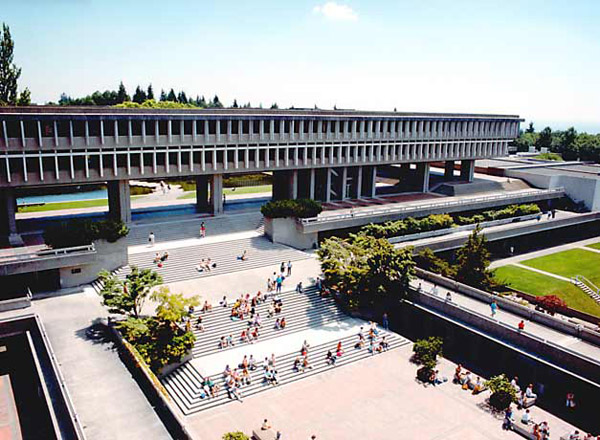

Indeed, one of my favourite architecture books is Rhodri Windsor Liscombe’s The New Spirit: Modern Architecture in Vancouver, 1939-1963. Modernist buildings haven’t really stood the test of time, I have to say, especially those designed to look like concrete bunkers, such as the Canadian Embassy. SFU is one of the most depressing places in the world on a cloudy, rainy day atop Burnaby Mountain. Unfortunately, it is often rainy and cloudy atop Burnaby Mountain. University campuses across North America are dotted with modernist buildings, as the great boom of construction on these campuses came at the height of modernism in the post-War era. In many instances, modernist behemoths look as if they were dropped into more classical settings, such is the case of Student Center Building at the University of Masscachusetts, Amherst. In the picture below, you can see those older, classic buildings scattered around the Student Center and the residence towers behind it.

So pervasive is modernist architecture on campuses that it is oftentimes pejoratively referred to as “Neo-Brutalist” architecture. Indeed, buildings such as the Student Center, or the entire Burnaby Mountain campus of SFU, re-enforce this. The buildings are concrete, massive, and imposing. Inside, there is a lot of dark browns, dark woods, and black. Gloomy is about the only way to describe these interiors.
Long and short, the term “Neo-Brutalist” quite often fits, not that there aren’t some beautiful modernist buildings to be found, such as Vancouver’s old BC Hydro Building, which has since been condofied, or MOntréal’s Palais de Congrès.


But, despite this, I can’t help but chuckle when I read stories like this one in the Globe & Mail yesterday, about the Public Safety Building in Winnipeg.

This particular behemoth, built in 1966, is a textbook case of Neo-Brutalist Behemothology. Frequently the several hundred employees of the Winnipeg Police Force are required to vacate the building because of noxious fumes that waft up into the building. This happens frequently, apparently. This time it required the Hazmat to come. The PSB is built out of
brittle Tyndall limestone, hasn’t held up against Winnipeg’s climate. Dozens of steel brackets cling to the building’s exterior like Band-Aids, preventing the facade from avalanching into the street. A $98,000 awning encircles the building, stopping pieces of the gaudy structure from braining pedestrians.
And this is the crux of the problem with many Neo-Brutalist behemoths, from SFU to Montréal’s legendary Stade Olympique, known in English as the “Big O”, or more fittingly, the “Big Owe,” as it took 30 years for the city to pay off its legacy from the 1976 Summer Olympics, by which time the Expos had decamped for Washington and the Alouettes had been re-born in McGill University’s quaint Molson Stadium at the foot of Mont-Royal. But the Big Owe and the PSB, and SFU, for that matter, all have something in common. The materials used to build them aren’t all that well-suited to the climate they are in. Hence, the PSB is falling apart, the Big O has had large slabs of concrete fall off it, and SFU, well, that much concrete in a rain forest isn’t the best idea, either.

But the bigger question is what to do with these buildings, especially those that are falling apart or being abandoned, as is the case with the PSB. Urban preservationists in Winnipeg argue that the PSB is worth saving,
According to University of Winnipeg Art Historian, Serena Keshavjee,
It’s not a love-hate relationship people have with these buildings; it’s just hate. People grew up with these buildings and don’t see them as heritage buildings, but the same thing happened 40 years ago with Victoria structures.
Had we ripped out every Victorian building in the country we would be very sorry these days,” she said. “And these are the times when they become vulnerable. The country is coming out of recession and people are gearing up to tear things down.
UW historian David Burley echoes, arguing that modernism
reflects a time when the federal government lavished money on public projects and Canadian pride soared ahead of Expo 67 and the centennial. “It was a nationwide movement,” he said. “There was this great optimism. The central parts of cities had deteriorated and there was a sense it was time to redevelop things.”
Personally, I’m not so sure that a modernist building is worth saving just because of its own merits. A building like the PSB is an ugly imposition on the urban landscape. Buildings like it seem to mock their landscapes, they don’t fit in, they crush them, they impose upon them. They belittle us. Of course, granted, that’s the point with a police station, or at least it was in the 1960s. But that doesn’t mean a building should be saved just because it’s old. Sometimes, old things are just junk. And the PSB is an example of that.
Crime in the Big City
January 15, 2010 § Leave a comment
This is kind of bizarre and gruesome, but yesterday a body was found in a suitcase at the corner of rues de Bullion and Charlotte in that funky part of downtown, just off the Main, the legendary Lower Saint-Laurent. There are a bunch of rooming houses there. Anyway, the Montréal police, in all their brilliance, then announced that the body showed signs of violence. Really???? A body is stuffed into a suitcase and you might think that it got there by means of violence? Wow.
Certainly this was only part of the story, of course the cops knew more than they were saying, and no doubt this bit of intelligence came as an answer to a simplistic question from a reporter, and The Gazette ran with it. But, still.
Anyway, the Montréal police got their man, arresting a man in Ottawa today.
Congrats, That’s How to State the Obvious
December 7, 2009 § Leave a comment
Congratulations to the US EPA, which has just determined that greenhouse gases are a threat to humans. It depresses me that it took Obama’s election for the EPA to come to this conclusion.
In related news, over at the CTlab’s Review, I have a review of a book entitled, Smogtown: The Lung Burning History of Pollution in Los Angeles, by Chip Jacobs and William J. Kelly, posted.
 Matthew Barlow