An Episode in the Life of a Diasporic City
February 5, 2010 § Leave a comment
Montréal is a city of literature. It has been the home of many great novelists, both of Canadian and international reknown. It is also a city that has been the setting of many novels, bestsellers at home and abroad. For years, I lived in the neighbourhood that was the setting of Gabrielle Roy’s Bonheur d’occasion, Saint-Henri. Prior to that, I called Duddy Kravitz’s Mile End home. Presently, I call the setting of Balconville home. The Plateau-Mont-Royal has been immortalised by the likes of Michel Tremblay, Mordecai Richler, and Rawi Hage. One of the best academic reads of recent years was Sherry Simon’s Translating Montreal: Episodes in the Life of a Divided City. Simon explores the cultural and social history of her Montréal through the literature, in both official languages, that depict the city’s multicultural landscape and lived experience.
Montréal’s literary authors, to say nothing of Simon herself, have projected and reflected the experience of immigrant groups and their diasporas through their works. It was from Richler’s works that I learned so much of the Jewish experience of Montréal, that I came to understand the city as a Jewish one. Indeed, Richler was instrumental in re-casting Montréal as something more than just a bifurcated locale, a city caught between French and English, in that he inserted the city’s Jews into the dialogue, his writing maturing with the city throughout the 2nd half of the 20th century.
Today, however, in trying to find a bowl of matzoh ball soup, I was kind of stunned by just how much Richler’s Montréal has changed. As I wandered through the city’s downtown core, both searching for the soup and running a handful of other errands, I got to thinking about not just how diasporas inform and reflect off each other, but also how diasporas evolve, shift, and replace one another. This was especially true, I thought, in a 5-block section of downtown just west of Concordia’s downtown campus. In this stretch, there are, amongst other things, a German restaurant that has been there for most of my life, as well as newer Russian, Indian, Iranian, Lebanese, Irish, Armenian, Mexican, Central American, Chinese, and Thai restaurants. And not a single place that served matzoh ball soup. During Richler’s years studying at Sir George Williams University, one of the founding institutions of Con U, I’m sure matzoh ball soup could be found in the vicinity of the campus. Of course, one would not have found the plethora of “ethnic” food (the term is in quotations because it is such an unsatisfactory one to use in this instance).
This is neither a lament nor a complaint, I eventually found the matzoh ball soup at Dunn’s, an old Jewish deli, on Metcalfe. It just is what it is, an episode in the life of multicultural, diasporic city.
Diaspora and the Haitian Earthquake
January 25, 2010 § Leave a comment
I spent a chunk of my weekend reading theory on diaspora and transnationalism, as I begin the process of writing the Introduction to the book, so these topics were fresh in my mind when I read The Gazette today. Today, here in Montréal, a group of global bigwigs, including US Secretary of State Hilary Clinton, French Foreign Minister Bernard Kouchner, as well as foreign ministers from Canada, Japan, Brazil, and a hanful of other nations, plus the UN, are meeting with Haitian Prime Minister Jean-Max Bellerive to discuss rebuilding plans for Haiti.
Upon arriving in Montréal yesterday and meeting with Québec Premier Jean Charest, Bellerive told reports that the Haitian diaspora is fundamental to the re-building of his nation:
We need a direct, firm and continuous support from them. This cataclysm has amplified the movement (of people) out of Haiti, unfortunately. We will have to work hard to encourage them to come back to Haiti…I’m very happy that the help has now arrived and is being distributed, because we had a lot of logistical problems in my country.
In other words, the Haitian diaspora is a transnational one, as it stretches across several nations in addition to Haiti (including Canada and the US), and a dynamic relationship exists between Haiti and its diaspora, diasporic Haitians have not just settled in places like Montréal and New York City, they also continue to send money back to Haiti, establish charities and trusts, and so on. In the days since the earthquake there, and its aftershocks, I’ve been struck by the actions of prominent diasporic Haitians, such as Indianapolis Colts’ receiver Pierre Garçon, former Montréal Canadiens’ tough-guy Georges Laraques, Philadelphia 76ers’ Samuel Dalembert, and musicians such as Wyclef Jean and the Arcade Fire’s Régine Chassagne, amongst others. They, along with less-well-known Haitians, have been working feverishly raising funds, visiting Haiti, helping in rescue efforts and so on. Indeed, the Haitian diaspora has been instrumental in not just raising consciousness, but in keeping Haiti in the global consciousness beyond the initial burst of news of the earthquake, to work towards a rebuilding plan for a devastated nation.
Bellerive’s recognition of that is impressive, as national leaders tend not to recognise the importance of their nations’ diasporas, even in times of trouble. And yet, transnational diasporas are central to the homeland nation, as the Haitian example makes clear.
Radicalism and Diaspora in Canada
January 15, 2010 § 2 Comments
Yesterday, the ring-leader of the Toronto 18, Zakaria Amara, apologised to Canadians for his role in plotting to blow up U-Haul trucks outside of the Toronto Stock Exchange, the Toronto CSIS HQ, and a military base just outside the city. It is worth noting that the Toronto 18’s goal was specific, to convince the Canadian government to pull out of Afghanistan. Amara said that he “deserves nothing less than [Canadians’] complete contempt.” At least according to The Globe & Mail, he went onto to explain how it was he was radicalised in suburban Mississauga.
Starting off by quoting the Quran, in hindsight, [Amara] said his interpretation of Islam was “naïve and gullible,” and that his belief system made worse by the fact he had “isolated himself from the real world.”
Today he told the court he has been rehabilitated by his time awaiting trial in jail – mostly through his interactions with fellow prisoners who challenged his hate-filled ideology. He promised he would change from a “man of destruction” to a “man of construction.
He also apologised to Canada’s Muslim community, noting that he had brought unwelcome attention and scrutiny.
The Globe also reports on Amara’s accounting of his radicalisation in suburban Mississauga, a multicultural locale with a population larger than all but a handful of Canadian cities (Toronto, Montréal, Vancouver, and Ottawa-Gatineau), one that sounds not all that dissimilar than what Marisa Urgo describes in Northern Virginia, a suburb of Washington, DC. As she notes, Northern Virginia has produced a fair number of radicalised young men. Mississauga, on the other hand, has not, other than the Toronto 18. In Mississauga, Amara isolated himself from all but a small handful of radicals, and they fed off each other.
In prison, Amara claims to have seen the light, befriending a former stock broker who worked at the very exchange Amara had planned to blow up. He, a Sunni Muslim, also befriended both a Jew and a Shi’a Muslim. In his radical era, Amara had nothing but contempt for Jews and Shi’a. But now, he says, he’s seen how wrong he was.
Amara’s psychiatric examination in prison suggests that he became radicalised as a means of escapism, the drudgery of life, of having had to drop out of university to help support and raise a daughter, as well as the pain from his parents’ divorce.
One thing that strikes me the most, though, about the discourse surrounding the Toronto 18, is this horror that Canada might have produced radicalised terrorists from a diasporic community. Canadians seem genuinely befuddled that this could happen in his multicultural nation where immigrants and their progeny are generally welcomed (not that there isn’t racism in Canada, there is. A lot).
But, this is where being an historian is kind of fascinating. As I have argued over at the CTlab, historians get to take the long-view, we see context, and depth. We don’t, or at least we shouldn’t, engage in knee-jerk reactions. And so, I would like to point out that this isn’t the first and only time that diasporic radicals have trod on Canadian soil.
Indeed, the neighbourhood I study, Griffintown, here in Montréal was once one of the hottest of hotbeds of radicalism, in the 1860s, 150 years ago. Then, it was the Fenians, a group of Irish nationalists who were always more successful in the diaspora than in Ireland itself. Indeed, their plan wasn’t all that different than that of the Toronto 18. The Fenians in the United States and Canada dreamed of seizing and conquering Canada and holding it as ransom against the British in return for Irish independence. And Griffintown was the centre of Fenianism in Canada.
The Fenians met secretly around Griffintown and Pointe-Saint-Charles, plotting how to act as a 5th column when their American brethren invaded, and how they would then take over the country. The Griffintown Fenians were also the ones responsible for the first political assassination in Canadian history (there have been only 2 in total), that of Father of Confederation and Member of Parliament for Montréal West, Thomas D’Arcy McGee on 7 April 1868 on Sparks St. in Ottawa. McGee had been a radical in his youth in Ireland, a member of the Young Ireland movement there in the 1840s, but, after relocating to Montréal, he had become convinced of the Canadian cause, and during the particular contentious 1867 federal elections (the first Canadian election), McGee had outed the Fenians in the pages of The Gazette. Not surprisingly, this didn’t go over well, and the Fenians, acting, it seems, independently of their American counterparts, and Patrick Whelan shot him.
Then, as now, there was all sorts of anguish over the thought of terrorists (though this word wasn’t used for the Fenians) on Canadian soil. Anglo-Canadians couldn’t understand why the Irish would wish to carry their old world battles into the new Dominion, and they tended to see Irish-Catholics as a singular whole. Not unlike how Canadians in the early 21st century have responded to the Toronto 18, in fact. Not that this exonerates either the Fenians or the Toronto 18 as radicalised diasporic terrorists, but the long view is always interesting in and of itself.
Crime in the Big City
January 15, 2010 § Leave a comment
This is kind of bizarre and gruesome, but yesterday a body was found in a suitcase at the corner of rues de Bullion and Charlotte in that funky part of downtown, just off the Main, the legendary Lower Saint-Laurent. There are a bunch of rooming houses there. Anyway, the Montréal police, in all their brilliance, then announced that the body showed signs of violence. Really???? A body is stuffed into a suitcase and you might think that it got there by means of violence? Wow.
Certainly this was only part of the story, of course the cops knew more than they were saying, and no doubt this bit of intelligence came as an answer to a simplistic question from a reporter, and The Gazette ran with it. But, still.
Anyway, the Montréal police got their man, arresting a man in Ottawa today.
U2
December 12, 2009 § Leave a comment
I just want to say apropos of nothing, that I am completely blown away that U2 would spend $3 million to build themselves a temporary outdoor stadium at the recently disused Hippodrome-de-Montréal. More than that, that they would offer tickets for as low as 30$. And even more than that, that this temporary stadium will seat up to 80,000 people and that U2 sold out two shows on 16-17 July 2010 in next to no time (and no, I don’t have tickets). As the Irish say in such moments, Jay-sus! Up to 160,000 people for two nights to see U2.
One of my students last week tried to argue that U2 were a spent force as a rock band. Apparently, dude was wrong.
I wish I could tie this to some commentary on the strength of the Irish diaspora in Montréal, or something like that. But sometimes, well, a cigar is just a cigar. So, instead, I present you with this video, tying U2’s classic “Sunday Bloody Sunday” back to its original meaning, Bloody Sunday on the Bogside in Derry, Northern Ireland, on 30 January 1972.
Remembering the Montréal Massacre
December 6, 2009 § 1 Comment
On 6 December 1989, a lone gunman burst into the École Polytechnique de Montréal, part of the Université de Montréal, and opened fire. He targeted women specifically. He was upset that “feminists” had ruined his life. For his delusions, 28 innocent people were shot, before he turned the gun on himself. In the first classroom he broke into, he separated men from women, then shot all 9 women, 6 of whom died. Then he wandered the hallways, the cafeteria, and another classroom, targeting women, shooting another 14 women, and 4 men. All 4 men survived, of the 24 women who were shot, 14 died. All this within 20 minutes.
I was 16, living in suburban Vancouver when this happened. I remember the shock. I couldn’t fathom then, and I still can’t, how someone could open fire in a school, let alone, to kill women for being in school. These 14 women died because they were just that: women getting an education. I have never been able to wrap my head around that concept. It doesn’t make sense to me. It didn’t in 1989 and it doesn’t in 2009. The Montréal Massacre is one of those transformative moments in my life, it is deeply embedded in my view of the world. It was a shocking, terrible event. And despite all of the school shootings since in both Canada and the USA, this is the one that is, to me, a horror story. Every 6 December, I remember watching the chilling news footage in the living room back in BC, I remember trying to understand why this had happened, my mother and I both horrified. And every 6 December, I find myself asking those same questions over and over. I still don’t have an answer.
But what particularly upsets me about 6 December is that the shooter’s name lives on, in infamy, of course, but nearly everyone of my generation, we were all affected wherever we were, know his name. I refuse to utter it, print it, post it, etc. I do not want to remember him. Diane Riopel, who taught at L’École Polytechnique in 1989, and narrowly missed meeting the killer, echoes this sentiment: “We have given him enough publicity. Out of respect for the victims, the killer should be completely anonymous.” I don’t think Hell exists, but when I think of him, I hope it does. I don’t think anyone can name all 14 women who died. I certainly can’t. They’re all agglomerated as “the victims.” The shooter maintains his individuality in death, but the 14 women he martyred lose theirs. All we seem to know is that they were engineering students. But what else about them? What were their dreams? What did they plan to do with their lives when they finished school? What books did they read? Where did they hang out with their friends? All of this, I wonder about every year at the anniversary. And I have no idea what the answers to these questions are.
These are the victims:
- Geneviève Bergeron (born 1968), civil engineering student, age 21.
- Hélène Colgan (born 1966), mechanical engineering student, age 23.
- Nathalie Croteau (born 1966), mechanical engineering student, age 23.
- Barbara Daigneault (born 1967), mechanical engineering student, age 22.
- Anne-Marie Edward (born 1968), chemical engineering student, age 21.
- Maud Haviernick (born 1960), materials engineering student, age 29.
- Maryse Laganière (born 1964), budget clerk in the École Polytechnique’s finance department, age 25.
- Maryse Leclair (born 1966), materials engineering student, age 23.
- Anne-Marie Lemay (born 1967), mechanical engineering student, age 22.
- Sonia Pelletier (born 1961), mechanical engineering student, age 28.
- Michèle Richard (born 1968), materials engineering student, age 21.
- Annie St-Arneault (born 1966), mechanical engineering student, age 23.
- Annie Turcotte (born 1969), materials engineering student age 20.
- Barbara Klucznik-Widajewicz (born 1958), nursing student, age 31.
On the Mark
November 17, 2009 § Leave a comment
I’m not entirely sure where this site comes from, but The Mark is a new current events/news site heavy on the analysis, and staffed, it seems, by a group of scruffy urban hipsters. All power to them. This site is worth a read and following in the future.
At any rate, there is a section on The Mark that looks at the future of the city in the 21st century. It has become pretty much commonplace to refer to the 21st century as the urban century; the world’s population recently passed the tipping point and we are a predominately urban species now. Of course, in the industrialised west, this mark was reached in the 20th century. Canada, incidentally, was one of the first predominately urban nations in the world. The Mark’s section on the future of the city is hosted by former Vancouver Mayor, and Premier of British Columbia, Mike Harcourt, and has brought together a pretty impressive array of news and analysis on Canada’s cities, as well as analysis on our collective future. Worth checking out.
The House of the Irish: The Book
November 15, 2009 § Leave a comment
Well, almost 6 months to the day of defending my dissertation, I am heading out tomorrow to begin, in earnest, work on the book. Now that I have interest, at least, from a publisher, I am getting going on the new research I want to do, and moving forth with the revisions and whatnot. Next weekend or the following one, depending on when I get a bit of time, I am going to re-write the Preface of the dissertation to lay out where I want the book to go, though, of course, that will change a few times as I move forward.
Anyway, tomorrow I am meeting with a former Griffintowner I met at a talk I gave last year, to do an oral history interview. This is kind of exciting for me, and I’m excited to learn that I am not, in fact, sick of Griffintown and its history yet. In fact, I feel rather rejuvenated by 6 months away from it, as I have been immersed in Griffintown lore for most of the past 3 years, since I started writing the dissertation in earnest.
So let us hope the book doesn’t take as long to write as the dissertation did and sometime in the not-too-distant future, The House of the Irish: Diaspora, History & Memory in Griffintown, Montréal, 1900-2010, will be on the shelves of a bookstore near you.
Griffintown Horse Palace Foundation Launch
November 15, 2009 § Leave a comment
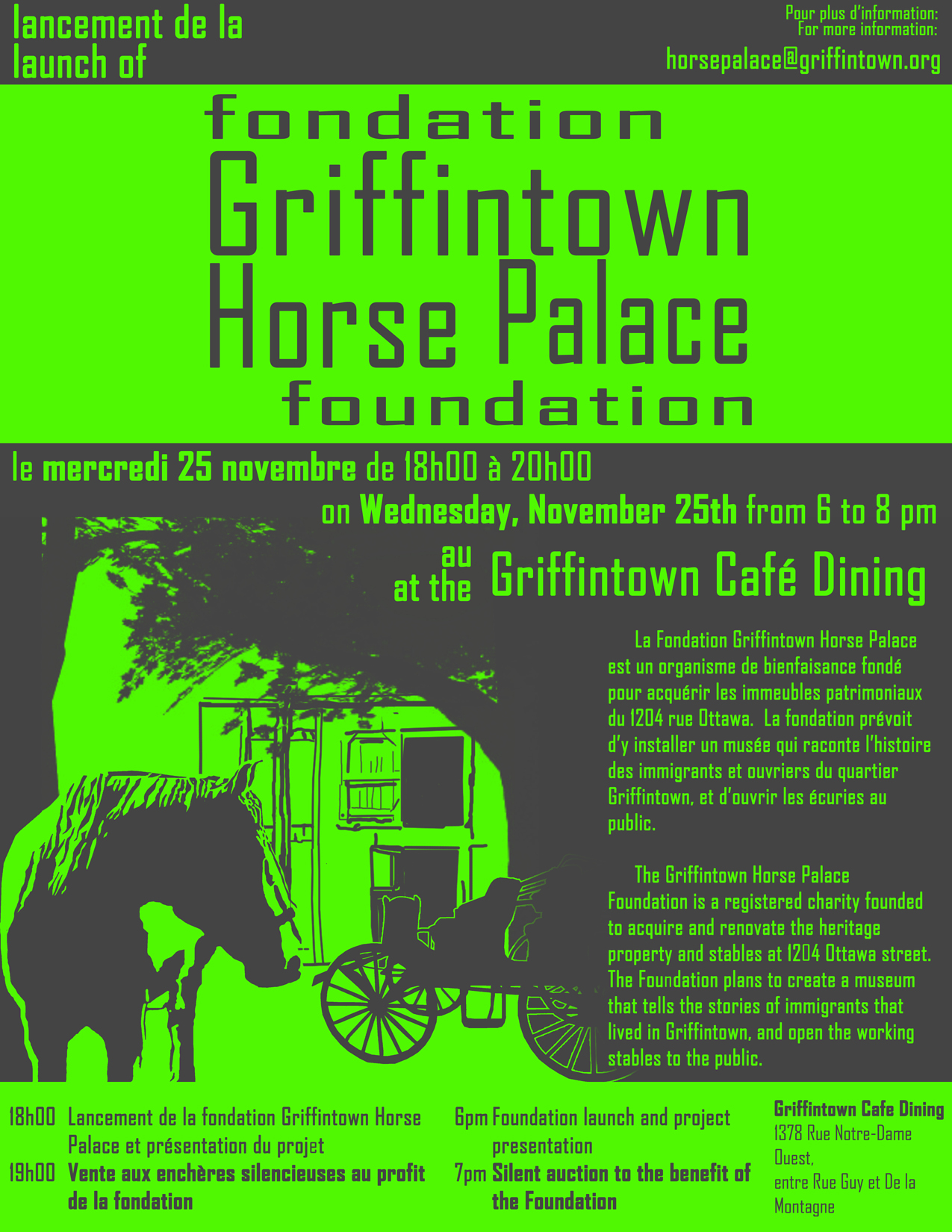
The Griffintown Horse Palace Foundation is dedicated to purchasing and renovating Leo Leonard’s Horse Palace in Griffintown, to turn it into a museum along the lines of the legendary Tenement Museum on the Lower East Side of Manhattan (frankly, one of two museums I find interesting). The Foundation is holding its launch at Café Griffintown at 1378 rue Notre-Dame in the Griff on Wednesday, 25 November, from 6-8pm. Unfortunately, I cannot be there, as I teach a night class on Wednesday nights out at Abbott, but I hope this is a resounding success. For more information, contact the Foundation at horsepalace@griffintown.org.
 Matthew Barlow