Joseph McCarthy and Intellectual Dishonesty
July 17, 2013 § 2 Comments
I’m working on a new research project, for which I am reading George H. Nash’s classic The Conservative Intellectual Movement in America since 1945. Nash, a conservative himself, wrote this book 37 years ago, in 1976, but it has been updated regularly, most recently in 2006 (the edition I’m reading). It is, for the most part, a tour de force, but too often Nash (and the men he studies) are incapable of recognising the moral and real world implications of their arguments.
One glaring example of this is in the 1950s and the support of the American Right for McCarthyism. At least according to Nash, almost to a man, the right in the 1950s supported the bullying, unintelligent senator from Wisconsin. They supported his lies. They did so because of their belief in the evils of communism. But they seem to have been incapable of recognising the cost of McCarthyism. As one of my old professors, Steve Scheinberg (a 1960s radical) noted, many lives were destroyed by McCarthy and his accolytes in the early 1950s.
Nash even refers to one, Owen Lattimore. Lattimore was accused by McCarthy of being a Soviet stooge (along with many of the China Hands at the CIA, for that matter). Lattimore was was professor at Johns Hopkins University, in the 1930s, he was an adviser to both the American government and Chiang Kai-Shek’s nationalist movement in China. Chiang, of course, was engaged in a long and brutal civil war against Mao Zedong’s Communists throughout this period and was supported by, amongst others, the Americans. The Senate Internal Security Subcommittee engaged in an investigation of the Institute of Pacific Relations, as well as the American government’s China policies (remember, Mao and the Communists won the civil war in 1949, Chiang’s nationalists withdrew to Taiwan, but it was not until 1972 that the Communists were recognised by the US as the legitimate government of China).
Rumours of Lattimore being a Soviet spy had existed since 1948, but it in the early 1950s, McCarthy went after him, calling him the top Soviet spy in America, as well as accusing him of having delivered China into the hands of the Soviets. After investigation, it was found that Lattimore, though he had been an admirer of the Soviet Union and Stalinism in the 1930s was not, and had never been a Soviet spy, nor had he engaged in espionage. But that didn’t stop the Subcommittee’s report from concluding that Lattimore was “from the some time beginning in the 1930s, a conscious articulate instrument of the Soviet conspiracy.” This was untrue and a lie. Nonetheless, it ended Lattimore’s career as a consultant for the CIA and the American government. Ultimately, he left Johns Hopkins and moved to Leeds University in England, perhaps for obvious reasons.
But very little of this is in Nash’s book. The quote from the Subcommittee above is, and then he goes on to note how the right then used the report of the Subcommittee and quoted it “from one end of the country to the other” and of the impact of the report and its supporting documents. There is not a single mention of Lattimore’s innocence. At all. And all throughout Nash’s discussion of McCarthyism and its import for the American Right in the 1950s, he conveniently avoids mentioning all the lives that were destroyed by Communist witch hunts.
To me this is intellectual dishonesty. Nash completely avoids the implications of the arguments made by the conservative intellectuals of the 1950s he studies. He decontextualises these implications. One could read this chapter in Nash’s book and have absolutely no clue of the excesses and dangers of McCarthy, an ill-educated bully who ranted and raved about names he had listed on what were actually completely blank pieces of paper.
Insta-Memory: Dismantling the Boston Marathon Bombing Memorial
July 10, 2013 § 12 Comments
Over at NCPH’s History@Work, I have a piece up today on the dismantling of the Boston Marathon Bombing Memorial a couple of weeks ago by the City of Boston. In it, I explore the meaning of the memorial and what happens to commemorations and memories once a temporary memorial, like this one, is taken down. Today, incidentally, is the day that the surviving bomber/terrorist makes his first court appearance.
The Symbolism of Maps
July 1, 2013 § 4 Comments

London Tube map. 1908
As noted, I’m reading Peter Ackroyd’s epic London: The Biography. As might be expected of such a tome, it’s a treasure of information, some interesting, some not so much. But in reading it, I’m reminded of the London Underground map. Like the transportation network in any major city, London’s was originally a hodgepodge of private companies providing service, which were eventually centralised and then nationalised. The maps were created for what maps are always created for: to help people navigate their way around the system. The first map dates from 1908.

London Tube map, 2013
The basic template of this map remains in use today. As Ackroyd notes, “The original Underground map bears only approximate relation to the location of lines and stations, but it is so aesthetically pleasing that its lineaments have never been changed.” In other words, today’s Tube map is a representation of reality, it only gives a vague idea of the system. Countless Londoners and tourists both state at the map with great intensity trying to figure out where to go. And while the map does give a vague idea of where things are, it is highly impressionistic. But, boy, it sure does look great, doesn’t it?

Montréal métro system map
The thing I find most interesting about the London Tube map, though, is that it has become the template for subway/métro systems the world over. These maps are stylistic triumphs, but they are, quite frankly, useless as maps. Nonetheless, as urbanites, we are trained to be able to read these maps and navigate our way around the city. And let me also point out that cities are incredibly complex organisms. Navigating them has become second nature to us, but if we stop and thinking about it, what we can do on a daily basis without thinking too much is pretty impressive. At any rate, these transit maps. Consider, for example, the Montréal métro map. It’s a highly stylised representation of the métro and commuter rail lines in the city and its surrounding areas. Nothing other than the stations and ultimate destinations of the train lines are identified. In order to read the métro map, one requires a basic knowledge of the geography of the city.

Map of Montréal
Compare the métro map with that of the city as a whole. The métro map only covers a small part of the central portion of the Île-de-Montréal. Of course, that’s where the métro is. And note that the map of Montréal as a whole is missing perhaps the biggest geographical fact of the island, other than it is an island: Mont-Royal. That, of course, suggests that maps in general are just impressionistic and little more than symbols of what it is they are meant to represent.
 This is a point that I like to make to my students about the great explosion of map-making in the West during the Age of Exploration, as well as the process of state formation in the Early Modern era: I ask them to think about what it is that they know makes them American (or Canadian, when I lived in Montréal), what makes them know that they in the upper right corner of the country know that all those people down in the lower left hand corner are all American. The map of the United States. As Benedict Anderson notes in his still brilliant Imagined Communities (seriously, this remains one of the greatest books I’ve ever read), part of the process of state-formation is achieved through the creation of a logoised map that is then emblazoned into the brains of the citizenry. When someone says the word “Canada” to me, many things flash through my head, but amongst all these images is the outline of the map of Canada.
In other words, maps aren’t really anything more than symbols of what it is they represent. We are trained in map reading from a very young age, so that even as children we can look at a map and instantly recognise what it is we’re supposed to be seeing.
The Urban Cacophony
June 28, 2013 § 31 Comments
I’m currently reading Peter Ackroyd’s epic London: The Biography. This is the third non-fiction book I’ve read in the past year on the history and culture of London (the others were Peter White’s London in the 20th Century, and Iain Sinclair’s luminous London Orbital). I’m not entirely sure why I’m reading so much of London, a city I don’t have any connection to; nor is it a city I feel any attraction to. But, here I am, no doubt attracted to these books because I find the city to be so fascinating (that’s the city in generic, not London particularly). And London is the most written-about city in the English language. Anyway.
One of Ackroyd’s chapters is about the sounds of London in the early modern era. I find acoustic history to be fascinating. Historians are increasingly interested in the sounds of the past (including my good friend, S.D. Jowett, whose blog is here), and this shouldn’t be surprising. Given the innovative uses we historians have made of our sources, it’s really no surprise that now we’re beginning to ponder the smells and sounds of the past. And cities, of course, are prime locations for such explorations. One of my favourite Montréal websites is the Montréal Sound Map, which documents the soundscapes of the city.
Ackroyd has done interesting work in excavating the audio history of London, including references to the combined sound of the city in the early modern era, like a cacophony or like the roaring of the ocean. These noises, of course, were and are entirely human created, the noise of people living in close quarters in a big city. Even the sounds of nature in cities are mediated through human intervention, such as the rushing streams and rivers of early modern London, or the mediated parks of the modern city, such as Mont-Royal in Montréal or Central Park in New York, both of which were created and landscaped by Frederick Law Olmsted. It came as a shock to me when I learned that most of the flora and fauna on Mont-Royal were not, in fact, native species, but were brought in by Olmsted and planted there for aesthetic reasons.
When I think of the roar of the city, I tend to think of Manhattan. For my money, there is no urban space on this planet as loud as mid-town. The endless roar of traffic, the honking of horns, the sounds of people on the streets talking, sirens wailing, fights breaking out, the sound of planes flying overhead, people hawking things along the sidewalks. I had never really thought all that much about the noise of the city, it was just part of the background noise. But a few years ago, I realised that I like white noise machines. They were, I though, supposed to be evocative of the ocean (near which I grew up), but that’s not what the sounds evoked in me. They evoked the sounds of the city, the constant hum of human activity. The only other place I’ve been that challenges Manhattan for the capital of noise is my hometown. Montréal is downright noisy, as all cities are, but Montréal hurts my ears. Hence my love for Parc Mont-Royal. Once you get amongst the trees on the side of the mountain, the sounds of the city become a distant roar. The same is true for Central Park.
Where I sit right now, I hear the sounds of the city, over the sound of the loud music blasting out of my speakers. But I can hear people walking by my house, I can hear the traffic on the busy street at the end of my block, and sirens.
It’s not surprising that academics as a whole are starting to turn to the sounds that surround us, given how much of an impact our environment has upon us. This is just as true of rural areas (in which case, the silence can tend to frighten city folk). In the late 19th century, the anti-modernists took hold of a part of North American culture. They were turned off by the city, by the noise, by the hustle & bustle, by the fast pace of life. People began to develop neurasthenia, wherein the patient began to feel frazzled, burned out, and depressed due to a frazzling of the nerves. It was particularly common in American cities, and for awhile was also known as “Americanitis.” So the anti-modernists, who preached a basic ‘back to the land’ message. Canada’s most famous artistic sons, the Group of Seven, were predicated on this kind of anti-modernism, they championed the mid-Canadian north as a tonic against the aggravation of living in the city.
But what I find most interesting about the kind of acoustic history that Ackroyd introduces us to is the way in which he is so successful at recreating the past, I can almost put myself in the streets of London in the 17th century. Perhaps this is not surprising. I read something once that said that sounds, more than sights, triggered our other senses, as well as our imagination and memory (think of this next time you hear a song that has meaning for you, you will be transported back to that meaning). But, for historians, acoustic histories (as well as histories of smells, the other incredibly evocative sense) really do work at making history come alive, so to speak. Plus, it’s also just kind of cool to imagine what a city sounded like 200 years ago.
Re-Manufacturing the War of 1812
April 30, 2013 § 2 Comments
Over at the National Council of Public History‘s (NCPH) blog, history@work (wherein public historians such as yours truly discuss issues related to history and the public and historical public memory), I have a new piece up on Canadian Prime Minister Stephen Harper’s delusional history of the War of 1812, entitled Re-manufacturing 1812: Stephen Harper’s Glorious Vision of Canada’s Past. From the title, you can probably guess my angle on Harper’s attempts to re-brand Canadian History through the War of 1812. Quite frankly, I find it disturbing. Let me know what you think.
Diaspora and Terrorism
April 24, 2013 § Leave a comment
Scholars studying diaspora and immigrant communities have noticed that there are some very general, very real trends amongst diasporic immigrant communities. The first generation, the immigrants, arrive in their new home, but find themselves caught between two worlds, struggling to fit into the new home, whilst still maintaining very real and very strong ties to the homeland. Their children, the second generation, are citizens of the new country by birth, and grow up in that host culture, and generally do not express a lot of interest in the culture of the homeland; they are fully integrated into the new homeland. It’s their children, the third generation, that begins to cast an eye back to the old homeland, curious about where their grandparents are from and the culture their grandparents carried with them in the new land until they died. These are trends that have existed in North America since the Irish began coming over here in the mid-19th century, and have been replicated time and again by pretty much every single group that has arrived in the United States and Canada in large numbers since.
Immigrants, their children, and grandchildren, of course, have greatly changed North American culture ever since the Irish. Take, for example, the city I live in now: Boston. Boston is the birthplace of the American independence movement in the 1770s, and was a tight-knit Anglo-Protestant city prior to the Irish arriving. Boston was never the same after the Irish arrived in huge numbers in the mid-19th century. And as the Irish infiltrated the city’s economy, culture, and politics, they left their mark. This can still be seen today: at present Stephen Lynch and Ed Markey are both attempting to gain the Democratic nomination for the special election to replace John Kerry in the US Senate. Both Lynch and Markey are currently Congressmen. Both are Irish Catholics, Markey’s from Malden and Lynch is from South Boston, aka: Southie. He grew up in the same housing projects as Whitey Bulger. The Irish still have their tentacles in the Democratic Party machinery in Boston today, 160-some odd years after they arrived.
Other cities are affected differently. Take, for example, my hometown of Montréal. Montréal has long been the recipient of immigrants, dating back to the Irish, who began arriving there in large numbers in the 1840s. The Irish completely changed the city, adding an Anglophone group that was Catholic to an already divided city. The Catholic Church was also massively changed in Montréal as the Irish muscled their way in. Indeed, they are largely to thank for the fact that there is an English-language Catholic Church in the city today. But Montréal is also being fundamentally changed by immigration from nations in the Francophonie in Africa and the Caribbean today. In the past decade or so, Montréal has undergone a fundamental cultural shift, as new French-speaking communities arrive. The consequences for French Canadian nationalism and separatism should be obvious.
But this process of acculturation may be now speeding up. Our cities have become faster, life is lived at a frenetic pace in our cities on this continent. Last week, two bombs went off at the Boston Marathon, killing 3 people and injuring over 200 more, some very seriously. The bombs were planted by Tamerlan Tsarneav, 26, and his younger brother Dzhokhar, who is 19. The Tsarneav brothers are immigrants, they came to the United States from Dagestan just over a decade ago. Tamerlan was here on a green card, whilst Dzhokhar became a citizen last year. Their parents have both returned to Russia in recent years, leaving them here. But they’ve been here a long time, Tamerlan was 14 or 15 when he arrived here, Dzhokhar was 8 or 9. They were both Americanised, and their brand of terrorism, experts have concluded is of the ‘home-grown’ variety.
Yesterday in the Boston Globe, Farah Stockman commented on this growth in homegrown terrorism, citing forensic psychiatrist Marc Sageman, who in 2008 predicted that terrorism in the West would increasingly be of this variety. Of course, by 2008, we had already seen the writing on the walls. On 7 July 2005, four terrorists detonated bombs during the morning commute in London. All four were homegrown terrorists, two were the sons of immigrants, a third was an immigrant himself, but had grown up in England. The bombing of Madrid’s transportation system in March 2004 was also of the homegrown variety.
This new generation of terrorists, the so-called 3rd wave, are younger than the Al Qaeda terrorists of the previous decade. According to Stockman, the average Al Qaeda terrorist in the 90s and early 00s was in his 30s. Today, the average age of these 3rd wavers is in his early 20s. The 2nd wave were devoutly religious and had grown up in devoutly religious homes. The 3rd wave grew up secular, as the brothers Tsarneav had. So, why the turn to radicalism and terrorism, she asks:
For some, it was out of a warped romanticism for a homeland they barely knew; an act of rebellion against hardworking immigrant parents who brought them to the West for “a better life.” Others were US-born converts to Islam who found in terrorism a sense of camaraderie and purpose that had eluded them all their lives. A few became terrorists after years of gang-banging and drug dealing. It was an ideology that transformed their violent tendencies into something heroic. It made them feel they were on the side of the angels.
Sagemean concludes that for some of these young men, ‘terrorism is a fad.’ This is an interesting thought. But if these young men are attracted, in part, by this romantic attachment to their parents’ homeland, or the homeland of their families, or to the religion that sustained their family generations ago, I’m not so sure that this is a fad. Scholars looking at notions of diaspora note the attachment 3rd generation children and those beyond have to the mythical homeland. Looking at my own community and what I study (the Irish), I would note that men and women whose families emigrated to North America 160 years ago remain curious and interested in the mythical homeland of Ireland. Ireland draws them in, they’re curious about the history, the culture, and some even the language. This becomes a life-long interest.
Maybe Sagemen is correct in that the violence of radicalism and terrorism is a fad of youth and some of these young men will eventually mellow out and choose to focus on aspects of their culture that do not lead to violence. Certainly there are echoes of this in the Irish diaspora, where many young men (and some young women) have been attracted to the glory of the violence in the North. This was certainly true when I was younger, before the establishment of peace following the Good Friday Accords in 1998. Young Irish-American and Irish-Canadian men would hold romanticised images of the IRA and the resistance “back home”. Most have long since grown out of this fascination with the IRA, of course. (This did, however, inspire Bono to go on a legendary rant during a performance of “Sunday, Bloody Sunday” during the 1987 Joshua Tree tour, which was released on the DVD of Rattle & Hum).
Getting Redevelopment and Community Right
March 12, 2013 § 2 Comments
Yaletown in Vancouver has undergone massive redevelopment in the past two decades. It was once the site of Expo 86 along False Creek, and before that, an urban wasteland (actually, after Expo, too). But today, it is a sea of glass towers; one statistic I’ve seen said the population just in Yaletown approaches 30,000, though I find that hard to believe. All along False Creek is a string of residential condo towers; all along Pacific Boulevard, from Granville to Cambie streets there are towers and pied-à-terre condos. Some of them even look nice.
 As I went out for my morning run today (I’m staying with my sister here), I noticed something: this is actually a well-thought out urban redevelopment. There’s a billboard on Pacific Blvd that says that Concord, one of the developers is building community here. It’s easy to scoff at that claim. But it’s not a ridiculous claim. My sister knows her neighbours. More than that, she has friends amongst them. Dog owners around here have claimed a patch of Cooperage Park on False Creek as a dog run. They police each other, making sure nobody leaves their dog doo behind. They also police each other’s dogs, making sure they behave. There’s a bunch of cafés and restaurants along Marinaside Drive (I know, what a horrible name), and they’re populated with regulars, the neighbours around here. People nod and say hello to each other on the streets and along the path that goes along the bank of the water.

There’s more, though. There’s actual, real parks here. Cooperage stretches almost from the Plaza of Nations at the head of False Creek towards and under the Cambie Bridge. A few blocks on is David Lam Park, which lies between Pacific, Drake, and Homer streets. But it’s more than that. These parks are actually used. There’s basketball and tennis courts at David Lam, and a playground. An elementary school is on David Lam and the children can be seen playing in the park at recess and lunch and after school. The path along the water is almost always busy with joggers and cyclists, as well as roller-bladers and walkers (Vancouver was experiencing one of its trademark torrential downpours when I was out taking pictures today, thus, aside from one intrepid jogger, there was no one out playing).
When I lived in Vancouver in the late 90s, there was a lot of hand-wringing about the redevelopment of the old Expo site. The city was determined to increase density, to follow the model of the West End, which is apparently the densest neighbourhood of North America that’s not Manhattan. So the old Expo lands saw these condo towers grow out of the ground. The major difference between the West End, which lies on the other side of the Burrard and Granville Street bridges and this area, which is part of the larger Yaletown neighbourhood, is that Yaletown tends to be resident owners, whereas the West End is largely rental units (there are, of course, many exceptions to both).
 At the end of the day, however, Vancouver got it right. There is community here, the public spaces are widely used. The cafés and restaurants are, with the exception of one Starbucks (this IS Vancouver, after all) independent operators (this isn’t as true as Pacific Blvd., the main east/west thoroughfare, which has plenty of chains in between and around the indie stores). This also contributes to community, as the small business owners connect to their local community in a way that Starbucks and Quiznos can’t. And studies show that locals are more likely to patronise these small businesses than the chains. Indeed, this morning, Bojangles, the local indie café was busy, filled with both commuters on their way to work and those with more time to sit and enjoy their coffee. Whereas the Starbucks, while it got a fair amount of foot traffic from commuters, it doesn’t have the same community feel.
I fear, however, that Montréal is getting it wrong with Griffintown. The early plans for the massive redevelopment of Griff by Devimco called for massive shopping areas and big box stores. The commercial developments were supposed to pay for the residential developments. As for anything else that urban residents might need, well, “Whatever,” Devimco seemed to say. Of course, Devimco’s bold plans were thwarted somewhat by the recession. The redevelopment is now a mixture of Devimco’s big District Griffin (how tragic it would be to have that old English name on the neighbourhood, eh, OQLF?) and a smattering of smaller developments, with the massive redevelopment of the old Canada Post Lands at the other end of Griff at the foot of rue Guy.
Missing, though, from all these redevelopment plans in Griff was any idea of what residents were supposed to do. There still are no plans for schools in the neighbourhood. It wasn’t until early 2012 that the Ville de Montréal announced that it had earmarked some money to create public parks. It’s still not entirely clear where they’ll be, other than the already extant Parc St. Ann/Griffintown at the bottom of rue de la Montagne at Wellington. And given Montréal’s history of development and redevelopment, and the fact that the mayor, first Gérald Tremblay and now Michael Applebaum, just has dollar signs in his eyes when talking about Griffintown, I have zero hope of Griffintown being redeveloped right. In fact, I am almost positive it will be a disaster.
It’s tragic, as Montréal has a chance to redevelop a huge swath of valuable land at the foot of downtown, to emulate what Vancouver did with Yaletown in the 90s and 00s. But it has done nothing to suggest that it will get it right. And that’s trafic.
Writing Montréal
February 2, 2013 § 1 Comment
I am reading Kim Echlin’s beautiful novel, The Disappeared, right now. It was shortlisted for the Giller Prize in Canada, and it won a Barnes & Noble award down here in the States. The awards are very much deserved, Echlin’s prose is beautifully constructed; sparse, taut, sensual sentences follow the heroine, Anne Greves, from the cold streets of Montréal to the scarred streets of Phnom Penh in the wake of Pol Pot and genocide in Cambodia. It is compelling reading.
But (and you knew this but was coming), I find myself fascinated with the problems in writing Montréal, as The Disappeared is full of them. I have sometimes wondered if Montréal, being the complicated, chaotic, bizarre city it is, can even be successfully written, especially en Anglais. But, of course it can. Mordecai Richler. Rawi Hage. Occasionally, even we academic types get it right, most notably, Sherry Simon in her brilliant book, Translating Montreal: Episodes in the Life of a Divided City. Montréal is not your average city. Your average city is a huge, complicated, seething multitude of humanity. Your average city is complicated, it is corrupt, it is beautiful and it is dirty and savage. Montréal is all that and more, in large part because it is, as Simon argues, a divided city. Divided cities, of which there are many in the world, are necessarily more complex and complicated. There are competing historical narratives and political realities battling for space on the cultural and political landscape of the city. Derry, Northern Ireland, is a small divided city, but the city is caught between two competing narratives of the city’s past, one Catholic, one Protestant, fighting for dominance.
Montréal, of course, is rent between the francophone version of the past and vision of the present and the anglophone equivalent. Historically, the city is split down the middle, blvd. Saint-Laurent, the Main. To the east, francophone and Catholic, to the west, Anglophone and Protestant. But this dichotomy doesn’t really work in reality, as the Irish complicated it, they were Catholic and lived in the west end, they were English-speaking and lived in the east end. Then the Jews came around the turn of the last century and settled in between the French- and English- speakers. And then the rest of the world came, and the city became multicultural in the last third of the 20th century. Then there’s the question of class. Montréal today is a city that holds a history for all these diverse populations, speaking their own languages, going to their own houses of worship, patronising their own businesses. But Montréal also holds a history of these people crossing their divides, and working together, shopping together, sharing their food and their language across these divides. We historians are left to find all these disparate strands of Montréal and attempt to unravel the complications, to look at how the complications arose, to see how all these peoples co-operated, and how they conflicted.
To return to The Disappeared, Echlin gets caught up in all of these complications. For example, the main character, Anne Greves, an Anglophone teenager in the 1970s, whose father teaches at McGill, lives on avenue du Parc. Anglos in Montréal today tend to call it Park Ave. Even bilingual ones. In the 1970s, Anglos did not call it av du Parc. But Anne also uses the English names for nearly everything else in the city. Bleury Street. The Oratory. Mount Royal. Old Montréal. And of course Anne would, all my cousins who are Anne’s age, who still live in Montréal, use the Anglo names. The only other locale in Montréal that gets called by its French name by Anne is the bishop’s cathedral downtown, Marie-Reigne-du-Monde. Being the Montréal purist and historian, I find these kinds of misnomers distracting. Perhaps it’s because Anne is caught between these various Montréals, perhaps it’s because she came of age in the late 1970s and the 1980s, when we fought about all of this, what to call things, what language we must speak and so on. And maybe it’s because Montréal is just here in passing, it’s where Anne is from. Soon, we are in Phnom Penh with her, sifting through the aftermath of Pol Pot’s psychotic reign.
But Echlin’s problems with nomenclature in Montréal really only speak to the general day-to-day issues on the street there. What you call av du Parc (OK, I admit, I’m an Anglophone who tends to use the French names) reflects a lot on who you are, where you’re from in the city, what your politics are. The same is true of Saint-Viateur, Mary Queen of the World, the Oratory and so on and so forth. And it is exactly this nature of the divided city I adore about my hometown. And I have to admit, I kind of miss it.
The Working-Class and Community, Griffintown and Beyond
February 1, 2013 § 6 Comments
Almost to a person, every former Griffintowner I talked to over a decade of working on the neighbourhood commented on the sense of community they felt in living there, how it was a place where people took care of their neighbours. David O’Neill, who helped me extensively during the research and who put in me in contact with many former Griffintowners, commented that when he was growing up there in the 1940s and 50s, it was like having a community of parents, everyone watched out for each other’s children on the streets. And if O’Neill and his friends got up to something they shouldn’t have, by the time they returned home, their parents would be waiting for them with the intelligence, ready to punish the kids.
But Griffintown was never unique for this characteristic, this is a commonality to nearly all former working-class neighbourhoods I’ve ever read about, on both sides of the Atlantic Ocean. It is also a way that is lost today. People who grew up in close-knit working-class communities are almost always nostalgic for what has been lost. They miss the community and comaraderie they experienced in those communities. They miss what kept them in line, be it the Church or work, or just the simple existence of real and authentic community.
The universality of this mindset hit home the other day in Salem, MA, at the National Park Service’s Custom House site. When the Park Service created the site, they removed a set of derelict buildings that had popped up in an alleyway behind the old Customs House on Derby Street. In the early 20th century, an entire working-class immigrant community existed along Derby Street, and in the alleys behind the Customs House. Here there were tenement houses of varying quality and shops and services that served, first, Irish immigrants, and then, in the 20th century, Poles and Russians and Ukrainians. Taking aside the question of the authenticity of the Customs House site given the destruction of the homes of this long-gone working-class community, what struck me the most was the description of what was once there, including a quotation from a former resident, Dorothy Philip, as seen in the photo here.
Canada and Empire
December 12, 2012 § 3 Comments
I often amuse myself with the attempts of Canadian historians to try to explain how, in the years leading up to the First World War, Anglo Canadians could alternately view themselves as Canadians, English, British, and as citizens of the greatest empire the world had ever seen (that would be the British, if you’re wondering). They tend to see this as a contradiction, a confusion, and get themselves twisted into knots in explaining this phenomenon. It just seems so contradictory to them. Here, for example, is Ian McKay, one of Canada’s greatest historians, with Jamie Stairs in their excellent new book, Warrior Nation: Rebranding Canada in an Age of Anxiety:
Many Anglo Canadians like [Bill Stairs, a Canadian hero of Empire] believed that a good British subject could and should simultaneously be loyal to Nova Scotia [Stairs’ home], Canada, and the Empire, and in doing so experience no contradiction.
To our 21st century Canadian identity, it is anathema that one could see oneself as more than just Canadian. And I just don’t get this. I really don’t. In the late 19th/early 20th centuries, Canada was a colony. It was not an independent nation, no matter what the politicians of the era, the Jack Granatsteins and Stephen Harper’s of today tell you. Canadian independence is a slippery concept, there is no exact moment that Canada gained its independence. For example, it could be 1848, when the Canadas gained responsible government. Or it could be 1867, when three colonies came together to form a united whole (Canada, Nova Scotia, New Brunswick). It could also be 1931, when the Statute of Westminster gave Canada (and all the other white Dominions: South Africa, Australia, and New Zealand) control over their foreign affairs. But, there was still no such thing as “Canadian” citizenship. That came on the 1st of January 1947. The following year, the Supreme Court of Canada became the highest court of appeal in the land. Prior to that, it was the Judicial Committee of the Privy Council in London (not Ontario, the UK one) that held that position. In 1982, our constitution was patriated from Mother Britain and made an act of our own Parliament. If you want to go all republican on the matter, I’d note that the head of state today is Queen Elizabeth II of England. So, politically, declaring the date of Canadian independence is difficult.
But the long and short of it is that 100 years ago, Canada was not an independent nation. It was also part of this massive Empire. The British Empire controlled something like 20% of the world’s land and 25% of the world’s population at the dawn of the 20th century. Think about that for a second. I mean it, just imagine the globe, imagine 20% of that land coloured the pink of the British Empire. Or just look at this map (and imagine the red as pink).
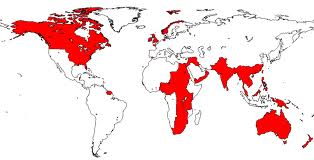
Empire was a very powerful concept in that Canada (and if Stephen Harper has his way, we’ll be thinking this way again soon). It was not incongruous for the average Canadian of Scots, English, or even Irish, stock to see him or herself as both Canadian and British at the same time. For being Canadian made one British, such was the nature of citizenship laws, and such was the fact that the monarch of the United Kingdom of Great Britain and Ireland was (and remains) the head of state in Canada.
Thus, the simple fact of the matter is that Canadians 100 years ago were both/and, not either/or. They were both Canadian and British, not Canadian or British. That was the way they rolled, so to speak. The same was true for other subjects of the British Empire throughout the Dominions. It might be time for Canadian historians to recognise this simple fact, and to stop twisting them like Mike Palmateer trying to bail out his woeful hockey team in trying to explain this. Joy Parr long ago instructed we Canadian historians that identities are not sequential, they are multiple and simultaneous. And the average Anglo Canadian’s identification with Canada, Britain, and Empire is just that: the simultaneous identities of an ambivalent population. No more, no less.
 Matthew Barlow