Success at Failure
March 26, 2014 § 3 Comments
Last week I was in sunny California at the National Council on Public History‘s annual conference in Monterey on the central coast. I was in a roundtable called “Failure: What is it Good For?” The idea behind the panel arose out of discussions between myself and Margo Shea in the autumn, surrounding various community-based projects we’ve been involved over the years, as well as our wider experiences in public history. At that point, Margo ran with it, and we proposed a roundtable to the NCPH, along with Jill Ogline Titus of the Civil War Institute at Gettysburg College, Melissa Bingmann of West Virginia University, and Dave Favolaro of the New York Tenement Museum. All five of us have a wide and divergent experience in community-based history projects in Canada and the US.
We were slightly nervous before our session, unsure if we’d have a full or empty house. The word “failure” is one that our culture and society does not like very much. We seem to go out of our way to avoid using the word, given it’s negative connotations. I have been slightly bemused with Gwyneth Paltrow and Chris Martin’s announcement yesterday that they were splitting up, they were “consciously uncoupling.” A column I read somewhere on that term (which I conveniently cannot find today) poked fun at their pretentious terminology (aren’t all breakups conscious uncouplings?) as it is really a way of getting around saying their marriage failed. I don’t find it surprising. Failure is a bad thing, continual failure makes us losers, etc.
https://twitter.com/Matthew_Barlow/status/446676391136751616
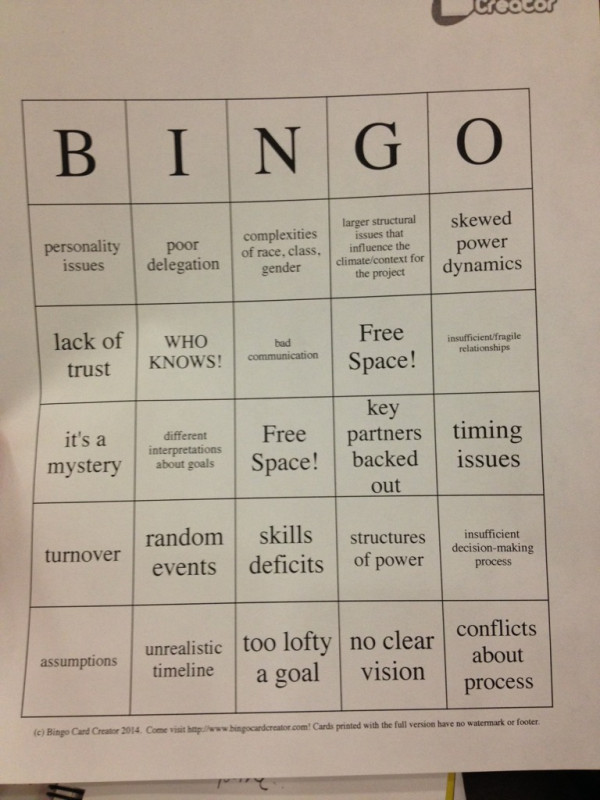 We were very pleasantly surprised to watch the room fill up; by the time Margo began the introduction to our session, I counted 3 empty seats in a room that sat somewhere between 45 and 50 people. What followed was amazing. We had our audience play some Failure Bingo ™ to get our crowd involved in the session early. And then we began to discuss the commonalities of our case studies, as well as some discussion about our particular cases.
One of the really neat things about the NCPH conference was that it was live-tweeted by several of the participants (myself included). The conference as a whole was interesting for this feature, as at every session there were a handful of people glued to their phones, laptops, and tablets as they live tweeted. I had several interactive sessions with session participants on Twitter, carrying on discussions about their talks throughout the panel.
What followed during the roundtable was kind of amazing, as a number of participants were live-tweeting events as they unfolded. After I was done with my bit, I sat back and resumed live-tweeting our session, engaging in dialogue with some of the audience members. This led to a multi-dimensional discussion between us and the audience. We had a live talk, amongst us in the room, we also used an app called Poll Everywhere to have people text their comments in, which then appeared on the screen behind us, and then there was the live-tweeting, which included interaction between me and some of the tweeters.
https://twitter.com/Matthew_Barlow/status/446779880185663488
The discussion in this multi-platform setting was fascinating, and, of course, kind of hard to keep up with. But that made it all the more interesting. As a group we spent a lot of talking about how failure works in other settings. In particular, medicine, science, and design. In those fields, failure is a necessary part of the process. It’s not too trite to say that in those cases, failure is part of success. In order to be successful, one has to first fail.
https://twitter.com/Matthew_Barlow/status/446794528393928705
https://twitter.com/Matthew_Barlow/status/446780787732381696
https://twitter.com/Matthew_Barlow/status/446792393816166400
But, of course, the difference between fields such as science, medicine, and design is that we, as public historians engaged in community-based projects is that we are dealing with other human beings. So, while I think we must be more open to failure in the same way that medical researchers and scientists and techies are, we must also keep in mind the human costs of failure. It can be embarrassing, humiliating and all other kinds of things. Marla Miller, from UMass-Amherst, also noted the way around this:
https://twitter.com/Matthew_Barlow/status/446796105963950081
But, either way, it is impossible to escape failure. But,
As this multi-dimensional discussion carried on, it was hard not to feel amazed, looking out at such a passionately engaged audience. I felt like we had at least succeeded at getting failure into the discussion.
https://twitter.com/Matthew_Barlow/status/446794954082242561
The following day, more than a few people told me ours was their favourite session of the conference. A few, tongue firmly in cheek, called me “The Failure Guy.”
https://twitter.com/Matthew_Barlow/status/447036533799784448
Power and imperialism: The power of naming things
March 19, 2014 § 2 Comments
I was at a public talk being given by my wife, Margo Shea, at the Beverly Public Library on Monday. She was talking about the Troubles in Northern Ireland and their aftermath, attempts to deal with the past, to heal, etc. One of the great contestations of that greatly contested history is what to call it: was it a civil war? Was it a police action? In the case of the former, she cited family members of young men, members of the IRA, killed by the British Army in the early 1970s. They, their family members argued, felt they were fighting in a war. On the other hand, Margo cited the families of Royal Ulster Constabulary (RUC) officers, who argued this was most certainly NOT a civil war.
Over 3,700 people died in the Troubles. Another 50,000 were injured. It is well nigh impossible to draw a line between civilians and combatants, given the Provisional IRA, much like the IRA it took inspiration from during the Irish War of Independence (1919-21) was a guerilla force and faded back into the civilian population after striking. At least in theory. The official dating of the Troubles is 1969-97, the years of the Provos campaign against the British. But the violence began at least a year earlier and the last major bombing, in Omagh, happened in 1998.
I am less interested in the history than terminology here. Because as Margo was talking about this dispute as to whether the Troubles was a civil war or police action, I got to thinking about the term “Troubles.” It is very British in origin. I also thought about the 1857 “Sepoy Mutiny” in India. And the 1837 “Rebellion” in Lower Canada. In all three cases, the descriptive name came from the British, the colonial power the Irish, Indians, and Lower Canadians were rebelling against.
In grad school, I read Alan Greer’s The Patriots and the People: The Rebellion of 1837 in Rural Lower Canada. In it, Greer argues that the failed 1837 Rebellion would be better understood as a failed revolution, as the Parti patriote were directly inspired by ideas of liberalism and freedom that drove the American, French, and Haitian Revolutions. The Patriotes, then, were products of their time.
Twenty years later, in 1857, the sepoys, or the Indian soldiers in the employ of the East India Company, rebelled. The rebellion began in Meerut and then spread. It took 13 months to fully suppress. The British termed it the “Sepoy Mutiny,” attempting to limit the damage to the military, dismissing it as the work of a few disaffected soldiers. In India, however, the 1857 rebellion is more commonly known as the First War of Indpendence.
Interesting. The distance between “Troubles”, “Rebellion,” and “Mutiny” from “civil war,” “revolution,” and “war of independence.” The terminology and the fight over it, though, are not surprising. For the British, minimising these revolts to minor occurrences makes sense in the name of justifying continued British imperialist presence. This is especially the case for Lower Canada and India, perhaps much less so for 20th century Northern Ireland. On the other hand, “civil war,” “revolution,” and “war of independence” also carry a lot more weight from the other, oppressed sides. These words work to serve the rebels’ purposes.
It is worth noting, though, I have never heard anyone seriously refer to the 1837 Rebellion in Lower Canada as a revolution, even amongst nationalist/separatist circles. Unlike the case of the Troubles and the Indian Rebellion, I have included the Lower Canadian conflagration here due to an argument made by an academic, as opposed to common usage.
But. I do think the battle over terminology for different circumstances in three very different corners of the British Empire (Ireland, it turns out, was both the first and is now the last of the English overseas colonies). And which term one chooses says just as much about “which foot you kick with,” to use a Northern Irish turn of phrase, than anything else.
I bring this up due to a series of conversations I have been involved with of late, both in real time and on social media, about power and privilege. And, certainly, tied up with questions of power and privilege are the rights to name events and items. A similar process can be seen in the naming of the landscape in any colony. Take, for example, Lake Superior. As Gordon Lightfoot reminds us in my favourite of his songs, “The Wreck of the Edmund Fitzgerald,” the Ojibwe called the lake gichigami,” which means, literally, “great sea.” (It’s also worth noting that Lightfoot calls the Ojibwe the Chippewa, the name the Europeans gave them) But, when the French arrived, they re-named the body of water Lac Supérieure, due to both its size and the fact it is the head of the Great Lakes. Literally, Lac Supérieure means “upper lake,” as in it is above Lake Huron. Lake Superior is simply an angicisation (though technically incorrect) of the French name.
Such is how power and privilege work. And when the formerly oppressed/subjugated/colonised people gain a modicum of power and/or independence, name changing abounds. For example, in my hometown, take the case of Dorchester Boulevard. It was renamed in honour of René Lévesque upon his death in the late 80s. Guy Carleton, first Baron Dorchester, was the Governor General of Canada following the Conquest (which is called La conquête in French, if you were wondering). Lévesque was the first separatist premier of Quebec, from 1976-84. Or, take the case of Mumbai, formerly known as Bombay. I could go on. I won’t. I’ll stop here.
Happy St. Patrick’s Day: “Race” and the “True Celt”
March 17, 2014 § 2 Comments
I’m currently finishing off my Griffintown manuscript, and continuing the endless revisions of the PhD dissertation it was based on. By this point, “based on” is loose, like when movies claim to be based on a book, but you can’t really see the book in the movie. Anyway, right now I’m revising the sections on Irish nationalist sentiment amongst the Irish-Catholics of Griff in the early 20th century. And so, I’m reading Robert McLaughlin’s Irish Canadian Conflict and the Struggle for Irish Independence, 1912-1925. McLaughlin’s work, like mine, is part of a growing movement amongst historians to challenge a decades-old belief amongst Canadian historians that Irish Catholics in Canada couldn’t care less about what happened in Ireland. This is a refreshing change.
McLaughlin, unlike most of us who study the Irish in Canada, focuses on both sides of the divide, looking at both Catholics and Protestants. This is what makes his book so valuable. Off the top of my head, McLaughlin’s is the only book-length study to look at the Protestant Irish response to agitations for Home Rule and outright independence for Ireland in Canada.
As such, McLaughlin spends a fair amount of time discussing Sir Edward Carson, the leader of the Ulster Unionists in Ireland. I talked about Carson in class the other week in discussing Home Rule and Unionism. I had a picture of him up on the screen, blown up behind me. When I turned around, I kind of jumped, not really expecting Sir Edward to be so big and glaring at me.  The picture, however, is beautiful. Sir Edward looks out contemptuously at his audience, his lips pursed into a sour look, as if he had just smelled some Catholics. His jawbone is fierce, and his hair slicked back. He looks for all the world like a hard man. But, of course, he wasn’t. He was a knighted politician. But he was also the perfect avenue into discussing the “manliness problem” of the late Victorian/Edwardian British Empire, and the response, created by Lord Baden-Powell of the Boy Scouts, “muscular Christianity.” Sir Edward looks like he could tear you a new one as easily as argue the merits of Unionism versus Home Rule. And, in turn, this allowed me a direct entré into the Gaelic Athletic Association’s concept of “muscular Catholicism,” which turned muscular Christianity on its ear for Catholic Irish purposes.
At any rate, back to McLaughlin and his quoting of Sir Edward. Sir Edward wrote to his former Conservative Party colleague, Sir John Marriott in 1933, long after Irish independence and the partitioning of Ireland:
The Celts have done nothing in Ireland but create trouble and disorder. Irishmen who have turned out successful are not in any case that I know of true Celtic origin.
I find this humourous. See, by Sir Edward’s day, there was no such thing as a “true Celt” (not that Irish nationalists didn’t speak this same language). By the 18th and 19th centuries, the Irish, both Catholic and Protestant, were a wonderful mixture of Celtic Irish, Anglo-Saxons, Vikings, Spanish, English, Welsh, Scots, and so on that no one was a “pure Celt” or pure anything. But, of course, that myth persisted and still persists today.
I still have people come up to me today, in the early years of the 21st century, and want to discuss the “real Irish” or the “pure Irish” or the “real Celts” in Ireland. After disabusing them of the notion that there is such a thing (anywhere in the world, quite frankly, we’re all mutts, no matter our various ethnic heritages), I am left to just shake my head.
Happy St. Patrick’s Day.
The Problem with the Hashtag #firstworldproblems
March 14, 2014 § 2 Comments
I see the hashtag #firstworldproblems on Twitter a lot. It’s usage is alarmingly frequent. And it’s used by nearly everyone I follow, from radical lefties to far right conservatives, wealthy and poor. It’s meant to poke fun at the lives we live in Western Europe, Canada, and the United States, how we get upset and annoyed at things like our iPhones taking more than a split second to open an app, or our lattes being a tad too hot to drink right away.
Personally, I’ve never used the hashtag, and it makes me feel slightly uncomfortable seeing it. This might be because I’ve been thinking about privilege a lot of late, in part because I teach at a college with a lot of working-class, immigrant, and 2nd generation American students. A lot of my students are the first in their family to go to college. A lot of them are disadvantaged by their high school educations, their English language skills or what Richard Sennett and Jonathan Cobb termed “the hidden injuries of class.” But it also comes from discussions I’ve been involved in of late about misogyny, sexism, racism, etc.
To me, the hashtag #firstworldproblems lacks sensitivity. Not just to those in the developing world, but to those who live in poverty in Canada, the United States and Western Europe. Poverty and dislocation are real, fundamental problems. And, at least from where I sit, #firstworldproblems mocks that, mocks those who aren’t well-off enough in the so-called First World to have these “problems.” From where I sit, #firstworldproblems is just another example of how we are spoiled by our affluence.
Margaret Atwood: CanCon Queen
March 13, 2014 § Leave a comment
Last weekend, I read Margaret Atwood’s The Year of the Flood, the second of her dystopian trilogy (Oryx & Crake is the first part and MaddAddam is part three). I mentioned Oryx & Crake briefly in my post in January about my 2013 reading. There I noted I’ve never been an Atwood fan. But this trilogy is making me re-think my position. I spent a lot of time with both Oryx & Crake and The Year of the Flood simply overwhelmed with the world Atwood has created for this trilogy. I can see influences from outside sources, and with her previous fascinations with dystopia, most notably in The Handmaid’s Tale, but mostly I’m just impressed that Atwood could invent this alternate universe.
At any rate. Throughout The Year of the Flood, I appreciated reading a Canadian author, maybe out of a sense of missing home, or maybe just enjoying Atwood’s sly humour. The religious cult that is at the centre of this book, God’s Gardeners, have sanctified various ecologists, biologists, zoologists, and others who worked to protect the animals and the environment. God’s Gardeners are a pacifist, vegan sect who believe in the sanctity of all life, incorporating various aspects of Christianity, Buddhism, and the scientific revolution into their belief systems. When Adam One, the leader of God’s Gardeners gives a speech for the Feast of Saint Dian Fossey, Atwood slyly slips in Canadian content:
Today is Saint Dian’s Day, consecrated to interspecies empathy. On this day, we invoke Saint Jerome of Lions, Saint Robert Brown of Mice, and Saint Christopher Smart of Cats; also Saint Farley Mowat of Wolves, and the Ikhwan al-Safa and their Letter of the Animals. But especially Saint Dian Fossey, who gave her life while defending the Gorillas from ruthless exploitation. She laboured for a Peaceable Kingdom, in which all Life would be respected.
“Saint” Farley Mowat is one of Canada’s best-loved authors, at least he used to be. He’s still kicking around at age 92, but he reached the pinnacle of his fame in the 1950s, 60s, and 70s. He is most known for his work on the Inuit of the Canadian Arctic and the wolves of the Canadian tundra. For me, though, he is the author of the children’s lit Canadian classic, The Dog Who Wouldn’t Be. I loved that book when I was a child.
The “peaceable kingdom,” is a biblical reference, yes. But it is also a reference to Canada, the land of “peace, order, and good government,” according to the Constitution (though the latter has been lacking since January 2006).
The Value of Research
March 12, 2014 § 3 Comments
I find myself annoyed by complaints about government money being “wasted” on research. The argument is simple, and simplistic: obscure research is a waste of taxpayer money and should be stopped. There are countless examples of allegedly obscure and useless research paying off. But I like this one the most.
I recently read Siddartha Mukerjee’s epic The Emperor of all Maladies: A Biography of Cancer, a rather deserving Pulitzer Prize-winner. In it, Mukerjee tells a brief story about an obscure biophysicist, Barnett Rosenberg, at Michigan State University, who was conducting research to find out whether electrical currents would cause bacterial cell division in 1965. Exciting stuff. Mukerjee describes what happened next:
When Rosenberg turned the electricity on, he found, astonishingly, that the bacterial cells stopped dividing entirely. Rosenberg initially proposed that the electrical current was an active agent in inhibiting cell division. But the electricity, he soon determined, was merely a bystander. The platinum electrode had interacted with the salt in the bacterial solution to generate a new growth-arresting molecule that had diffused throughout the liquid. That chemical was cisplatin.
Cisplatin, it turns out, was part of the next generation of chemotherapeutic treatments of cancer in the 1970s. And it led to improved survival rates due to that treatment (as well as insane nausea).
Nevertheless, Rosenberg’s apparently obscure discovery in a lab in East Lansing, Michigan, led to thousands of lives being saved, extended, and cancers put into remission. Thus the value of research.
It turns out that this is a especially prescient given the recent state of cancer research, at least, in the United States. According to the Sunday Boston Globe last weekend, industry is coming to provide more and more research money, both in terms of absolute and relative numbers, in the past few years. At Boston’s Dana-Farber Cancer Institute, one of the world’s leading sites of cancer-related research, industry funds have risen steadily as a total of funds in the past decade; today, 22.7% of all research moneys come from industry (the remainder from the federal government). The same is true at the rest of the nation’s leading cancer centres.
The consequences of this are very real. As government cutbacks lead to reduced investments in research, industry increases its involvement. This is in and of itself not a bad thing, but pharmaceutical companies have a bottom line and are looking for profit. And it’s not unheard of for the companies to interfere in the research. For example, industry-sponsored research trials more often lead to positive results for the drug being tested. Many of the researchers interviewed for the Boston Globe story are ambivalent about industry-funded research, but recognise it can be the only source for funding.
But, industry-funded trials will not lead to the kinds of developments like that of Rosenberg, this model is not equipped for obscure research or, for that matter, long-term research and trials.
The Spanish Civil War: On Memory and Forgetting
March 10, 2014 § Leave a comment
 I have just finished reading Jeremy Treglown’s fantastic Franco’s Crypt: Spanish Culture and Memory since 1936. Treglown is a literary critic, so he approaches history and memory in a manner rather different than a historian, nonetheless, there is definite overlap in methodologies. I must say, I was originally concerned when I picked up the book and read this on the dust jacket: “True or False: Memory is not the same thing as History.” Um, yeah, true. No kidding. But, the whims of publishers are rather different than the arguments of authors.
Treglown does a fantastic job of dealing with the complexities of the Spanish Civil War of 1936-9 and then the long Francoist dictatorship from 1939 until the Generalisimo’s death in 1975 and the transition to democracy that followed. Treglown works very hard against the myth that Republicans = Good and Nationalists = bad during the Civil War. He also works hard against the myth that Franco’s régime was purely repressive and oppressive vis-à-vis art and artists, noting that a great amount of art (film, literature, music, visual art, sculpture) emerged in Francoist Spain. This is not to say that Treglown paints a rosy picture of Francoist Spain. He doesn’t. He doesn’t glorify Franco, but he seeks to complicate the dictator and the community of artists in Spain during and since the Civil War. He also deals with the complexity of characters like Camilo José Cela.
Cela was a nationalist soldier during the Civil War, and later worked as the censor for the Francoist state. And yet, he was also himself a novelist, and remarkably blunt and sensitive in his work. He began a literary journal in 1956 “as a way of countering cultural officialdom and giving space to the ideas of Spanish writers living abroad.” A noble sentiment, given that most of those expat Spanish writers were expatriates due to the Civil War and Franco’s dictatorship.
Treglown points to Cela’s most famous work, San Camilo, 1936. While San Camilo, 1936, has been criticised for a lack of morality, both due to the amount of time the characters spend in brothels and Cela’s avoidance of the larger issues of the war, it is in the details that the novel works. Cela shows the moral and actual ambiguity of war, in Treglown’s words:
Above all, San Camilo, 1936 grieves for Spain, gazing at a graveyard full of flowers of all colors, ignoring the shouts of “¡Viva la república!” and “¡Viva España!” because “it is no use being too enthusiastic when melancholy nests in the heart.
But what mostly interests me about Treglown’s discussion about San Camilo, 1936 is the intersection between memory and forgetting. As Cela writes, “No one knows whether it is better to remember or to forget. Memory is sad and forgetting on the other hand usually repairs and heals.” Nevertheless, as Treglown notes, San Camilo, 1936, is essentially a “puzzled, angry act of commemoration.” In other words, Cela and his characters remain ambivalent with what is to be done with trauma, history and memory.
I find Cela’ claims about the virtues of forgetting to be interesting. We live in an era that seems to believe the opposite in many ways. In our times, cultural historical memories have been exhumed and examined in public. Sometimes this takes the form of commemoration, (such as in Cork, Ireland, in the summer of 1997, marking the 150th anniversary of the Famine) or commissions of Truth and Reconciliation (such as in South Africa after Apartheid). Treglown himself recounts attempts by the caretakers of Franco’s memory to maintain his dignity, three decades later at the Valle de los Caidos (Valley of the Fallen), a huge monument outside of Madrid to honour the Nationalist fallen of the Civil War. Meanwhile, since the end of the dictatorship in 1975, the Spanish have attempted to exhume the bodies of massacred Republican soldiers and sympathisers. Indeed, the balance of power has tipped in favour of the Republicans, to the point where the atrocities committed by them during the Civil War have been whitewashed, just as the Francoists whitewashed the Nationalist atrocities.
Cela’s words, however, led me to think about Marc Bloch’s blistering Strange Defeat: A Statement of Evidence Written in 1940, about the quick Fall of France at the start of the Second World War. Bloch, a captain in the French Army and the country’s most famous historian, wrote this on the run from the Nazis (who eventually killed him). Strange Defeat is a searing book, almost painful to read, written by a fierce French patriot stunned and shocked his nation collapsed in defeat at the hands of the Nazis. Bloch blames France’s political and military leaders for failing to have prepared for modern warfare. And while Bloch remains an annaliste (the school of historical scholarship Bloch pioneered) in writing Strange Defeat, the immediacy of the events he’s describing and his anger and fury are clear.
Bloch was too close to the events, and too involved, to provide a long-view analysis of the Fall of France (nor, for that matter, did he wish to). The same can be said of Cela, a Nobel laureate. San Camilo, 1936 was published in 1969, thirty years after the end of the Civil War, while Franco was still alive and in power. Cela, like Bloch, was involved in the events his novel attempts (or doesn’t attempt) to deal with, and his view on the past, memory, and forgetting is perhaps not surprising.
My grandfather, Rodney Browne, was 17 when he joined the Royal Canadian Air Force in 1943. He was a tail gunner, which meant his chances of survival were pretty slim. And yet he did survive, and he came home to Montréal in 1945 with the conclusion of the war. But he was traumatised, deeply. He suffered silently, primarily by drinking. And he was restless, unable to settle into a job or family life, until his late 40s/early 50s, nearly thirty years after the war. By the time I was born, Rod was settled, married again, and he was a good grandfather. It is from him that I gained an historical consciousness about the Irish in Montréal. He didn’t talk about his past much, and he never talked about the war. I later found out that this was pretty common for men of his generation who served in the Second World War. He didn’t want to remember, which is why he drank when he got home, trying to obliterate those memories.
So maybe, it is the generation who lives through the worst of the trauma that wishes to forget, to never have to think of the atrocities they saw or committed. It is their descendants who feel the need to excavate these memories. Either way, these are not complete thoughts on memory, commemorations, and forgetting. Memory and forgetting remain incredibly powerful tools in historical scholarship.
Atheism as Dogmatism
March 9, 2014 § 7 Comments
Frankly, I don’t care about people’s religious beliefs or lack thereof. We should be free to choose to believe or not believe, and we should be free to practice our beliefs however see fit, so long as we do not cause harm to others. I have never been particularly religious, when I was younger, I flirted with Catholicism (the religion I was born into) and various brands of Protestantism, been attracted to Sufi Islam, and explored Buddhism. Then I realised Buddhism isn’t really a religion so much as a guide to what the Buddha calls the good life. I have also tried out atheism, deism, and everything in between. I seem to have settled into some nether world where I’m irreligious, in the sense that I’m indifferent.
But. I also teach history, and I’ve taught far more sections of Western and World History in my career than I care to count. And, as I go over the various calamities that have befallen humans over the past 3,000-4,000 years in various corners of the world, I have come to realise the initial point of religion. It is to help people make sense of the Terror of History. Bad things happen all the time, and, as the Buddha noted, all existence is suffering. Every religion and systems of belief I have come across from the Babylonians to China, Japan, Africa, Europe, and the Americas has attempted to offer comfort against this suffering and terror.
At the core, I think all religions are beautiful in their attempts to make sense of the chaos, to give people hope. And, of course, I recognise that every religion has also been perverted to bring pain and suffering and misery to others.
But that’s to be expected. I read once that the difference between liberals and conservatives (in today’s usage of those two terms) is a basic belief in human nature. Conservatives generally believe in the good of humanity, liberals are not so optimistic. Hence, conservatives tend to believe in less regulation and restrictions on individual liberty, under the assumption that we’ll sort it out. Liberals, on the other hand, believe we need regulations to ensure basic decency, otherwise we’ll destroy ourselves. In this sense, it turns out I am a liberal. I believe human beings are capable of beauty, but also of atrocity. It’s hard to conclude otherwise as a historian, I’m afraid.
A few years back, I was subbing for a colleague who was teaching a course on the History of Science & Technology. The students were clearly divided. On the left of the room were the atheists, on the right were the religious. I kid you not, they were split down the middle like this, like we were standing in the National Assembly in Paris in 1791. Their arguments were exactly what you’d expect from young minds finding their way: aggressive, scoffing, and yet, careful not to go too far in arguing with their friends to the point of insulting them. I posited to the atheists that they were just as dogmatic as their religious classmates, that atheism, in that sense, was no different than religion. The religious students got this argument right away, whereas the atheists were offended and argued that there is no dogma to atheism, therefore it cannot be religion. End of discussion. I tried again, the right side of the room argued the point with the left side of the room. But the atheists would not see it. The fact that they were dogmatic in their disbelief in God was lost on them.
Yesterday, on Twitter, I somehow got into a discussion about religion, atheism, and all the fun stuff that goes along with that. Twitter, of course, is not really the ideal forum for complex ideas, nonetheless, I and my two interlocutors were managing to be intelligent, rational adults, exchanging our views. But then another person who I suppose follows one of the people I was conversing with joined in. The joys of Twitter, in all their worst ways. Her basic line of argument is that all religion is evil and causes bad things to happen. Full stop. Then she started insulting.
I find this approach just as boring as those who wish to evangelicise their religious beliefs. And I see this belief as just as dogmatic, and even fundamentalist, as any religious evangelical. This woman stated point blank that religious people are wrong and that she is right. Clearly, in her view, anyone who disagreed with her is a fool. I find it ironic that some atheists have become as ossified in their beliefs as those they attack for “silly superstitions” (to quote from a tweet I saw last week on the issue). And as much as some religious folk are contemptuous of those who don’t believe, this brand of atheism is as contemptuous as those who do believe, or those who express some interest in avoiding categorical statements about religion. And I can’t help but feel that’s rather depressing.
Argh. The Men’s Rights Movement
March 8, 2014 § 2 Comments
Apparently one of the search terms that led people to my website is “why is it sexist and racist to have women’s day, black history month, but not white men’s day.” Seriously. As if every day isn’t already white men’s day.
Dear Boston: Reflecting on the Marathon Memorial at the Boston Public Library
March 7, 2014 § Leave a comment
Back in July, when the insta-memorial for the Boston Bombing of 15 April 2013 was taken down, I wrote this piece at the National Council of Public History’s history@work blog. In it, I expressed my cynicism of what happens to the items of the memorial when they are removed from the site and put in storage, or even brought out again for a more permanent exhibition. I also argued in favour of insta-memorials such as this, seeing some value in our hyper-mediated lives, watching the world through the screens of our iPhones. What resulted, from the piece on history@work, as a notification here on this site, as well as Rainy Tisdale’s blog, was a rather robust discussion, especially between myself and Rainy, a Boston-based independent curator about authenticity and memorials.
 To sum up the discussion, we debated whether or not Boston needed an exhibition on the first anniversary of the attack. I argued that the running of the 118th Boston Marathon, as well as the traditional Boston Red Sox game at Fenway Park, would serve as a chance for Bostonians to reclaim Boylston Street and Copley Square one year later. Rainy, on the other hand, argued that an exhibition was necessary in order to prevent the kind of frenzy that began to emerge surrounding the #BostonStrong rallying cry when the Bruins went to the Stanley Cup Finals last spring (and lost. I hate the Bruins).
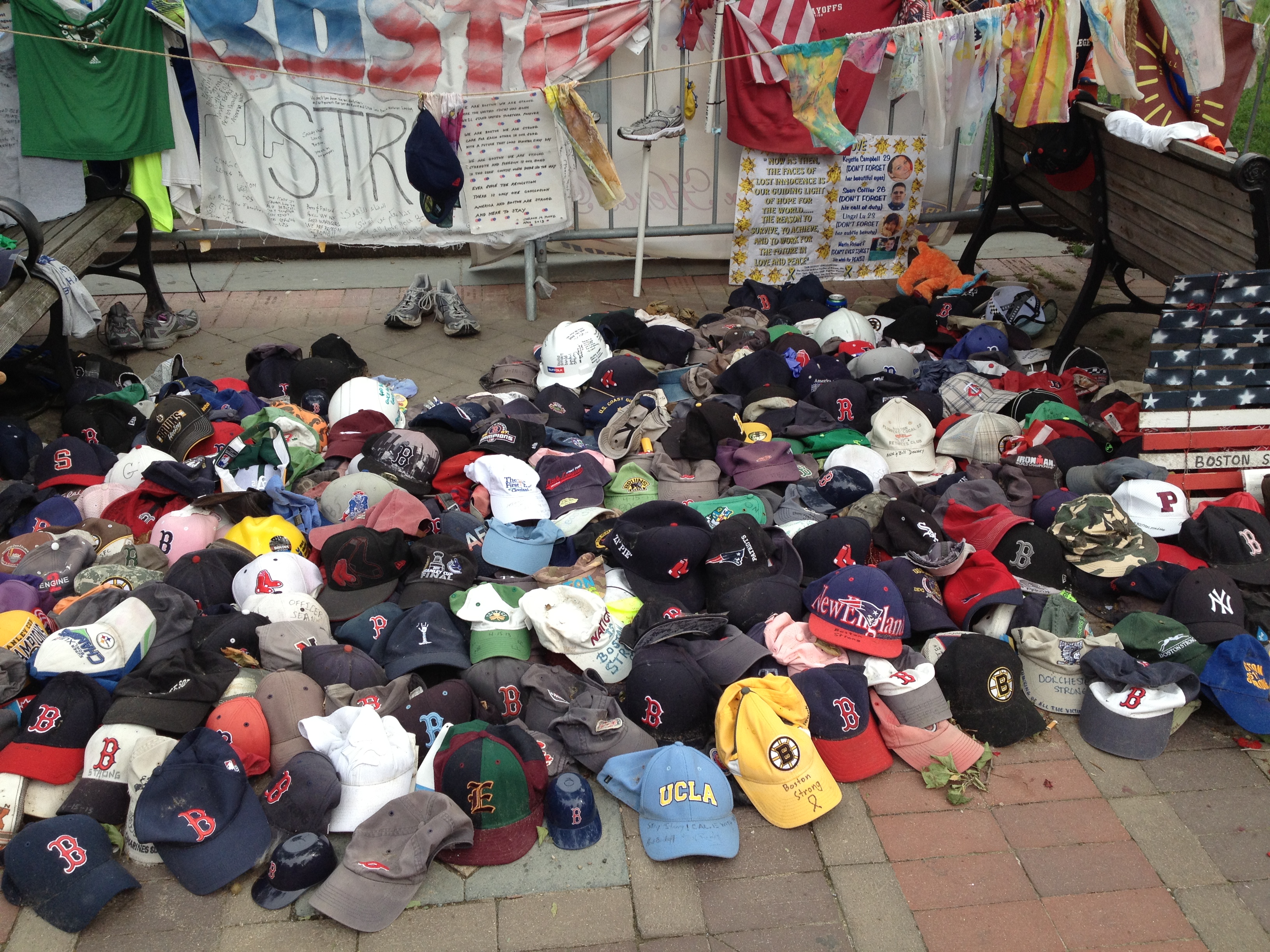 In the time since, I have come around more to Rainy’s argument than my own, though I still worry about questions of authenticity and memorial mediation on the part of the curatorial hand (though, of course, that spontaneous memorial, first on Boylston Street and then at Copley Square was also curated, in part). Nevertheless, I am very much looking forward to Rainy’s exhibit at the main branch of the Boston Public Library on Copley Square. Dear Boston: Messages from the Marathon Memorial opens on 7 April, and will run to 11 May. It is a tri-partite exhibit: the first part will encompass the immediate responses to the bombing, the second will be people’s reflections on the bombs, and the final part will be the hopeful part, messages of hope and healing.
 I appreciate the exhibit’s title perhaps more than anything at this point, as it makes direct references to the curatorial hand at work here, as the exhibit will deliver messages from the memorial. In July last year, I worried about the loss of meaning of the individual artefacts when they were boxed up and stored in the Boston Archives. A running shoe had a very poignant and powerful meaning when displayed at the memorial, and in a box in the archives, it’s a running shoe. Restored to the public eye, however, attached with a symbolic meaning that no one in Boston, or anyone visiting the exhibit, will miss, the shoe regains its poignancy.
What struck me in my discussion with Rainy last summer was how she intended to approach the exhibit, and her sensitivity to the very issues that concerned me. I am very much looking forward to what she comes up with.

 Matthew Barlow