Changes in Griffintown, 2011-2014
February 6, 2014 § 1 Comment
I got an email from Dave Flavell the other day. I’ve known Dave for a few years; he contacted me awhile back for some help on a project he was doing on Griffintown. He was collecting oral histories of the community and its diaspora, with a view towards publishing a book. Last time we talked about it, he said the book was on its way to publication. This email contained photos of Griff, in particular of the Horse Palace on Ottawa street, taken in 2011, 2013, and 2014. The changes are stunning.
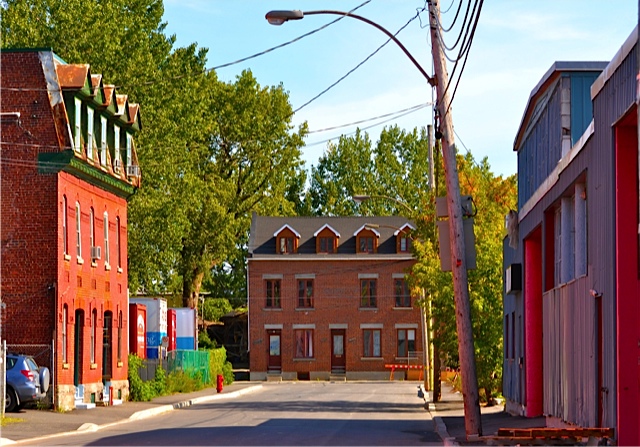
Griffintown Horse Palace, 2011. Photo courtesy of Dave Flavell
In the first photo, we look down Eleanor street at the Horse Palace, built in 1862, standing at the end of the block on Ottawa, surrounded by huge trees. Time was these were amongst the only trees in Griffintown a hundred years ago. The old St. Ann’s Kindergarten is on the left, now the headquarters of King’s Transfer, a moving company that’s been based in the neighbourhood for almost a century. It’s also where I conducted the majority of the oral history interviews for House of the Irish, thanks to the generosity of Bill O’Donell, the president of King’s. In this picture, the Horse Palace looks much as it has for the past thirty-forty years. But a closer look shows that it’s already under transformation. Leo Leonard, the legendary proprietor of the Horse Palace, and his wife Hugeuette, had already sold and moved to a retirement home. Leo, though, did not get much of an opportunity to enjoy retirement, he died in in July 2012 at the age of 87. Already, the building is under renovation, new windows have been put in on the second floor. But the actual stable, which is just out of sight, behind those moving trucks, was still in full working order.

Griffintown Horse Palace, 2013. Photo courtesy of Dave Flavell
The next picture was taken last year. From the exact same spot. Now the Horse Palace residence is dwarfed by an 8-story condo built next door and behind it, fronting on rue de la Montagne. This building was under construction in 2011, but had not yet risen to dwarf the Horse Palace. The Horse Palace building looks tiny and insignificant in the shadow of the condo, which stretches across at least three lots on de la Montagne.
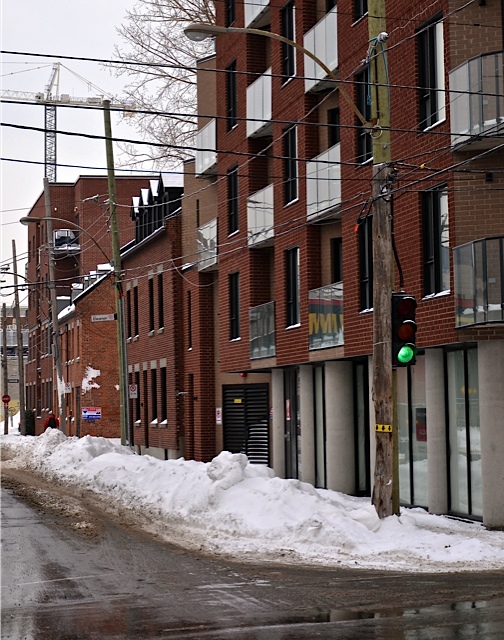
New condo tower and the Griffintown Horse Palace, January 2014. Photo courtesy of Dave Flavell
The final picture was taken a couple of weeks ago, from the corner of Ottawa and de la Montagne, looking east. The shop fronts on Ottawa in the new building remain empty, but looking down the block, after the Horse Palace residence is the old paddock of the stable, which was bought last year by the Ville de Montréal for purposes of turning it into a park to provide access to the actual stables, which the Griffintown Horse Palace Foundation has done yeoman’s work to preserve and save. (Full disclosure: I was a board member of the GHPF from 2008 until I left Montréal in 2012). Continuing on past the paddock, another mid-19th century residence still stands. And then, at the corner of Ottawa and Murray, another, shorter, 4-story condo stands. It was built in 2011. The crane is on the site of Devimco’s massive “District Griffin” development on Peel street.
Even though I have seen this view down Ottawa from de la Montagne, I was still shocked by Dave’s photo. The entire landscape of Griffintown is massively changed. The condo at the corner of de la Montagne and Ottawa is representative of the redevelopment. The streets of Griffintown are narrow, the buildings have always been hard up against the sidewalk. This has contributed to a somewhat claustrophobic atmosphere, at least on those blocks where enough buildings still remain. But these old buildings were 2 floors, at most 3. The stacking of 4, 6, 8, 10-story condos, lining these narrow streets only enhances this claustrophobia. It devastates the urban environment.
The Civil War and the Atlanta Flames
February 5, 2014 § Leave a comment

Atlanta Flames goalie, Daniel Bouchard, c. 1977
Last week, I was watching the Calgary Flames play, I can’t remember who they were playing; I watch a lot of hockey. I’ve never liked the Flames. They were arch rivals of the Vancouver Canucks in the 1980s and, as much as I have never cheered for the Canucks (who wore the ugliest uniforms in NHL history in that era), I never cheered for their rivals either (Edmonton Oilers, Winnipeg Jets, Calgary), with the exception of the Los Angeles Kings. The Flames also committed the venial sin of defeating the Montréal Canadiens for the Stanley Cup in 1989 (to this day, the last time two Canadian teams played for Lord Stanley of Preston’s mug).

Vancouver Canucks road uniforms, 1978-84
The Calgary Flames came into existence in 1980, when the Atlanta Flames packed up shop and moved to the much smaller Canadian city (in a wonderful twist of fate, Atlanta’s next chance at an NHL team, the Thrashers, packed up and moved the much smaller Canadian city of Winnipeg in 2011, where they became the Jets, Version 2.0, the original Jets having moved to Phoenix in 1996, becoming the Coyotes).
When I was a kid, the Atlanta Flames were this team that no one ever thought about. The only real time they entered my consciousness was in 1977 or 1978, when my parents were considering moving from Montréal to Atlanta. We moved to Toronto instead. But, due to the snow storm that hit Atlanta last week and the fact that it was in the news, I was thinking about the old Atlanta Flames whilst watching the Calgary Flames.
I may be slow on the uptake, but the reason why the Atlanta NHL team was called the Flames was a Civil War reference. After Atlanta fell to the Union Army under General William Tecumseh Sherman in July 1864, Sherman, a vindictive sort, ordered the civilian population out, and then proceeded to sack the city old school, by burning it (though he was persuaded to save the city’s churches by Fr. Thomas O’Reilly of the Church of the Immaculate Conception). The city was devastated.

The ruins of the Atlanta rail roundhouse, July 1864

Calgary Flames star Kent Nilsson, c. 1984
When Atlanta was awarded an NHL expansion franchise for the 1972-3 season, Tom Cousins, the owner, chose the name to commemorate the burning of Atlanta. When the Flames relocated to Calgary eight years later, Nelson Skalbania, the new owner, decided to keep the name, thinking it a fitting name for an oil town. The uniforms remained the same, except that the flaming A was replaced by a flaming C.
Matterhorn: Fiction of the Vietnam War
February 4, 2014 § Leave a comment
 Last February, I was back in Vancouver for a visit. I love visiting Vancouver, a city I know well (having grown up there). Everytime I’m back in town, I go to Blackberry Books on Granville Island. I have bought many, many books there over the years. This time when I was in, I got into a long chat with the guy working there about history and fiction (two of my favourite subjects) and he recommended Karl Marlantes’ sprawling Vietnam War book, Matterhorn. It’s an epic novel, telling the story of a young Marine lieutenant, Waino Mellas, and his indoctrination into the jungle war. It takes a long, long time to get going, I must say, but eventually it became engrossing and nearly impossible to put down. The guy at Blackberry Books said that he doesn’t read long fiction anymore, but this book was an exception to his rule. I agree. For some odd reason, probably due to the amount of American history I’ve taught of late, I’ve read a lot of Vietnam War fiction, and Matterhorn is definitely up there with Tim O’Brien’s two works, The Things They Carried and If I Die in A Combat Zone, Box Me Up and Ship Me Home.
Niall Ferguson Almost Gets It Right
February 3, 2014 § 4 Comments
Niall Ferguson likes attention. There’s no other way to explain his public pronouncements. Like when he predicted there’d be blood on the streets of major Western cities in response to the 2008 global economic meltdown. Or when he said John Maynard Keynes was a bad economist because he was gay. Or when he attacked Gandhi in his Civilization: The West and the Rest. Then there’s that book in general, with its incredibly lame attempt to be hip, as Ferguson talked about the West developing “killer apps” that allowed it to dominate the rest of the world. This idea was so bad it detracted from what was actually a decent argument. Ugh. So when I saw that Ferguson had opined to the BBB’s History magazine that Britain should never have entered the First World War in 1914, I was already in mid-eye roll when I realised that Ferguson was actually onto something here.
The BBC article is behind a paywall, but when Ferguson speaks, the media listens and The Guardian published a quick account. Basically, Ferguson says that Britain made “the biggest error in modern history” by entering the war in 1914. He says that Britain could’ve let the Germans, French, and Russians slug it out on the continent, and then dealt with a victorious Germany at a later date, on its own terms. He also notes that had Germany defeated the Russians and French, it would have had the same problems Napoléon had a century earlier, in terms of governing an unruly empire and being behind a British sea blockage. In 1914, Britain was simply not ready for war, especially a land war.
And then he looks at the long-term cost for Britain of the war. It nearly bankrupted the nation, Britain was saddled with debt after 1918. It ultimately cost the British their empire and their status as a major world power (as it also did to France).
There is something to be said for his argument here, but, as usual with a polemicist, he overshoots his mark, taking a claim that might actually be something and then wrapping it up with ridiculousness, like what he did with the unfortunate Civilization. At its core, the Great War was calamitous for Britain, there’s no two ways about that. But Ferguson doesn’t take into account the human cost of the war. An entire generation of young men was destroyed by the war. The costs of that lost generation are immense, in terms of politics, economy, and culture. It also meant a decline in birth rates, so the lost generation had a long-term effect of Britain.
Ferguson does talk about the cost of the war economically, the massive debt the country accumulated, and the fact that this ended up costing Britain its empire. This is where I think Ferguson gets his hackles up, given that he’s the last great defender of the force of civilisation that the British Empire was.
As historians, we are supposed to enjoy the benefit of hindsight, to be able to see the bigger picture that, say, Sir Herbert Asquith, the British Prime Minister in 1914, could not. But we still need to take into account the view from White Hall in August 1914. From Asquith’s point-of-view, Britain was bound by treaty to protect its Allies. Britain was also militarily prepared for war (a point Ferguson dismisses), even if it was the wrong kind of war it anticipated.
Recently, I read a review of three books on the start of the First World War in the Times Literary Supplement. There will be a lot of that this year, since its the centenary of the start of the war. One of the books was written by a journalist, and one with a particular axe to grind, and was full of broad, sweeping statements about the war, the British generals, and politicians. The reviewer took issue with this approach as being ahistorical and anti-intellectual. And while I wouldn’t go that far with Ferguson’s argument, it’s on that route. At least at this point. I hope a book will emerge from this thought, as it would certainly be worth the read.
An Alternative America
January 30, 2014 § 4 Comments
A couple of days ago, an interesting article appeared in the Des Moines Register. I knew of it because my social media friend, and a geographer at Mansfield University in Pennsylvania, Andy Shears, had a map published with the article. Andy’s map is an alternative United States, based on historically proposed states, none of which came into existence. He created the map 2 1/2 years ago for his own blog. The Register also mis-identifies Andy’s map as one of what the country would look like if all the separatist movements in history had actually worked. But, either way, it’s actually a really interesting map, put together in what I image was after agonising research, Andy came up with an alternative United States based on a country of 124 separate states, all based on proposals that never came to be. In the case of Massachusetts, there would actually be two states: Massachusetts and Boston. Of course, anyone who lives outside the Hub, especially in Western Mass, would say there already ARE two Massachusetts. Cascadia, in this version, is a state that straddles the mountains of eastern Washington and Oregon. And then there’s a wonderful little state called Forgottonia carved into what is today the border between Illinois and Missouri, just north of the hypothetical state of St. Louis.

The America That Never Was, map courtesy of AndrewShears.com
But I digress. The column in the Register was written by Steffan Schmidt, a political scientist at Iowa State. In it, Schmidt ruminates on an apparent proposal in California to split the state into six smaller states, based on a proposal from Silicon Valley. Schmidt notes that this would give the general California region 12 senators compared to the 2 it has now, which means that it would have much greater power in Washington. Schmidt, though, seems to assume that the 6 Californias would all elect Democratic senators, which is incredibly unlikely.
Schmidt’s larger point is about the apparent immutability of the United States, that Americans consider the national boundaries to be sacrosanct. He ties that back to the Civil War, just another legacy of that war in American life. But then he goes on to note that countries fracture into newer ones continually, pointing to various examples from Slovakia to Scotland to South Sudan. Interestingly, he does not mention Québec and Canada. But that’s an entirely different kettle of fish (though, interestingly, both Canadians and Quebecers consider their national borders to be sacrosanct). But it is a point well worth considering, at least to a degree.
The difference between, say, Scotland and the United States is simple. Scotland was annexed by England to create Britain in 1707. The United States is comprised of states that all chose to be part of the Union. By that I mean the European settlers of the territory that is now the United States of America all petitioned to Congress to be admitted to the Union. And even if the Confederate States were defeated and then had to be re-admitted to the Union, they also did so willingly (or at least as willingly as they could). In contrast, Scotland was annexed. Slovakia was annexed. We all know how Yugoslavia was formed and what happened when that came apart.
So there is a huge difference between the American model and those Schmidt offers in comparison. Similarly, Canada was formed in a manner very similar to the United States. But Schmidt is correct to note that it is remarkable how resilient the American state has been since 1776. I was recently thinking about this when I saw news that the population shift in the United States, based on recent census data, will make the South and the West stronger politically, at least in the House. This led me to think about my current research, of course (The far right of American politics and history), and I began to wonder if the relative decline of New England and the Northwest in favour of greater power in the South and Southwest would lead to separatist movements throughout the nation. Not that I think they’d ever be successful, any more than I think Québec will ever separate. But it’s fun to have such idle thoughts.
And then I got one of the great classics of punk rock in my head, “Alternative Ulster,” by Belfast punks Stiff Little Fingers. The song dates from 1978, the height of the Troubles, and the Stiffies, two Catholics and two Protestants, simply wanted a different future for themselves.
Bad Journalism: A textbook case
January 29, 2014 § Leave a comment
On Saturday, Montréal’s left-wing, nationalist French-language daily, Le Devoir, published a rather simple-minded article about a series of homophobic attacks that have occurred lately in Montréal’s Gay Village. A series of assaults last weekend came on the heels of several others in Fall 2013. This has left many in the Village feeling unsafe. The Service de police de la Ville de Montréal, not surprisingly, refuse to see a connection between a series of attacks on gay men and homophobia. Plus ça change, I suppose. Amazingly, while people in the village are feeling unsafe, Vincent Richer, the commander of Station 22 in the Village, claims that the neighbourhood is safe and secure.
But then there’s the article. It talks about the fringe characters of the neighbourhood, the ones in shadows, the homeless, the drunks, drug addicts, etc. And then there’s the usual drunken frat boys who like to show off how enlightened they are by heading downtown into the Gay Village to call people names. As an aside, a funny story: back in the day in Vancouver, I was sitting outside at the Fresgo Inn, an all-night greasy spoon in the West End, on Davie St., that’s long since gone. Next door was a café, with all of these big, huge, hot gay men on the patio. A bunch of meatheads started calling them names. It did not end well for the meatheads, they got beaten pretty good for their efforts. And that being Vancouver, the police, after reprimanding the neighbourhood guys for getting violent, arrested the meatheads for creating a disturbance.
Le Devoir also set a team of journalists into the Gay Village one night last week, as if they were heading out into Whitechapel, London, on the trail of Jack the Ripper. Seriously, the article reads like a horrible anthropology paper. But then, as my friend Anna Sheftel pointed out on Facebook, the paper proceeds to insinuate that the hate crimes on gay men is being perpetrated by the homeless, drunks, and drug addicts (the frat boys get forgotten). As if, to paraphrase Anna, all violence is the same, as if all marginalised groups are the same. As she notes, the LGBT community has a disproportionate number of homeless, especially youth, even in a place like the Gay Village.
All in all, this is horrible, bush league journalism from a newspaper that should, and usually does know better.
Happy Black History Month
January 28, 2014 § Leave a comment
I’m an historian. I teach history. I study history. I write history. I even think about it in my spare time. February is Black History Month. In theory, I support this. I support the teaching of Black history. As well as the history of other groups who have been marginalised, oppressed, and written out of history. I remain deeply influenced by the New Left of the 1960s, particularly the work of E.P. Thompson and Eric Hobsbawm. Black history has to be incorporated into the rest of the curriculum, it has to be included in the story at the core. Black History Month is important to raise awareness, but we need to do more than that if we’re ever going to get anything done. African American history is central to the American story, and not just through slavery, the Civil War, and Civil Rights.
I was struck nearly stupid by a post on NPR.org today, “What Does ‘Sold Down the River’ Really Mean?” Seriously. This is considered to be a newsworthy blog post by the leftist, liberal, listener-supported public radio station. The comments on the story on Facebook are predictable in many ways. There are the liberals having pedantic arguments about whether the apocryphal river is the Missouri, Mississippi, or the Niger, whether the provenance of the phrase is American or African. On the actual post on NPR.org,the liberals are arguing about whether or not slavery still exists today in relation to agricultural workers from Central America. But back on Facebook, there are also people claiming that this is race-baiting, or “playing the race card.” Others say that there is no racism in America today. Others say that its racist to even have a Black History Month, because there is no equivalent White History Month. These are the folks who call Women’s Day sexist because there’s no Men’s Day. And then there’s the one who says that this is all ancient history and belongs “up there on the shelf with the other antiques where it belongs.”
Pointing out the history of slavery and the historic oppression of black people in this country is neither race-baiting nor playing the race card. Pointing out that racism still exists today is also not race-baiting or playing the race card. In fact, from my experience, those who make such claims are doing to from a place of racism themselves. As for the one who said that racism and slavery are ancient history and belong up on the shelf with the other antiques, well, the less said about that, the better.
As for the claim that Black History Month is racist because there’s no White History Month. Well, it’s not often I will outright say an idea is stupid. But this is an exception to that rule. The majority of the history we teach, in primary and secondary schools, in university, is about dead white men. Still. In the early 21st century. There is a reason for this, of course, and that’s because most survey history courses are overviews and, at least when it comes to North America and Europe, it is dead white men who were the kings, presidents, advisers, cardinals, popes, explorers, revolutionaries, politicians, and rebels. In short, in the United States, the history curriculum is still overwhelmingly about white people, particularly white men. So the suggestion that Black History Month is racist is ludicrous, ridiculous, and downright stupid.
But, it’s stories like this, and the comments made on them, that point out the real need for Black History Month. We do need to spend some time privileging African American history, if only to draw attention to it. And then to include it in the rest of the curriculum. A high school teacher commented on the Facebook post that slavery IS taught in the schools, and to suggest otherwise is wrong and stupid. Well, yes, it is taught. And then once we get past the Civil War and Reconstruction, black history isn’t generally deal with again until the Civil Rights era, but then that’s it. So, black history appears in relation to slavery, Civil War, Reconstruction, and Civil Rights. In short, when the national story was dominated by issues related to race and African Americans. When race and African Americans aren’t part of the national story, it’s back to the sidelines. I don’ think this is good, it doesn’t create an inclusive history, it is an exclusive history. The same is true of women and other minorities.
This NPR story and the comments to it on Facebook and NPR show that rather than moving towards a post-racial society (hey, remember those dreams in 2008?), we are caught in a stasis, and we need Black History Month now as much as ever.
The Upside to Gentrification?
January 22, 2014 § 7 Comments
I read an interesting article on NPR.org this morning, about gentrification. Based on recent research from Columbia University and the Federal Reserve Bank of Cleveland, gentrification may not entirely suck for low-income people in gentrifying neighbourhoods. The Columbia study looked at displacement in Harlem and across the US, calculating how many low income people moved out of their neighbourhoods when gentrification occurred. Meanwhile, the Federal Reserve Bank looked at the credit scores of low income people in gentrifying neighbourhoods. In the first case, researchers found that people didn’t necessarily move out, in fact, low income earners were no more likely to move out of a gentrifying neighbourhood than a non-gentrifying one. In the case of the Federal Reserve Bank, the credit scores of low income earners actually improved with gentrification of their neighbourhoods.
Not surprisingly, I find these kinds of studies slightly disarming. Lance Freeman, Director of the Urban Planning programme at Columbia, expected to find that displacement was a common occurrence. But he is still cautious to note that gentrification can and does indeed lead to displacement.
Most studies, at least most I have read from a wide variety of disciplines, lay out the reasons for displacement with gentrification: higher housing costs, higher food costs, higher taxes (if they own), amongst others. In my experience of living in gentrifying neighbourhoods, the cost of gentrification is obvious on the street, as the original residents get marginalised as cafés, hipster clothing stores, and yuppy restaurants open. There is no place for them to go, and the coffee shops and bodegas they used to frequent close down. However, it is also obvious that people stay. In part, they are helped by things such as rent control, or dedicated low income housing. And, at least from my own anecdotal evidence, mixed-residential neighbourhoods are certainly friendlier, more community-based, and generally nicer to live in.
Last weekend, there was a story in the Boston Globe about a Southie woman, Maureen Dahill, who ran for State Senate, but lost gloriously, in large part because she supported the right of LGBT groups to march in the St. Patrick’s Day parade. Dahill ran for office in order to attempt to bridge the gulf between “new” and “old” Southie, between the yuppies, artists, and hipsters, and the old Irish. Dahill, a native of South Boston, works in the fashion industry, her husband is a firefighter. In other words, she was the ideal candidate for the role.
What I find interesting, aside from the fact she was trounced in the election, was the discussion in this article about the gulf that exists between the old and the new in Southie. And this is something that is overlooked by quantified research studies such as the Columbia and Federal Reserve Bank ones. However, what they add to the discussion is that there are those who remain, who refuse to leave for a variety of reasons. The job now is to, if not attempt to emulate Dahill’s failed campaign (the Globe notes that from the get go “there were many who didn’t want any part of her bridge-building.” The article doesn’t identify which side of the gulf this resistance came from.
At any rate, it is refreshing to see researchers attempt to explore the myths of gentrification, but I would also caution that we do not need a neo-liberal backlash that leads us to conclude that gentrification is good, it’s the best thing that can happen to us. We must still discuss the human costs of gentrification, we must still fret over the plight of low income earners in neighbourhoods where rents go from $500 to $3,000 a month in short order.
When Selling Out Isn’t Selling Out
January 21, 2014 § 2 Comments
I was sitting on my couch watching football on Sunday and a Nike ad came on. The music was familiar. Then it hit me. It was one of my favourite bands, the Montrealers Suuns. It was their track “2020,” the second song on last year’s excellent album, Images du futur. I was a little stunned. Suuns are, for the most part, pretty obscure, even for a Montréal band, many of whom gained attention just due to the simple fact that they were from the same city as Arcade Fire.
I was a little stunned also because Suuns had sold their music to Nike, a multinational corporation, for advertising. Then I realised the massive generational difference at work here. When I was in my 20s, I would be sickened and appalled at any of my favourite alt.rock banks “selling out” to the adverstising industry. Nirvana wouldn’t have done this. Smashing Pumpkins wouldn’t have done this. But the Dandy Warhols did. In 2001, their track “Bohemian Like You” was used in a Vodafone ad. But, that was easy to discount, the Dandys never attempted to claim any alt.rock or indie rock purity. Life carried on.
But the Black Lips did the same thing with T-Mobile. I wasn’t sure what to think about this one, either.
Earlier this weekend, I was having a conversation with a friend on Facebook about the band Neutral Milk Hotel, and she was commenting how she wished music could still be as honest as this band was. We were also talking about the band makes us nostalgic for the 90s.
But still, it’s one thing for M.I.A. to sell her song to Nissan for a car ad, it’s another thing for Suuns to do it. But, of course, the times they are a-changing. For Suuns to sell their song to Nike only works to increase their exposure, to increase record sales. In her brilliant The Gentrification of the Mind, Sarah Schulman talks about this process. She cut her teeth as an artist on the fringe in New York City in the 80s. But today, she notes, artists are all tied into the matrix. For them, it’s not selling out, it’s just the way it is. Skrillex sells his music. So if The Black Lips and Suuns do so, does it make a difference?
I’m sure if I asked my nieces and nephews what they’d think if one of their favourite bands had sold their music for an ad, they’d shrug their shoulders and think I was out of touch. And so, I guess so. Bully for Suuns for selling “2020.”

 Matthew Barlow