New Project: NCPH’s Off the Wall
July 14, 2010 § Leave a comment
My friend, Cathy Stanton, has begun a new blog, sponsored by the National Council on Public History in the US, called Off the Wall. The aim of the blog is to offer up “critical reviews of history exhibit practice in an age of ubiquitous display.” Cathy has assembled an impressive set of contributors and commentators to facilitate discussion. Since the blog was launched last week, there have been a handful of posts, reviewing events, exhibits, and displays, my favourite being this one on Flick’s “Looking into the Past” project.
I am one of the contributors, though, so far, all I’ve added to the discussion is a single comment. But the discussions that are arising over there are rather central to the study of history in the digital age. History is all around us, and is a central component of pop culture. At Off the Wall, we’re interested in examining how history interacts with pop culture and the public, to examine how history is used (and abused), how usable pasts are created. Or not created, as the case may be.
Enjoy!
Historical Consciousness
July 13, 2010 § Leave a comment
So, I’m reviewing and revising a textbook right now (not mine, I’m just the outside expert). In this textbook, in the Introduction, I have come across the following passage, which I find amusing. I’m not sure I agree entirely with the idea, but it is an intriguing one for someone who lives in Québec and is a citizen of Canada and who studies Irish history:
In essence, reflecting on human reality means reflecting on ourselves, since we are all humans and nothing in the human experience is completely foreign to us. In this sense, history is to groups of people what psychology is to individuals. Imagine an historian talking to his “patient”:
You suffer from a colonization complex, compounded by a repressed rebellion and a weak constitution. I recommend that you go through a major political crisis every ten or fifteen years over the next 100 years. Then you should feel a bit better. But your past will follow you until the end of your days, in one way or another. You’ll be better off if you accept it right away.
The Beast & The Other Hand
July 8, 2010 § Leave a comment
Over at Current Intelligence, I have posted an article on asylum seekers in the UK and Chris Cleave’s recent novel, Little Bee. It has even garnered the attention of the man himself. Check it out.
Vive le Canada!
June 30, 2010 § 1 Comment
Tomorrow, Canada Day, I will be on CJSW radio in Calgary, as part of their new series, “Today in Canadian History“, where I will be talking about the process of Canadian independence between 1848 and 1982. Details below:
Today in Canadian History launches on Canada Day of 2010. Each episode of the series contains an interview with a Canadian professor, journalist, author, or “everyday” historian and focuses on a unique event or moment that took place on that day in Canadian history. To date, the series has received contributions from over sixty individuals from across Canada.
As a podcast and radio series, Today in Canadian History presents Canada’s past in a unique and accessible manner. The series is designed to be a first step to learning more about our past. We would like to remind Canadians not just about what makes our country great, but what makes it complicated, beautiful, diverse, and ours.
How Can I Listen?
Starting on Canada Day, CJSW will be making the audio available on a variety of platforms. You can listen to the episodes:
- Every weekday morning on CJSW 90.9 FM in Calgary and cjsw.com!
- On this webpage (audio will be posted every weekday)
- On our Facebook page (search, “Today in Canadian History”)
- As a podcast (series will be posted in iTunes on Canada Day)
The series is produced by Joe Burima and Marc Affeld. Local jazz musicians Simon Fisk, Steve Fletcher, and Jon May provided original music for the series. Original artwork was provided by Reid Blakley.
____________
For more information, or to get involved in the series, contact Joe Burima at (403) 220 8033, or todayincanadianhistory@cjsw.com
French Culture in Downtown Montréal
June 22, 2010 § Leave a comment
One of the most persistent complaints of the linguistic nationalists of Québec is about the fate of the French language in downtown Montréal. They claim it’s an English centre again, that they can’t get served in their own language anymore. It’s true to a degree, you hear more English in downtown Montréal than anywhere else in the city, but it’s not just because of the old Anglo business class. It’s also because downtown Montréal is where the tourists go, along with the old city. And the tourists, largely Americans, like to be served in their own language. But you want service in French, it’s there.
But there is a creeping Anglicisation going on here, culturally-speaking anyway. The downtown movie theatres don’t show French-language films, and if they do, they’re subtitled in English. There are no French-language bookstores downtown. There is an Indigo, a Chapters, a few Coles, and Paragraphe, which, despite its name, is an English-language store. There was a Renaud-Bray near Concordia University, but it closed a few years back and is now a chicken restaurant. The big Archambault in the old Eatons store is now a clothing store. The French-language music section of HMV downtown is wanting. And French-language DVDs there? Forget about it.
Yesterday, I was on a mission. I wanted to find a québécois film, le 15 fevrier 1839, about the plight of a few Patriote rebels and their execution in prison by the British on 15 February 1839. Anyway, this was a big film when it came out a few years back, caused a lot of controversy. One idiot writing in The Hour even claimed the Patriotes were génocidaires. So, I thought it would be easy to find. HMV doesn’t carry French-language films, though it does have a big section of French-language TV DVDs. The movie store in the Carrefour Industrielle-Alliance, its “Section française” is about 3% of the store. Indigo, forget about it. So I walked to the Renaud-Bray in Place-des-Arts. Nope, its film section is all English-language movies. So, for sure, the big Archambault at the corner of Sainte-Catherine and Berri would have it, correct? Nope. Its film section is also about 95% English-language films. Their québécois section is tiny, and shoved into the back corner of the store.
I don’t get this. Québécois cinema is the only one in Canada that is actually watched. People go to québécois films here, they make money, and so on. But don’t try t0 find québécois films on DVD in downtown Montréal, my friends. Because they’re not there. In the end, I had to go up the rue Saint-Denis to Boîte Noîre to find my film. The Plateau, that is.
Ruminations on the Wisdom of Don DeLillo & the Ruins of Griffintown
May 23, 2010 § 1 Comment
It’s no secret that Don DeLillo is one of my favourite novelists. His novels have a tendency to strike me on several levels, perhaps because the narrative is usually fragmentary and on several levels. And whilst his dialogue is predictable in many ways, based on particular idioms of New York City English, it’s the way DeLillo constructs sentences and thoughts that always leave me digesting his work long after I’ve read, or re-read, it. I oftentimes lose patience with people who say things like “I don’t have time to read fiction” or “I can’t remember the last time I read a novel.” To me, this shows a fundamentally closed mind; novels percolate with ideas, philosophy, and ways of being in the world. Novels allow us to personalise events and history, to re-consider moments in time, to re-consider our own ways of thinking, our own narratives.
Certainly this is true with DeLillo’s novel, Falling Man, about the aftermath of 9/11 in New York City. This is not just a rumination on 9/11, indeed, the terrorist attack is a motif to explore post-modern family life in New York. But it doesn’t have to be New York, and it doesn’t necessarily have to be post-9/11, either. But the novel would lack the punch if it was set in Winnipeg in 1986.
Anyway, the reason I’m writing this is to give thought to the on-going argument between Nina, the mother of the novel’s main female character, Lianne, and Nina’s lover, Martin. Martin, however, isn’t really Martin, he’s a former terrorist himself, named Ernst Hechinger. Nina and Martin/Ernst argue throughout the book, in the presence of Lianne, over the nature of terrorism and the attack on New York. Nina’s argument is hued by the fact that she is a Manhattanite. Martin/Ernst is German. She lacks the critical distance to see the attacks, he lacks the intimacy with Manhattan. Throughout the argument, which is fierce and scares Lianne, they consider God and the motives of the attackers. Nina sees fear on the part of the terrorists, Martin/Ernst sees history and politics.
Nina has just had knee surgery (and is developing a reliance upon painkillers) in the time after the attacks. Indeed, Lianne is stricken at how her mother, in the wake of the surgery, has embraced her old age. This worries Martin somewhat. He wants her to travel again, to go out and see the world, to revitalise herself in the wake of the surgery and the attacks. She is somewhat more reluctant.
Martin: Travel, yes, it’s a thing you ought to consider. Get your knee back to normal and we’ll go. Quite seriously.
Nina: Far away.
Martin: Far away.
Nina: Ruins.
Martin: Ruins.
Nina: We have our own ruins. But I don’t think I want to see them.”
Martin: But that’s why you built the towers, isn’t it? Weren’t the towers built as fantasies of wealth and power that would one day become fantasies of destruction? You build a thing like that so you can see it come down. The provocation is obvious. What other reason would there be to go so high and then to double it, do it twice? It’s a fantasy, so why not do it twice? You are saying, Here it is, bring it down.
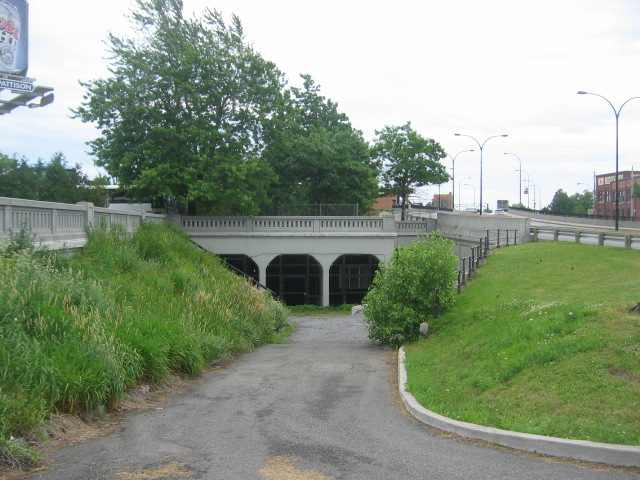
I love this passage, not so much for what it says about NYC and 9/11, but for what it says for cities in general. Ruins are all around us on the urban landscape (or the rural one, for that matter, abandoned homesteads, for example). Ruins tell us the story of what was once here, how we got here, how we might have otherwise been. Ruins tell us powerful stories about destruction, that is true, as Martin is noting. But they also tell us powerful stories about ways of being that have been lost. The ruins of Griffintown are a prime example.
The ruins of the neighbourhood are there for all to see. In Parc St. Anns/Griffintown, on the former site of St. Ann’s Church, the remaining ruins of the church itself, its foundation, as well as foundation stones of the presbytery, the girls’ school, and the dormitory for the crusading priests who came through the Griff on their way to other parts of the world, are all there. There are ruins of factories and warehouses throughout the neighbourhood. Ruins of tenement flats. Palimpsests of advertising for consumer products that are long gone.

Parc St. Ann's/Griffintown
Wellington Tunnel
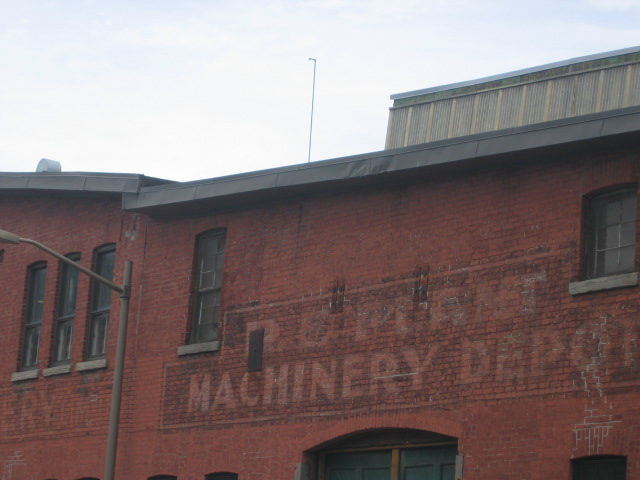
Griffintown Palimpsest
We see this life as it used to be. We consider what once was. How people moved out of Griffintown because of its proximity to all these factories, train yards, and the like. How the flats were cramped and cold, lacking in modern amenities like hot water. Or yards. The neighbourhood, when I began studying it a decade ago, always reminded me of the Talking Heads’ song, “Nothing but Flowers.” Here was the site of the beginnings of the Canadian Industrial Revolution in the 1830s, reclaimed in large part by nature. An inner city neighbourhood sprouting leaves and trees. And grass growing through fractured concrete. Trees growing out of windows of derelict, decrepit buildings. Their floors reclaimed by nature.
The ruins of Griffintown also speak to this power that Martin refers to in the novel. This was a locus of power for Canada, for the British Empire and Commonwealth. Not just the products manufactured there, but the working classes trudging along to work, filling out the army in World Wars I and II. The hulking CN viaduct, not technically a ruin yet, but something close to it, speaks to a time when the railway was king. Indeed, it was built to separate the railway from the roads.
Anyway. DeLillo’s got me thinking about the meanings of the ruins of Griffintown. And what they mean, to the old Irish community that once lived there, to the urban landscape of Montréal today, and to plans to re-develop the neighbourhood in the future.
The Apocalypse is Nigh
May 16, 2010 § Leave a comment
We interrupt regularly scheduled programming here on Spatialities to bring you the following developing news: this weekend, the Théâtre Corona, here in Montréal, held a 2-night tribute to Phil Collins: Dance into the Light: Le Meilleur de Phil Collins. The Phil Collins impersonator is Martin Levac, billed as “the best impersonator of Phil Collins” in the world, and his show spent last spring at Le Capitol in Québec before embarking on a 20-city European tour.
Yes. Phil Collins merits a tribute show. I always thought that in order to merit a tribute, an artist had to be, well, an artist. A Phil Collins tribute. WTF?!?
The Irish & Crime in 19th Century North America
May 4, 2010 § 7 Comments
WordPress lets me see what search terms lead people to this site. Usually, they’re predictable, people searching my name, or Griffintown, or things along those lines. But today, there is this term: “explain the strong association between the 19th century irish diaspora and crime?” So, explain I shall.
Yes, this is a stereotype. But behind this stereotype is some kind of truth. Yes, the Irish, especially Catholics in inner cities, tended to find themselves in trouble with the law in disproportionate fashion in the 19th century. This was particularly true in port cities: Montréal, Saint John (NB), Halifax, Boston, New York, Philly. 19th century sailors were hard-living men. And the consequence of that was an intimate knowledge of the inner workings of police stations in those cities. And, yes, a lot of those sailors were Irish Catholics.
There was also the matter of labour violence. The Irish tended to do the kinds of jobs that no one else would, but they also tended to guard their employment jealously, in that if someone else wanted to do their work (free blacks in the States, French Canadians in Québec), they would protect their right to work. Oftentimes with violence when others threatened to undercut their wages (and the Irish tended to do work on very thin margins to start with).
Connected to this was ethnic/racial violence. For example, the Bowery B’hoys Riot of 1857 in the Five Points of Manhattan, where the Irish Catholics who had recently settled there were attacked by the nativist gang, the Bowery B’hoys. Or in York Point, Saint John, in 1849, when the ultra-Protestant Orange Order insisted on marching through an Irish Catholic neighbourhood on the Glorious 12th. Or more internecine battles in places like Philadelphia between black and Irish workers.
As an aside, this has led to one of the most simplistic arguments I’ve ever come across. Noel Ignatiev, in his overly dramatic How the Irish Became White (in order to “become white,” you have to first be considered something other than “white,” and I’m not convinced that the Irish were ever seen this way), argues that slavery essentially lasted another generation in the United States because the Irish Catholic immigrants to New York and Philadelphia, poor working-class immigrants, I might add, refused to throw their lot in with the free black populations of those 2 cities prior to the US Civil War. Had they, he argues, slavery would’ve ended. So, in essence, Ignatiev argues that the Irish “became white” by siding with the Anglo-Protestant hegemons in the United Sates against the blacks. Of course, to have expected anything different is just, well, simple. Why would the Irish side with the blacks? The blacks were the only other group of people down near the bottom of the socio-econo-cultural totem pole with the Irish. So, obviously, they’re going to try to distance themselves.
Anyway, I digress. Political violence. Well, politics were corrupt in the 19th century, pure and simple, whether it was Tammany Hall in New York, or battles against Anglo-Protestant hegemony in Montréal, corruption was everywhere, and violence was a common tactic by all sides. The Irish got their shots in just like everyone else.
But the most common reason why the Irish found themselves in trouble with the law in North America wasn’t any of this. It was the drink. The Irish were a disproportionate number of public drunks in North American cities, at least in the northeast of the US and Eastern Canada, for much of the 19th century. But, before we get into stereotypes of the Irish and the drink, let us remind ourselves of something else: they were the working-classes, they lived hard lives of unsteady and dodgy employment in the factories, ports, and canals of these cities. Their lives were defined by insecurity, in terms of employment, finances, housing. Inner-cities of Boston, Montréal, New York, Baltimore, in the 19th century were, in many ways, worse than they are today. Housing was worse, social conditions were worse, welfare states were worse. And so, not surprisingly, people tended to distract themselves from their problems with alcohol. And not surprisingly, this means that they ran afoul of the law and ended up getting arrested. And the Irish, well, they were a significant chunk of the urban working-classes in these cities. So, no surprise that they appear so frequently in the crime statistics.
Years ago, I was reading a book by my MA supervisor, Jack Little, about state formation in the Eastern Townships of Québec in the mid-19th century. As the Grand Trunk Railway was being built between Montréal and Portland, ME, in the 1850s, Irish navvies flooded the Townships. A rash of crime broke out along the rail line, and Stipendiary Magistrate Ralph Johnston was dispatched out to Sherbrooke to investigate. The results of his investigation surprised him, and in his report to his bosses in Québec City, he stated that the crime was actually committed by non-Irish Catholic, non-navvies. In short, by locals. And the Irish-Catholics got the blame. “In the eyes of too many,” Johnston wrote, “their crimes are to be Irish and Catholic.”
Yup, racial profiling existed in the 19th century too.
Recent Readings on the Irish Diaspora
April 26, 2010 § Leave a comment
As I continue to read, deepening my knowledge of the Irish diaspora in the United States and Canada, I find I’m struck by the changing trends in the historiography, in particular the fact that this literature IS diasporic and transnational in nature. Ever since Kerby Miller published his landmark Emigrants and Exiles in 1985, historians of the Irish in North America have been encouraged to keep an eye on the Irish context. But, for a long time, this was no more than a cursory glance across the Atlantic Ocean, briefly acknowledging what it was that lead the Irish to leave Ireland in the first place.
But, in the past decade or so, a much deeper understanding of the Irish context has taken root in the literature. Diasporic Irish historians have been caught up in the debates in Irish historiography, the revisionists v. the post-revisionists, but even the older discussion between revisionists and nationalists. And what I’m finding interesting is the influence of these Irish historiographical debates on scholars studying the diaspora. It also seems that it is social scientists, rather than historians, who seem to be caught up in these debates. I suppose for historians, historiographical debates are so internalised in our work, to openly comment on them seems redundant, at least for some of us.
Take, for example, Reginald Byron’s 1999 study, Irish America, an overly ambitious title for a case study approach to the diasporic Irish of Albany, NY. Indeed, part of the chip on Byron’s shoulder is that studies of the Irish in the US have focused on the ethnic enclaves of major cities: New York, Boston, Philadelphia, and Chicago, to the detriment of smaller centres, such as Albany. But then the problem is that Albany itself isn’t all that representative of the larger American context, in that it was a predominately Catholic city, and it, too, is a northeastern city. Anyway. Byron is a cynic of the Irish, which is fine, he argues, ultimately, that symbols of Irishness, most notably St. Patrick’s Day, are no longer Irish in nature, they are American, as the Irish have been fully assimilated into the mainstream of American life. To an extent, I agree. He bases his conclusion on 500 oral interviews with “Albanians,” most of whom were people who are of Irish descent, amongst others (German, English, French Canadian, Italian, so on). What he found is that most of the informants had no special knowledge of Ireland and Irish affairs, and did not live their quotidian lives in the Irish fashion, whatever that is. Fair enough, but when you read into the Irish context he covers, in discussing the historical background as to how Albany became so Irish in the first place, one begins to see the connections.
Byron spends a lot of time attempting to portray Ireland as un nation comme les autres, to borrow from the revisionists of Québec historiography. Indeed, this is the very goal of the Irish revisionists, who seek to downplay many of the more traumatic events in Irish history as a means to normalise its history within the mainstream of Western Europe. The problem with this is that there are things that make Ireland exceptional: it was colonised by its neighbour, its Catholic population was oppressed and disenfranchised by the colonising power. Byron scoffs at the common misconception that the Irish were in permanent rebellion in the 19th century. Again, to some extent, I do agree. However, this ignores the fact that the Irish did rebel in 1798, 1847, 1867, and that there were revolutionary, physical force nationalists operated on Irish soil for most of the 19th century leading up to Irish independence and Partition in 1921. Indeed, the response to the 1798 and 1916 rebellions were particularly draconian on the part of the British colonisers.
Indeed, it was this on-going pattern of rebellion that galvanised the Irish diaspora, especially in Canada and the United States, as nationalist circles were strong in both countries. Indeed, it was the Irish in North America who raised funds for the independence struggle “back home,” even if Ireland was a country many diasporic Irish never saw, and only knew through stories and memories of their ancestors and more recent immigrants.
But this also leads to problems, as evidenced in Paul Darby’s Gaelic Games, Nationalism, and the Irish Diaspora in the United States. Darby, who plays Irish football, occasionally comes off more as a fanboy than a scholar in discussing the trials and tribulations of the Gaelic Athletic Association’s American branches, praising their dedication, hard work, and so on, and not acknowledging the American GAA’s biggest problem: an inability to make itself relevant to the diasporic Irish. The GAA, according to Darby, was incredibly successful within circles of Irish immigrants in the cities he studies: New York, Boston, Chicago, and San Francisco. But the American GAA faded when immigration from Ireland dried up.
At any rate, the larger issue I have with Darby’s work is that he seems to equate the Irish in North America with Irish nationalism, in that the Irish here were all nationalists. No doubt this stems from studying a particularly nationalist organisation as the GAA. But the GAA didn’t speak for all the Irish in North America, even within the contexts of Boston, New York, Chicago, and San Francisco.
Thus, Darby leaves us with a problem that is at the opposite end of the spectrum from Byron. Whereas Byron wishes to downplay the ruptures of Irish history and identity in Albany, NY, Darby seeks to keep those ruptures in his readers’ minds, in order to explain this strong Irish identity amongst his case studies in New York, Boston, Chicago, and San Francisco. Surely there is a common ground between Byron and Darby.
Indeed, my own work, as well as that of many others (Rosalyn Trigger and David Wilson, for example) explore the ambivalences and ambiguities of the Irish in North America. It is too simplistic to say, as Byron does, that they became assimilated into the mainstream of North American culture and politics (if they did, JFK wouldn’t have been identified as an Irish-Catholic American), or to say that the Irish in North America = Irish nationalists, as Darby does.
Urban Archaeology & Material Culture
April 21, 2010 § 1 Comment
Recently, I’ve been thinking about urban archaeology and material culture. Given my research interests, I suppose it’s only natural that I would also think about the actual physical landscape of the city and how it shifts and changes with time, populations, and construction.
Years ago, I visited Montréal’s Pointe-à-Callière Museum, in the Vieux-Port. Point-à-Callière is the site of the first settlement of Ville-Marie, where Paul de Chomedy, Sieur de Maisonneuve decided to plant his new settlement in 1642. The museum itself is based around 3 archaeological digs (Pointe-à-Callière iteslf, as well as Place Royale and Place D’Youville), and artefacts from these archaeological digs are on display. But it’s not just that. In the underground of the museum, down where the digs took place, one can physically see the layers of city and settlement on Pointe-à-Callière, from the initial aboriginal inhabitants through the founding of Ville-Marie, to the governor’s mansion that was once located there, through urbanisation, industrialisation, and so on. The physical remnants of the buildings, and artefacts are there for the viewer to see.
My favourite part is the William sewer, which canalised, and placed underground, the Rivière Petite Saint-Pierre, which itself had become a stinking cesspool as it flowed above ground through what was once the Nazareth Fief (and later Griffintown), into the St. Lawrence, hence creating Pointe-à-Callière. Apparently (at least according to its entry on Wikipedia), the museum has plans to open up and expose the Petite Saint-Pierre, as well as the old location of St. Ann’s Market in Place D’Youville, as well as the remains of the Parliament House of the United Province of Canada, which was burned down in the Rebellion Losses Bill Riot in 1849 (just imagine a riot today in a democracy burning down the house of parliament!).
Anyway, this is where I first thought about urban archaeology, but I never really gave it much more thought in terms of my academic interests until a couple of summers ago, whilst walking along the Canal Lachine, where, at the St. Gabriel locks, Parks Canada has dug up the foundations and remnants of a factory on the northeastern side of the locks.
Andy Riga, over at The Gazette, has an interesting blog, “Metropolitan News;” his latest post is about the public toilets, disused and buried under Place D’Armes. During the reign of Mayor Camillien Houde in the 1930s, partly as a public works project, Vespesiennes were built in Carré Saint-Louis, Square Cabot, amongst other places, and public washrooms were constructed in places including Place D’Armes. The washrooms there were shuttered in 1980, victim of many things, including Montréal’s notoriously crumbling infrastructure. Since then, there have been a few plans or attempts at plans to revive the public toilets, but they are in serious decay and would cost too much money to renovate them, due to years of neglect, water damage, and humidity. So they remain buried under Place D’Armes which, like Dorchester Square downtown, is undergoing a massive renovation.
So notions of what’s underfoot have long interested me as I’ve wandered about the city, but especially in the sud-ouest, Griffintown and Pointe-Saint-Charles, as well as Saint-Henri, where I’ve lived for most of the past decade.
Also, too, there is the influence of Prof. Rhona Richman Kenneally of Concordia University, who encouraged me to give some thought to material culture in approaching my dissertation and my work on Griffintown. Ultimately, as interesting and exciting as I found approaches to material culture in my studies, there was no way to fit it into the dissertation (the same can be said of proper mapping of the Griff). But I remained intrigued by these ideas.
So, with all of this in mind, I finally got my hands on Stephen A. Brighton’s Historical Archaeology of the Irish Diaspora, based around digs in the Five Points of Manhattan and in Newark, New Jersey. Using the archaeological evidence, Brighton constructs an argument centred on the material culture of 19th century Irish-American life in these two urban centres. Using this methodology, Brighton is able to answer a lot of questions we cannot answer using more traditional historical methodologies. Brighton has the remnants of the material culture of the Irish immigrants and Irish-Americans. Finding glasswares with symbols of Irish nationalism on them suggests that the movement had some traction amongst the tenement dwellers of the Five Points.
My favourite part of his analysis, though, comes in relation to medicine. The artefacts from the Five Points come from the 1850s and 60s, whereas those in the New Jersey digs are from the 1880s. In other words, the Five Points Irish were more recent arrivals and lived in greater poverty than those in New Jersey. Thus, their access to the nascent public health system was different than that of their compatriots in Jersey. Brighton found that the Five Points Irish relied more on cure-alls and pseudo-medical tonics to cure what ailed them. Throughout the dig site are bottles that once contained tonics and cures, whereas in New Jersey, the digs uncovered evidence of reputable medicines. This, concludes Brighton, is symptomatic of that poverty but also, too, perhaps of the alienation of mid-19th century Irish immigrants from the mainstream of American culture and society (remember, the 1850s also saw the Know-Nothing movement in the USA and the Bowery B’hoys Riot of 1857).
So what Brighton offers up here is a piece of evidence to support what historians already know from more traditional sources. And this brings me to my problem with Brighton’s book: it doesn’t add much in the way of new information to our historical knowledge. Rather than challenge historians’ traditional takes on the Irish in the Five Points (especially), Brighton confirms what we already knew with the archaeological evidence.

 Matthew Barlow