Griffintown Book Launch
September 19, 2017 § 1 Comment
This Thursday, 21 September 5 à 7, come to my book launch at Hurley’s Irish Pub, 1225, rue Crescent, Montréal. 2nd floor.

#FakeNews, Memes, and US History
September 5, 2017 § Leave a comment
Sometimes I think that memes are going to be the undoing of all of us. They tend towards the stupid. I have written of this before, here and here. This weekend on Facebook, I came across this meme:

And once more we have a stupid meme. The quotation from Lincoln is out of context, and it would appear that Robert E. Lee never said this. Let’s start with Lincoln.
The quotation here comes from a letter he wrote to the prominent New York City abolitionist Horace Greeley, on 22 August 1862. Lincoln wrote to Greeley in response to the latter’s editorial in his influential New York Tribune, calling for the emancipation of the Confederacy’s slaves immediately. Here is the full text of that letter:
Executive Mansion,
Washington, August 22, 1862.Hon. Horace Greeley:
Dear Sir.I have just read yours of the 19th. addressed to myself through the New-York Tribune. If there be in it any statements, or assumptions of fact, which I may know to be erroneous, I do not, now and here, controvert them. If there be in it any inferences which I may believe to be falsely drawn, I do not now and here, argue against them. If there be perceptable in it an impatient and dictatorial tone, I waive it in deference to an old friend, whose heart I have always supposed to be right.
As to the policy I “seem to be pursuing” as you say, I have not meant to leave any one in doubt.
I would save the Union. I would save it the shortest way under the Constitution. The sooner the national authority can be restored; the nearer the Union will be “the Union as it was.” If there be those who would not save the Union, unless they could at the same time save slavery, I do not agree with them. If there be those who would not save the Union unless they could at the same time destroy slavery, I do not agree with them. My paramount object in this struggle is to save the Union, and is not either to save or to destroy slavery. If I could save the Union without freeing any slave I would do it, and if I could save it by freeing all the slaves I would do it; and if I could save it by freeing some and leaving others alone I would also do that. What I do about slavery, and the colored race, I do because I believe it helps to save the Union; and what I forbear, I forbear because I do not believe it would help to save the Union. I shall do less whenever I shall believe what I am doing hurts the cause, and I shall do more whenever I shall believe doing more will help the cause. I shall try to correct errors when shown to be errors; and I shall adopt new views so fast as they shall appear to be true views.
I have here stated my purpose according to my view of official duty; and I intend no modification of my oft-expressed personal wish that all men every where could be free.
Yours,
A. Lincoln.
In other words, for Lincoln, his primary duty was to uphold the Union. And, as any American historian will tell you, every action he took during his presidency was directed at exactly that goal. Slavery was not an issue for the Union, it was not why it went to war. That, of course, changed on 1 January 1863 when Lincoln’s Emancipation Proclamation came into effect.
As for Robert E. Lee, there is no evidence whatsoever he said this. It is most likely that this fake quote is a mangling of something he did say or write, but I even have my doubts about that.
Lee, of course, was the the Commander of the Army of Northern Virginia for the Confederate States of America, a failed statelet that existed from 1861-65. During its short lifespan, the CSA did not gain the official recognition of any other state. And it ended with the massive defeat of the Confederacy’s army. At any rate, Lee fought to preserve slavery. Full stop.
Slavery was the primary reason for the secession for each and every of the Confederate states. It was also the primary reason for the existence of the Confederacy. Not states’ rights. Not taxation. Slavery. And this was what Robert E. Lee fought to preserve.
So even IF this line from Lincoln could be extrapolated to mean something, and even IF Robert E. Lee said what this meme claims, it is irrelevant. One man ultimately ended slavery, the other fought to preserve it.
But, the meme is not correct. It is FAKE NEWS.
Remembering Zmievskaya Balka
August 11, 2017 § Leave a comment
Today marks the 75th anniversary of the massacre at Zmievskaya Balka, a ravine in Rostov-on-Don, Russia. The literal meaning of Zmievskaya Balka is ‘ravine of snakes.’ It was here on 11-12 August 1942 that the Jewish men of Rostov were marched out to the ravine, just outside the city, and shot. The women, children, and the aged of the Jewish population were gassed, and their bodies dumped at Zmievskaya Balka. Communists and some Red Army soldiers met the same fate, along with their family. All told, 27,000 people were massacred. At least 20,000 of them were Jewish.
This massacre is one of the forgotten ones of World War II and the Nazis. My guess is no one reading this post will have ever heard of it. Soviet and Russian authorities have done their best to make sure the massacre, or at least the Jewish fact of it, is forgotten due to the on-going anti-Semitism of the state.
In 2004, activists managed to get a memorial plaque erected that identified one of the massacre sites and noted the Jewishness of the victims. In 2011, approaching the 70th anniversary of the massacre, this plaque was removed. It was replaced with a more banal commemoration of the “peaceful citizens of Rostov-On-Don and Soviet Prisoners of War.” This erases the primary act of the Nazis in Rostov 75 years ago: the eradication of the city’s Jewish population. And, it obscures the Nazis murderous anti-Semitism.
This morning, organizers held a march to the sites of the massacre in Rostov, to remember this brutal massacre. We owe it to them to hold the memory of these victims in our
Harm Reduction in Drug Addiction
August 4, 2017 § Leave a comment
The opioid crisis that has taken root across North America exposes several ugly truths. The first is racial. The use of drugs is treated differently in the United States, depending on the race of the victims of addiction. When they are African American and/or Latinx, they are criminalized. But when it is white people using drugs, it becomes a crisis. To a degree. The important disclaimer here is class. When poor white people are using, it remains a criminal issue. But when middle- or upper- class white people are using, it becomes a public health issue. Thus, this is the second truth: class.
I think of all the jokes I have heard about ‘white trash’ and meth labs in trailer homes since I moved to the South. But, on the flip side, there is the criminalization and demonization of poor white people, and nearly all African American and Latinx drug addicts. Addiction, I remind, is a public health issue. Addiction is a question of psychology. It is not a matter of criminality.
Addiction is something very real in my world. It is something I grew up with in my family. When I was a university student in Vancouver in the early-to-mid-90s, the city was in the midst of a heroin epidemic. Walking through the fringes of the Downtown Eastside one afternoon, I passed the back alley on Carrall St., between East Hastings and East Pender, and saw a young woman, around my age, with a needle in her arm, foaming at the mouth and her fingertips going blue. There was no one around. And she was dying. I went into the alley, she was unresponsive, and her pulse was very faint. There was no one around. No police, no other pedestrians on Carrall St. All the doors in the back alley were closed, some of them barred from the outside. There was no one looking out the windows onto the alley. She was completely alone. And then she died. I don’t know how many people died in Vancouver of heroin overdoses in 1997. But I know she was someone’s daughter, sister, grand-daughter, girlfriend. I did find a police patrol on East Pender about two blocks away, and I told them. I told them everything I saw. I was very shaken, of course. I went home, they went to the back alley to deal with her body.
Vancouver is the site of a long-term heroin crisis. This crisis has been made worse by the addition of fetanyl to nearly every drug on the market on the West Coast. My mother is an addictions counsellor in Vancouver. Every time I talk to her, she says that her recovery centre has lost 2, 3, 4, 5, or more, guys in the past week or however long it has been since I last talked to her. Nonetheless, at least Vancouver has engaged in harm-reduction, which at the very least, makes it safer for heroin addicts, in terms of needle exchanges and safe-places for injection.
Vancouver is home to the only heroin-injection clinic in North America. It has been in operation for eight years now, operates at capacity (130 people, only a fraction of the addicts on the streets of the Downtown Eastside of the city), and is controversial, not surprisingly. In 2013, the then-Health Minister, Rona Ambrose, tried to shut it down, claiming that it enabled addicts. But it survived.
In Gloucester, Massachusetts, a sea-side town about an hour north of Boston, police there decided to begin treating the opioid crisis as a public health issue in May 2015. Police Chief Leonard Campanello notes, as many others have, that there has been a failure to stem the flow of illegal drugs into the country (be it Canada or the US), and that, ultimately, we have lost the war on drugs. Campanello thinks, rather, that it’s a war on addiction.
The important thing to note in both Vancouver and Gloucester is that the police and other agencies there treat addicts as human beings in crisis. And they treat all addicts as such, class and race are not part of the calculus. And Vancouver and Gloucester are just two examples of many across both the United States and Canada where jurisdictions have sought to treat addiction as a public health issue in order to engage in harm reduction.
Last month, in Philadelphia, news broke that the staff at the public library branch on McPherson Square in the Kensington neighbourhood had become first-line responders to heroin overdoses in the park. Several times a day, librarians were rushing out to administer Narcan to people overdosing. Volunteers scoured the park daily for used needles and other paraphernalia of addiction. Librarians referred to the addicts out in the park as ‘drug tourists,’ as Philadelphia, as a port city, has a particularly pure form of heroin on its streets.
But, within a couple of weeks, McPherson Square was nearly devoid of addicts. The police had descended onto the park and pushed them away. Thus, the addicts were back in the shadows, living and shooting up in abandoned homes, in back alleys, hiding in the dark corners of the city. And while some community organizations continued their work of trying to help the addicts, it appears that the police in Philadelphia have not turned to a new model, but, rather, to the old model of scaring off drug addicts, criminalizing them and sending them into the shadows.
I don’t think there is anything new or revelatory in what I’ve said here. Drug addiction is a public health crisis, first and foremost. Harm reduction in locations like Vancouver and Gloucester have made a difference, they have made positive changes in addicts’ lives, including saving lives and getting people off the streets. And harm reduction programmes have got addicts into rehab and off drugs entirely. The criminalization of drug addicts does not have such results.
More to the point, society’s response to drug addiction amongst marginal populations (poor white people) and ethnic and racial minorities (marginalized in their own ways) speaks to how we see some people as disposable. The morality of such a view is beyond my comprehension, it is something I just fundamentally do not understand.
The History of White People
August 2, 2017 § 4 Comments
I am reading Nell Irvin Painter’s The History of White People. For those who don’t know, Painter is Professor Emeritus of History at Princeton University. She is, in academic parlance, a heavyweight. This might be one of the most frustrating books I have ever read. Not for its content argument and its basic argument, which is to trace the history of ‘whiteness’ as a social construct in American society, stretching back to the Greeks. Rather, it is frustrating for a certain sloppiness and factual inaccuracy that dogs the book.

Part of what we base our reputation and claims to authority on, as historians, is our attention to detail and our attempts to make sure we remain factually correct.
To wit, only seven pages in, in discussing the great Greek historian, Herodotus, Painter writes:
Herodotus’ world is still flat — that notion would stand for another thousand years.
She is correct, Herodotus did believe the world was flat. So, too, did, amongst others, Homer. But, for many Greek philosophers (to the Greeks, philosophy and science was the same thing), the world was anything but flat. Pythagoras (he of the theorem) was amongst many Greek thinkers who believed in a spherical Earth. Plato believed the world was spherical. So, too, did Aristotle. Eratosthenes, around 240, attempted to estimate the Earth’s circumference. He did this without any modern tools, of course, and though he was wrong in his estimation, he was only off by around 10%. The great Ptolemy thought the Earth spherical. So, too, did the Romans. Even the early Christian Church believed in the spherical nature of the Earth. Indeed, the belief in a spherical Earth lasted into the Middle Ages and beyond. Stephen Jay Gould argued that the belief in a flat Earth was non-existant amongst the educated classes of Medieval Europe. So, clearly, Herodotus’ error in the belief in a flat Earth did not stand for another thousand years.
Other anachronisms abound. For example, she discusses Samuel Stanhope Smith’s views on race during his academic career in late 18th and early 19th centuries. And while, when introducing him as the president of the College of New Jersey, she notes that said college is now Princeton University, on the very next page, she calls Smith the President of Princeton. He was not. Princeton did not exist until 1896, until then, it was the College of New Jersey.
And then there is a long discussion of the works of Gustave de Beaumont, a French lawyer, more famous for his fiction and quasi-sociological studies of the United States and Ireland. Beaumont is even more famous for being the second fiddle to Alexis de Tocqueville. Beaumont and Tocqueville were life-long friends and Beaumont accompanied Tocqueville on his famous tour of the United States that led to his legendary Democracy in America. In fact, Beaumont published his own work, a novel, that examined that which Tocqueville did not, race in America. But, his Marie, or Slavery in the United States, a Picture of American Manners, while it won the Prix Montyon of the Académie Française, quickly faded from view. Following their tour of the United States, the two French gentlemen made their way to Ireland, and were rather shocked by the wretchedness of the Irish peasants.
But here, Painter engages in some very sloppy and lazy historical accounting. The Irish Famine was from 1845-52. During the Famine, any number of ‘journalists’ headed out from London and other English cities to the Irish countryside, to see the conditions of the starving nation first-hand. Painter is correct to suggest many of these journalists thought the news reports sensationalized. They discovered they were not. But, she conflates, for example, Thomas Carlyle toured Ireland in 1849, two years after the worst of the Famine in 1847, but in the midst of the Famine. Painter conflates the trip of Beaumont and Tocqueville a decade earlier, before the Famine. She also goes on about the Famine conditions Beaumont saw and wrote about. Except, of course, he was in Ireland six years prior to the Famine.
She also, I should add, claims that the Irish were slaves in North America. That is the subject of another post, at an another time.
This is nothing but sloppy and lazy scholarship. Painter is flat-out wrong in her characterizations of views of the shape of the Earth and Beaumont’s journey to Ireland vis-à-vis the Famine. She severely mis-characterizes what Smith was president of. Errors like this should cause the reader to stop and question the author. Is the author to be trusted? How could she make such lazy mistakes?
And this is most unfortunate. Because The History of White People is a fascinating read for the very fact that Painter historocizes and problematizes whiteness as a category. Anyone who knows anything about race and science knows that race is social, not scientific construct, and yet it still dominates our society. So, quite frankly, unpacking the constructions of whiteness in the US is an important historical, sociological, and political act. I would say that this is a book that everyone should read, but such egregious errors with historical fact makes me hesitant.
Equalization Payments in Canada
July 31, 2017 § Leave a comment
Over the weekend on Twitter, I was caught up in a discussion with an Albertan who didn’t believe that the province, along with British Columbia, is forecast to lead Canada in economic growth.
She argued that the province is still hurting, that big American gas companies had pulled out, and that people were leaving Alberta. Indeed, in June, Alberta’s unemployment rate was 7.4%, but even then, that was an improvement of 0.4% from May. But, economic growth does not mean that one can necessarily see the signs of a booming economy. Alberta’s economy, however, shows signs of recovery, and this 2.9% economic growth, as well as a decline in unemployment rates, shows that.
She also expressed a pretty common bitterness from Albertans about Equalization payments in Canada. These payments might be the most mis-understood aspect of Canadian federalism. The common belief in Alberta, which is usually a ‘have’ province (meaning it doesn’t receive equalization payments), is that its money, from oil and gas and everything else, is taken from it and given to the ‘have-not’ provinces (those who receive equalization payments). This is made all the more galling to Albertans because Quebec is the greatest recipient of equalization payments.
This argument, though, is based on a fundamental mis-understanding of how equalization payments work in Canada. Equalization payments date back to Canadian Confederation in 1867, as most taxation powers accrued to the federal government. The formal system of equalization payments dates from 1957, largely to help the Atlantic provinces. At that time, the two wealthiest provinces, Ontario and British Columbia, were the only two ‘have’ provinces. And this formal system was enshrined in the Constitution in 1982. Section 36, subsection (2) of the Constitution Act reads:
Parliament and the government of Canada are committed to the principle of making equalization payments to ensure that provincial governments have sufficient revenues to provide reasonably comparable levels of public services at reasonably comparable levels of taxation.
The general idea behind equalization payments is, of course, that there are economic disparities across the nation. There is any number of reasons for these disparities, which are calculated on a provincial level. These can include the geographic size of a province, population, the physical geography, or economic activity.
Quebec is a traditional ‘have not’, which seems incongruous with the size and economy of the province. Montreal, after a generation-long economic decline from the late 1960s to the mid 1990s, has more or less recovered. If Quebec were a nation of its own (as separatists desire), it would be the 44th largest economy in the world, just behind Norway. It contributes 19.65% of Canada’s GDP. But Quebec’s economy is marked by massive inequalities. This is true in terms of Montreal versus much of the rest of the province. But it is also true within Montreal itself. Montreal is home to both the richest neighbourhood in the nation, as well as two of the poorest. Westmount has a median family income of $220,578. But Downtown Montreal ($32,841) and Parc Ex ($34,211) are the fourth and fifth poorest, respectively, in Canada.
The formula by which equalization payments are made is based on averages across the country. Here, we’re talking about taxation rates and revenue-generation, based on the national averages of Canada. Provinces that fall below these averages are ‘have not’ provinces. Those who fall above it are ‘have’ provinces. The three wealthiest provinces are usually Ontario, British Columbia, and Alberta. But all three of these provinces have fallen into ‘have not’ status at various points. In 2017-18, in order of amounts received, the have-nots are: Quebec, Manitoba, Nova Scotia, New Brunswick, Ontario, and Prince Edward Island. Quebec, it should be noted, will receive more than the other ‘have-nots’ combined. The ‘have’ provinces this year are Alberta, British Columbia, Newfoundland & Labrador, and Saskatchewan.
The equalization payments, though, are not a case of taking money from Alberta to pay for Quebec’s social programs. The funds are not based on how much one province pays for its health care system, or for a universal child care system, or cheap tuition at the province’s universities (Quebec has both universal child care and cheap tuition for in-province students). Rather, the funds come out of the same general revenue stream that Ottawa has to fund ALL of its programmes and services. And, each and every Canadian contributes to this revenue stream. Thus, the fine people of Westmount contribute more to equalization payments (and general revenue) than the middle-class residents of suburban Calgary, or a person in a lower income bracket in Saskatchewan. And, because there are more Quebecers than there are Albertans, Quebec actually contributes more to the equalization payment scheme.
It is not just angry Albertans who believe they are getting hosed by the federal government. Many Quebecers will rail against their province’s funding priorities and point to the province’s status as a ‘have not’ as to why it should not have these programmes. Both positions are factually wrong, and based on a fundamental misunderstanding of Canada’s equalization payments.
Montréal: En construction
July 25, 2017 § 2 Comments
The running joke in Montreal is that a traffic cone should be our municipal symbol. From May to November or so annually, the streets of the metropole are a sea of traffic cones as workers frantically try to patch up roads thrashed by winter, and occasionally build something new. And annually, Montrealers kvetch about construction. As if it didn’t happen last summer and won’t happen next summer.

I was home last week, and it was the usual. Actually it’s beyond the usual. The city is awash in the orange beacons. Roads are dug up everywhere. But, something else occurred to me. This is not the status quo, this is not business as usual for my city. Instead, this is something new. This year, 2017, marks the 375th anniversary of the founding of the city in 1642. It is also Canada’s 150th anniversary since Confederation in 1867. This means that Montreal is seeing an infrastructural (re-)construction not seen since the late 1960s, in conjunction with Expo ’67, on Canada’s 100th anniversary. That boon saw the highway complex around the city built, as well as the Pont Champlain. Montreal also got its wonderful métro system out of that. But this infrastructural boom coincided with deindustrialization and the decline of the urban core of the city. Thus, what looked beautiful and shiny in 1967 had, by 2007, become decrepit and dodgy. There was no money for proper upkeep, so things were patched together.
Take, for example, the Turcot Interchange in the west end of the city. Chunks of concrete fell off it regularly, so there were these rather dodgy looking repair patches all over it. The Pont Champlain had outlived its expected lifespan of about 50 years. And the métro. Wow. While the trains still ran on time, more or less, and regularly, they were ancient.
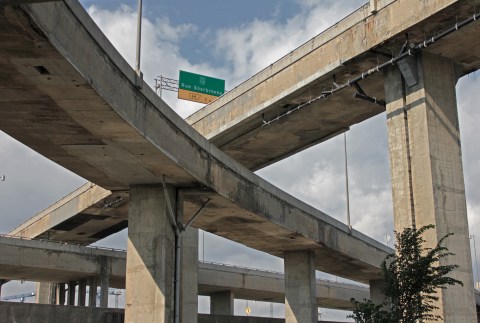
The old Turcot Exchange. The different colourations of the concrete indicates patch work concrete, except, of course, for the rust and discolourations from water/ice.
But now, all this money is being showered on the city. The Turcot is being taken down and replaced with a level interchange. Work is on-going 24/7 on this. The old McGill University Health Centre (MUHC), which had been jerry rigged in a collection of century old buildings on avenue des Pins on the side of Mont-Royal, has a beautiful new campus on the location of the old Glen Rail Yards in NDG. The Pont Champlain is being replaced. Meanwhile, on the ride downtown on the Autoroute Bonaventure, on the A20 from the airport, one will find access to the downtown core blocked. The Bonaventure, a raised highway that bisects Griffintown (buy my book!) is being knocked down to be replaced with an urban boulevard. And while I am not entirely clear what the plans are for the Autoroute Ville-Marie under the downtown core, construction continues apace there. Meanwhile, the Société de transport de Montréal has new cars on the métro! At least on the Orange line. And, while they don’t actually feel air conditioned, they do have an effective air circulation system that, if you’ve ever experienced Montreal in the summer, you will appreciate.

Montreal’s new métro cars
So, for once, Montreal is not just being patched up. It is being rebuilt. For once, the powers-that-be have planned for the future of the city. And one day, who knows when, the city will be radically rebuilt and will have perhaps the most modern infrastructure in Canada, if not North America.
Go figure. No longer is my city a dilapidated, crumbling metropolis.
Land & The Indigenous Population
June 21, 2017 § 3 Comments
Today is National Aboriginal Day in Canada. The point of this day is to recognize the contribution of the indigenous population to Canada, as well as to reflect on the cost of imperialism and Canada’s systemic attempts to remove the indigenous population from the national landscape. In Canada, it wasn’t as straight-forward as in the United States, where the government of President U.S. Grant and his successors used the US Army to clear the indigenous population off the Great Plains (and, of course, there’s Andrew Jackson’s Trail of Tears in the Southeast in the 1830s). In Canada, outright violence was relatively rare, though it did occur. Germs and disease did a lot of the work, to be fair. As did European expansion across the continent, which affected migration patterns, and populations, of the wild life the indigenous population depended upon. And then there were assimilative techniques, designed to make the indigenous population into good (white) Canadians. The basic legislation covering the government’s interaction with the indigenes, the Indian Act, is the base line here. But then there were things like the residential schools, a horror in and of their own right.
In short, Canada has historically abused and committed violence upon the indigenous population. And it’s not like it’s got any better in recent times.
Prime Minister Justin Trudeau came into office in 2015 on the promise of fixing all the ills of Canada’s toxic relationship with the First Nations. This was in the wake of the Idle No More movement that began in 2012. But Trudeau hasn’t really delivered (yet, I remain optimistic), other than an inquiry into the Murdered and Missing Indigenous Women. But even that seems in danger. More recently, Tragically Hip frontman, Gordon Downie, has become an ally of this movement. So, for better or worse, the issue of indigenous history and indigenous rights is, at the least, on the national radar.
But twice in the past week, I have been told on social media that the indigenous population didn’t hold land in the way we conceive of land-holding and therefore, their claims to any land in Canada is null and void. In short, as one interlocutor on Twitter said, ‘The Indians got conquered, they’re done.’ Another says that Canada was not founded by the indigenous population.
This reflects a story I read in the New York Times over the weekend about an élitist fishing lodge in Northern Quebec that is on unceded Innu territory. There, a group of Innu delivered a proclamation to the manager of the fishing lodge that, amongst other things, demanded the land be handed back. The Innu are essentially calling for Quebec to re-acquire this land along the Moisie River and give it back to them. They will then grant usage to the owners of this fishing lodge, wealthy Americans all of them. The president of the lodge, though, Donald C. Christ, a former partner at a prestigious New York law firm, however, states that, “‘I don’t think it will bring about any changes,’ he said. ‘There are many places in Canada where people are trying to undo history.'”
And this, I think, gets to the crux of the problem. Canada as the nation we know it now is based primarily on British common law and European notions of property ownership. Essentially, de Champlain, Cartier, et al. planted the French flag on the territory that became Canada and said this land now belonged to the King of France. Other territories were claimed via the British in a similar manner. And, of course, the French ceded their interest in the land after the Conquest in 1760. But, essentially, this argument states that history begins with the claiming of this land for European kings in the 16th-17th centuries. Prior to that, there was no history of the land, legally speaking.
In essence, then, the land that comprises Canada now was obtained via sleight-of-hand and imperialism, as a foreign system of land ownership was instantly enforced, one that was incomprehensible to the indigenous population. Not because of language barriers, though those existed, but due to cultural frameworks.
But the problem with this argument is that it’s wrong. In 1763, following the conquest of the French territories of New France, Great Britain suddenly controlled the Eastern seaboard and the interior of North America as far west as the Mississippi. And there were ongoing tensions in the Thirteen Colonies concerning land in the western expanses of the colonies. Thus, King George III issued the Royal Proclamation of 1763. Amongst other things, the Proclamation declares that the Crown must negotiate and arrange the sale of indigenous lands, through treaties, before it could be settled by Europeans.
In other words, George III recognized the sovereignty of the indigenous population of his territories in North America vis-à-vis the land. And, essentially, this extended to the point of contact between the indigenes and the British, at that moment, the land was recognized to be in the possession of the indigenous population.
Thus, in some parts of what is now Canada, treaties were struck between the Crown and the indigenous nations. Most famous of these are the so-called Numbered Treaties, that cover most of the land between Ontario and northeastern British Columbia. To call these fair trades, however, is a misnomer. The terms of treaty were usually imposed by the Crown (in right of Britain or the UK prior to 1867, and Canada after 1867). The First Nations had only so much room to negotiate better terms for themselves. And even after the treaties, Canada continued to whittle down indigenous land via land surrenders, some of them obtained through nefarious means.
In other parts of Canada, most notably the bulk of British Columbia, there are no treaties. The Royal Proclamation was, in essence, ignored. Thus, the Crown in Right of Canada, and the Crown in Right of British Columbia have, since the early 1990s, been engaged in a glacial-paced set of treaty negotiations with the First Nations of that province to settle land claim issues there.
At any rate, the claim that the advent of Canada negated the indigenous claim to the lands that now comprise the nation is fallacious. And unlike what Christ, the American lawyer seems to think, this is not the undoing of history. It is facing up to history and Canada’s imperialist past.

 Matthew Barlow