Remembering the Montreal Massacre
December 6, 2016 § 2 Comments
Today is the 27th anniversary of the École Polytechnique Massacre, also known as the Montreal Massacre. On this morning, 6 December, in 1989, an armed gunman walked into the École Polytechnique, separated the men from the women, and shot 28 people, executing 14 female students. Why? Because they were women and he felt that feminists had ruined his life. As per usual, I refuse to name him. He should be forgotten, he does not deserve infamy (he killed himself at the scene). His suicide letter contained the names of 19 other Quebec feminists he wished to kill.
For Canadians of my generation, the Massacre was and remains deeply shocking. It resonates. I remember where I was when I heard the news, I remember the shock I felt, and then the anger. I grew up in a violent household, my mother the target of my step-father during drunken outbursts. His violence appalled me. All violence against women appalls me. Deeply.
And here we are, 27 years on, and violence against women is still prevalent. For this reason, name and remember the victims of the Massacre in Montreal 27 years ago, to honour them. May they continue to rest in peace:
- Geneviève Bergeron (born 1968), civil engineering student, age 21.
- Hélène Colgan (born 1966), mechanical engineering student, age 23.
- Nathalie Croteau (born 1966), mechanical engineering student, age 23.
- Barbara Daigneault (born 1967), mechanical engineering student, age 22.
- Anne-Marie Edward (born 1968), chemical engineering student, age 21.
- Maud Haviernick (born 1960), materials engineering student, age 29.
- Maryse Laganière (born 1964), budget clerk in the École Polytechnique’s finance department, age 25.
- Maryse Leclair (born 1966), materials engineering student, age 23.
- Anne-Marie Lemay (born 1967), mechanical engineering student, age 22.
- Sonia Pelletier (born 1961), mechanical engineering student, age 28.
- Michèle Richard (born 1968), materials engineering student, age 21.
- Annie St-Arneault (born 1966), mechanical engineering student, age 23.
- Annie Turcotte (born 1969), materials engineering student age 20.
- Barbara Klucznik-Widajewicz (born 1958), nursing student, age 31.
The Centre Of The Universe?
December 2, 2016 § 2 Comments
An interesting thing has occurred in the realm of Canadian sports journalism in the past few weeks. For those of you who don’t know, the English-language Canadian media is centred in Toronto, which every media outlet will remind you is “Canada’s largest city.” The much smaller French-language media is centred in Montréal, which is Canada’s second largest city. Toronto’s got a population of around 4.7 million, compared to Montréal’s 3.8 million. Vancouver is third, closing in on 2 million. And Edmonton, Calgary, and Ottawa are all around 1 million. So we’re not looking at the situation in the UK, where London is the largest city and about 5 times larger than the second city, Birmingham.
But, reading Canadian sports media these days, and you’d be convinced that Toronto is the only city in Canada and that its sports teams are all wondrous, virtuous conquering heroes. Never mind the fact that Toronto teams don’t really win much of anything ever. The basketball Raptors and soccer Toronto FC have never won anything. The hockey Maple Leafs last won the Stanley Cup in 1967. And the Blue Jays last won in 1993. The Argonauts of the Canadian Football League are the really the only continually successful Toronto sports team, having last won the Grey Cup in 2012 (but, the CFL is a 9-team league, so law of averages…).
Toronto FC was engaged in a tense two-leg Eastern Conference final in the MLS Cup Playoffs against the Impact de Montréal, or IMFC. An all-Canadian conference final should be one of those things that grip the nation, or at least get the media to recognize its import. And while Sportsnet, the second of Canada’s sports networks, largely has, TSN, the largest sports network and MLS rights holder, has not. It has openly and blatantly cheered for a TFC victory, and its coverage has exclusively treated IMFC as an interloper in TFC’s eventual, wondrous assent to the top of the North American soccer world. On Wednesday afternoon, in advance of the second leg of the series, to be played at BMO Field in Toronto, TSN posted this article about the five keys to the match as its headline on TSN.ca. Note that it’s all about what TFC needs to do to win. This is just the most egregious example. The rest of the coverage on TSN.ca Wednesday afternoon was all slanted towards TFC: its mindset heading into the match, which players it needs to excel, and so on. Not a word from IMFC’s perspective, except for a feel-good story about the club’s 38-year old captain, and Montréal native, Patrice Bernier.
In the aftermath of the TFC’s victory Wednesday night, in a tense 5-2 match that went to Extra Time, allowing TFC to advance 7-5 on aggregate, TSN’s homepage was a torrent of TFC. And while this is a good thing, and deserved, TFC won, it’s also still one-sided. This was especially true of the headline that said “TFC MAKES CANADIAN SOCCER HISTORY.” Factually, yes, it did. It made the finals of the MLS Cup for the first time and is the first Canadian club to do so. But, it did so after making history in an all-Canadian conference final. And there was not a single story about IMFC and its own very improbable run to the conference finals. TSN has continually picked against IMFC all season. It predicted the Montréal side would miss the playoffs. Then it wouldn’t get past DC United in the first round, or New York Red Bulls in the second round. And so on.
On Thursday morning, TSN.ca’s home page featured no fewer than 12 features and stories about TFC out of the 28 in total. Of the remaining 16 stories and features, 10 were about the Maples Leafs (7), Raptors (2), and Blue Jays (1). One story was about how the Calgary Flames pummeled the Maple Leafs Wednesday night and another mocked Montréal Canadiens winger Andrew Shaw and his bad temper. There’s a reason why Canadians in the Rest of Canada tend to dismiss TSN as Toronto’s Sports Network.
Meanwhile: Hockey. The top team in the NHL right now is the Montréal Canadiens. But, TSN’s coverage is almost exclusively about the amazing, wondrous Toronto Maple Leafs, who have a collection of burgeoning young stars and actually look like they might be a good team again one day. There are also, you might note, five more Canadian teams in the NHL. Sucks to be a fan of one of them: TSN just doesn’t care, other than to note the ways in which they’re failing.
And then Sportsnet. Sportsnet is the rights holder for the NHL in Canada. And while its coverage tends to be more national in nature, in that it notes that there are indeed teams in Vancouver, Calgary, Edmonton, Winnipeg, Ottawa, and Montréal, besides Toronto, how about them kids in the T-Dot, y’all? But Sportsnet can even out-do TSN. On Wednesday, the American-based Forbes published its annual list of NHL teams ranked by value. As always, the New York Rangers are the most valuable hockey team. The Rangers are worth $1.25 billion USD. But Sportsnet’s headline reads: “Maple Leafs Rank Third in Forbes’ Annual Most Valuable Team List.” So, you think, well, that makes sense. But, wait, what’s the second most valuable team in the National Hockey League? Chicago? Los Angeles? The New York Islanders? Nope. It’s the Montréal Canadiens.
Now, I know we Quebecers had ourselves a couple of referenda on leaving the country, and we still harbour a pretty strong separatist movement; at any given time, around 35% of us want out of Canada. But, in both 1980 and 1995, we chose to stay. And 65% of us at any given time want to stick around in Canada. And we keep giving Canada Prime Ministers. In my lifetime, five of 9 prime ministers have been Quebecers.
So, in other words, my dear TSN and Sportsnet, Québec is part of Canada. And Montréal remains one of the largest cities in North America, and also remains a major centre of global commerce. And its soccer team isn’t that bad, even if its appearance in the Conference Finals is a surprise. And its hockey team, which is, after all, the most decorated hockey team in the world, is the most valuable Canadian team.
And, if you just so happen to be one of those provincials from the rest of the country, well, as we say back home, tant pis.
Leonard Cohen RIP
November 10, 2016 § Leave a comment
Leonard Cohen has died. He was 82.
A few weeks ago, he released his last album, You Want It Darker. I haven’t been able to listen to it, because I knew this was coming. He has been preparing us for his death for some time. In July, his first muse, Marianne Ilhen, died at the age of 81 in Norway. He wrote her a final letter. In it he said:
Well Marianne, it’s come to this time when we are really so old and our bodies are falling apart and I think I will follow you very soon. Know that I am so close behind you that if you stretch out your hand, I think you can reach mine.
And you know that I’ve always loved you for your beauty and your wisdom, but I don’t need to say anything more about that because you know all about that. But now, I just want to wish you a very good journey. Goodbye old friend. Endless love, see you down the road.
Earlier this fall, his son, Adam, told us his father wasn’t doing so well physically. So we knew.
But that doesn’t prepare us for his death. Leonard Cohen is dead.
My mother introduced me to Cohen when I was a child. He played alongside Bob Dylan on our stereo. When I really got into music as a teenager, Leonard Cohen was waiting for me then, too. He resumed his place on the soundtrack to my life. His music, his poetry, his literature, have all been a constant in my world for nearly 40 years. It has soothed me, challenged me, inspired me, and sheltered me.
I chanced to meet him once, in Calgary, 20-some years ago. I told him this. He looked a little stunned, and then blushed deeply. He thanked me. We talked of other things for a bit. And then we parted.
Like him, I am from Montreal. He wrote that one never leaves Montreal. It is always with us. And he was right. He was a wanderer. Like him, I have wandered and now live far from home. He has always been out there, wandering somewhere in the universe, comforting me. And now he is dead.
The Cubs Win the World Series?!?
November 4, 2016 § 2 Comments
I grew up as a fan of the Montreal Expos, or ‘Nos Amours,’ as they were known. I went to my first game with my dad in 1978, not long before my sister was born, when I was 5 years old. I was transfixed by the experience at Olympic Stadium in Montreal. It was still new, it had not yet become the albatross hanging around the neck of the franchise. It was glorious. So were the hot dogs, consistently ranked amongst the best in Major League Baseball. I don’t remember who the ‘Spos played that day, I don’t remember the score. But I remember the centrefielder, Andre “The Hawk” Dawson. He quickly became my favourite player. Others loved Gary Carter, the charismatic catcher. Or Tim Raines, the left fielder. And eventually, ‘Le Gros Chat,’ first baseman Andres Gallarraga.

In 1987, Dawson left the Expos. His knees were bad and the notoriously horrible artificial turf at Olympic Stadium made them worse. He signed with the Chicago Cubs. For a brief moment, I shifted my allegiances. It made sense to me, I was a kid. Plus, I was a Chicago Bears’ fan, and had been since I first discovered the beauty that was Sweetness, the Bears running back, Walter Payton, 4-5 years earlier. So I got a Cubs cap. And I was a Cubs’ fan. But old allegiances die hard, and in my heart, I remained an Expos fan. Imagine my disappointment in 1994.
But, underneath, I remained a Cubs partisan, and experienced heartbreak after heartbreak. But then Major League Baseball colluded and Nos Amours were stolen from Montreal in a skeezy deal that saw them move, eventually, to Washington and the horrible owners of the Expos, Jeffrey Loria, get the Miami franchise, while the owner of the Miami franchise, John Henry, moved up to Boston to take over the Red Sox. I was angry and devastated. I swore off baseball. Even today, I refuse to recognize the validity of the Washington team.
And then, in 2012, we relocated from Montreal to Boston. And I needed to cheer for at least one Boston team. See, the problem is this: I hate the fucking Boston Bruins. Hate them. The only thing on God’s Green Earth I hate is that team. Cheaters. Liars. Dirty SOBs. Hate them. And that deep, abiding hatred for the Bs seeped out to the other Boston teams, especially the Patriots. But, when I was a kid, the Toronto Blue Jays and the Boston Red Sox tended to be the two teams that rivaled each other for the AL East title. And I always cheer against the Jays, so, by default, I kinda cheered for the Sox. So, I took up a fandom for the Boston Red Sox. The fact that they play in Fenway Park helped. I love that stadium. And, they also won the World Series in 2013, which I appreciated, it being my first full year in Boston and all.
But I always kept an eye on the Cubs. In 2015 I tuned into a baseball game and watched it start-to-finish, without doing something else, but actually watched it, for the first time in forever. On 30 August 2015, the Cubs, beat the LA Dodgers 2-0. And pitcher Jake Arrieta got a no hitter. The last time I watched a complete baseball game was on 28 July 1991, when those very same Dodgers were victim to another no hitter, this time a perfect game, against the Expos and the brilliant pitcher, Dennis “El Presidente” Martinez. So I felt I had come full circle. I was still a Red Sox fan, but my affection for the Cubbies remained.
I enjoyed the 2016 baseball season. Both the Red Sox and Cubs were contenders, both won their division. Both made the post-season, though the Sox crashed out in the ALDS to Cleveland (I will not use that team’s nickname, as it is racist). The Cubs, on the other hand, made it to the World Series, against Cleveland.
On Wednesday night, the Cubbies won the World Series for the first time in 116 years. The last time they won was 1908. The last time they even made the World Series was 1945. In my lifetime, since Dawson signed there, they had met heartbreak after heartbreak. In 1989, they won the NL Central, but were easily defeated in the NLCS by the San Francisco Giants. They made the playoffs a handful of times between 1989 and 2015, and each time came up short. And let’s not get into that Bartman incident.
I was at a concert in Nashville Wednesday night, but kept checking my phone for the score. I was really caught up in it. I thought they had it in the bag when it was 6-3 in the 6th. But then, all of the sudden, it was 6-6, after Aroldis Chapman gave up a homerun. And it went to extra innings. And then there was a rain delay. All of this meant that by the time we got back to the car for the drive home, the game was still going on. We found it on the radio, and caught the final out and the victory. And it happened. The Cubs won the World Series.
I was down in Atlanta yesterday running errands. Wearing my Cubbies hat. And had all of these conversations with people. Everyone kept asking how it felt. I felt a little bad, not being a die-hard Cubs fan, but, I still found myself saying that it didn’t feel real. It doesn’t. It doesn’t feel real. I can only imagine what a real Cubs fan feels.
Griffintown
October 31, 2016 § 2 Comments
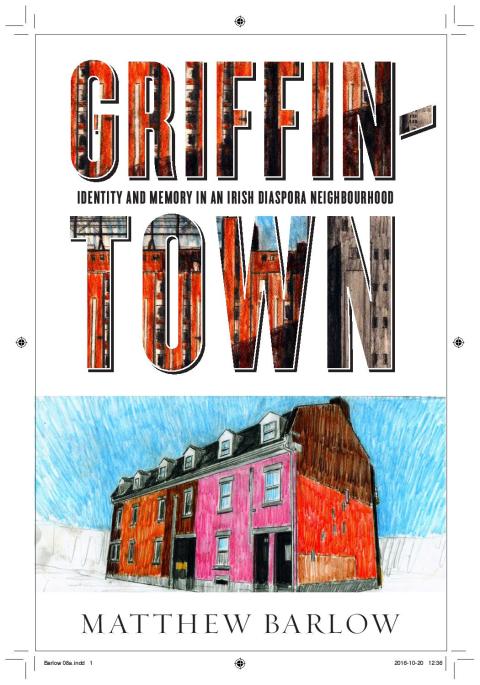
I just recently received the cover art for my forthcoming book, Griffintown: Identity & Memory in an Irish Diaspora Neighbourhood. It will be published in May 2017 by the University of British Columbia Press. To say I’m stoked is a minor understatement. The art work is by my good friend and co-conspirator on many things Griff, G. Scott MacLeod.
Gentrification: Plus ça change
September 14, 2016 § 2 Comments
I’m reading a book that is, for the lack of a better term, a biography of the Kremlin. I am at the part where the Kremlin, and Moscow itself, gets rebuilt after Napoléon’s attempt at conquering Russia. Moscow had been, until it was torched during the French occupation, a haphazard city; visitors complained it was Medieval and dirty. And it smelled. And not just visitors from Paris and Florence, but from St. Petersburg, too.
In the aftermath, Moscow was rebuilt along Western European lines, in a rational manner. And the city gentrified, the Kremlin especially:
This was definitely a landscape that belonged to the rich and the educated, to noblemen and ladies of the better sort. It is through the artists’ eyes that we glimpse the well-dressed crowds: the gentlemen with their top hats and shiny canes, the ladies in their bonnets, gloves, and crinolines. They could be leading citizens of any European state, and there is little sense of Russia (let alone romantic Muscovy) in their world.
Leaving aside the fact that there were no citizens of any European state in 1814, this sounds remarkably familiar. This is the same critique I have written many times about Griffintown and Montreal: as Montreal gentrifies, it is becoming much like any other major North American city.
But it is also true of gentrification in general. There is a part on the North Shore of Chattanooga, Tennessee, I really like. It finally dawned on me that it is because it reminds of me Vancouver architecturally, culturally, aesthetically, and in the ways in which the water (in this case the Tennessee River, not False Creek) is used by the redevelopment of this historically downtrodden neighbourhood. But. I could also be dropped into pretty much any North American city and see similarities: Toronto, Vancouver, Montreal, New York, Boston, Seattle, Portland (Oregon), Cincinnati, Cleveland, Buffalo, Chicago, Atlanta, Nashville. These are all cities (amongst others) where I have seen the same tendencies.
And, obviously, one aspect of gentrification is the cleansing of the city of danger and vice. Just like Moscow was cleaned up in the aftermath of 1812.
Rue Shamrock, Montréal
August 24, 2016 § 1 Comment
When I was in Montreal in the spring, I was interviewed by Tricia Toso, a PhD candidate in Communications at Concordia University/Université du Québec à Montréal, about the Montreal Shamrocks Lacrosse Club. Tricia is a multi-media practitioner and does some pretty wild stuff, and this particular interview was for a podcast on rue Shamrock, which is up next to Marché Jean-Talon in the north end of the city. The market is on the site of the old Shamrocks LC grounds.
Tricia posted the podcast last week on Soundcloud, and it’s turned out brilliantly. You can listen to it here.
The Death and Life of Griffintown
July 26, 2016 § 2 Comments
I was back in Montreal a couple of weeks ago to finish up shooting for the documentary my good friend, G. Scott MacLeod, and I have been working on for the past few years. We travelled around Griffintown, doing some B shots, and re-doing some other shots. And then we found ourselves at Parc Faubourg Sainte-Anne, on the site of the former St. Ann’s Church at the corner of de la Montagne and Basin. Across the street is one of the last remaining stands of 19th century rowhouses in Griff. And right behind and beside it is yet another condo development (because there never can be enough, right?).
Part of these rowhouses were part of a co-op. One Friday afternoon in April, a bunch of men in suits and hardhats showed up, milled around, pointed at things, and then disappeared. Later that night, the residents of the co-op were forced out of their homes. Their homes were quickly condemned and they weren’t even allowed to go back in to get their personal belongings (the fire department had to go back in to get the ashes of one woman’s husband). Why did this happen? Well, it seems that a water line had been opened and that had compromised the foundation of the 1867 building.

(photo courtesy of G. Scott MacLeod).
That Sunday night, around 10.30pm, a huge backhoe showed up and tore down the end unit of the co-op, the one with the leaky foundation. The residents were “temporarily” re-housed.
Today, the co-op units are empty, only three of them still stand. And they all have a notice of eviction on their front doors.

As we were filming, we were approached by a Griffintown old-timer. He doesn’t want his name used, so he will go unnamed. He showed us a bunch of photos on his cellphone of the suits and the backhoe. And he told us what he saw happen. He said that a retaining wall had been built behind the co-op units when excavation work began on the condos around it. But, interestingly, the wall behind the fourth unit of the co-op had somehow disappeared the week before the water leak. And, just as amazingly, it suddenly re-appeared after the fourth unit was torn down. As to who turned on the water, well, he left that to our imagination.
Whether or not his version of events is true or not, to me, this is symptomatic of the new Griffintown, one that is beholden to condo developers and the accumulation of tax money for the Ville de Montréal. We all know Montreal is a historically corrupt city, and the recent Charbonneau Commission detailed corruption in the Montreal construction industry.
And whether or not something fishy happened with respect to the co-op or not, the events of April do not pass the smell test. That no one seems to care is even more worrisome. Montreal is a wonderfully progressive city in so many ways, but Griffintown is a fine example of what happens when greed takes over. The city had this wonderful opportunity to remake an entire inner-city neighbourhood. And rather than engage in sustainable development, or even, for that matter, a liveable area, the Ville de Montréal took the money and ran. And this is to the city’s detriment.
Oh, and the residents of this co-op? Call me cynical, but I’ll be shocked if they end up back in their co-op. See, the developer’s office is right next door to the co-op and my guess is that these buildings will either also mysteriously fall down or become condos as part of this larger development.
Place and Mobility
January 8, 2016 § 7 Comments
I’m reading a bit about theories of place right now. And I’m struck by geographers who bemoan the mobility of the world we live, as it degrades place in their eyes. It makes our connections to place inauthentic and not real. We spend all this time in what they call un-places: airports, highways, trains, cars, waiting rooms. And we move around, we travel, we relocate. All of this, they say, is degrading the idea of place, which is a location we are attached to and inhabit in an authentic manner.
I see where these kinds of geographers come from. I have spent a fair amount of my adult life in un-places. I have moved around a lot. In my adult life, I have lived in Vancouver, Ottawa, Vancouver again, Ottawa again, Montreal, Western Massachusetts, Boston, and now, Alabama. If I were to count the number of flats I have called home, I would probably get dizzy.
And yet, I have a strong connection to place. I am writing this in my living room, which is the room I occupy the most (at least whilst awake and conscious) in my home. It is my favourite room and it is carefully curated to make it a comfortable, inviting place for me. It is indeed a place. And yet, I have only lived here for six months. In fact, today is six months sine I moved into this house. I have a similar connection to the small college town I live in. And the same goes for my university campus.
So am I different than the people these geographers imagine flitting about the world in all these un-places, experiencing inauthentic connections to their locales? Am I fooled into an inauthentic connection to my places? I don’t think so. And I think I am like most people. Place can be a transferrable idea, it can be mobile. Our place is not necessarily sterile. It seems to me that a lot of these geographers are also overlooking the things that make a place a place: our belongings, our personal relationships to those who surround us, or own selves and our orientation to the world.
Sure, place is mobile in our world, but that does not mean that place is becoming irrelevant as these geographers seem to be saying. Rather, it means that place is mobile. Place is by nature a mutable space. Someone else called this house home before me. This house has been here since 1948. But that doesn’t mean that this is any less a place to me.
Residential Segregation
September 23, 2015 § 2 Comments
Sometimes I’m shocked by segregation, in that it still exists. It exists in Canada. Don’t believe me? Look at East Vancouver, the North Side of Winnipeg, the Jane-Finch corridor in Toronto, or Saint-Michel in Montreal. But, in the US it is even more shocking. Boston was the most racist place I’ve ever seen, the casual racism of Bostonians towards black people, the comments on BostonGlobe.com. Or the fact that people told me that The Point, an immigrant neighbourhood of Salem, MA, was a place where “you can get shot.” Or the simple fact that residential segregation was very obvious in and around Boston. Unless you take public transit (as in the bus or the subway), you could live your entire life in Boston without noticing people of colour there.
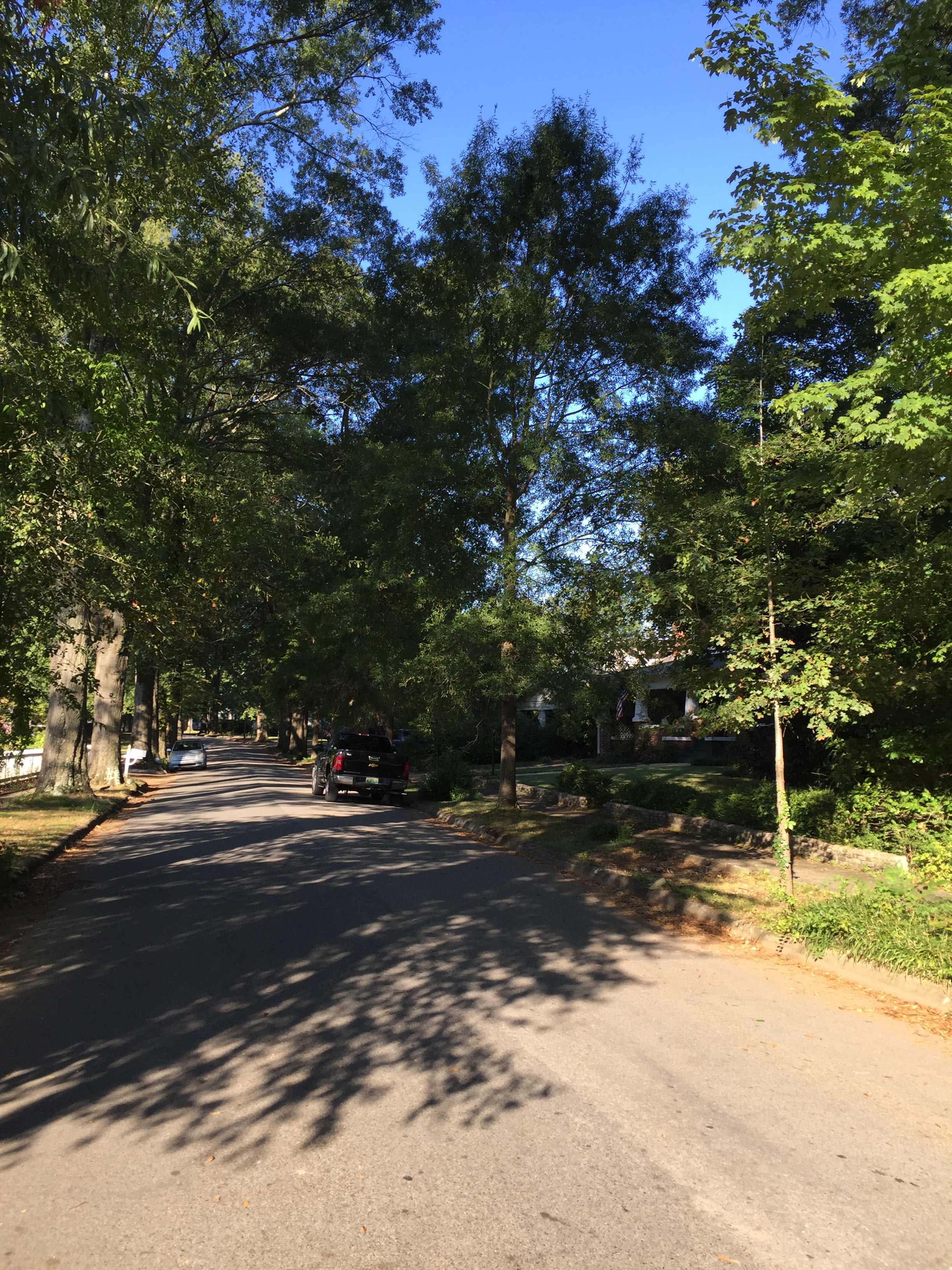
Down here in Alabama, though, it’s not a simple question of race, class is also central to residential segregation. I live in a small city (so small, in fact, that my neighbourhood in Montreal is about the same size as this city in terms of population). I live in a neighbourhood that is comfortably middle-class, veering towards upper-middle class the closer you get to the university. But, in the midst of this, there are a few blocks that look like something you’d expect to see in the 1920s in a Southern city. These images below are from one of these streets, a block behind my house. These houses are essentially a version of a shotgun house. The block behind me is about 70% black, 30% white. It is also full of abandoned houses, empty lots, and lots with the ruins of homes. The street itself is about a car-width wide, and where I come from, would be called a back alley.
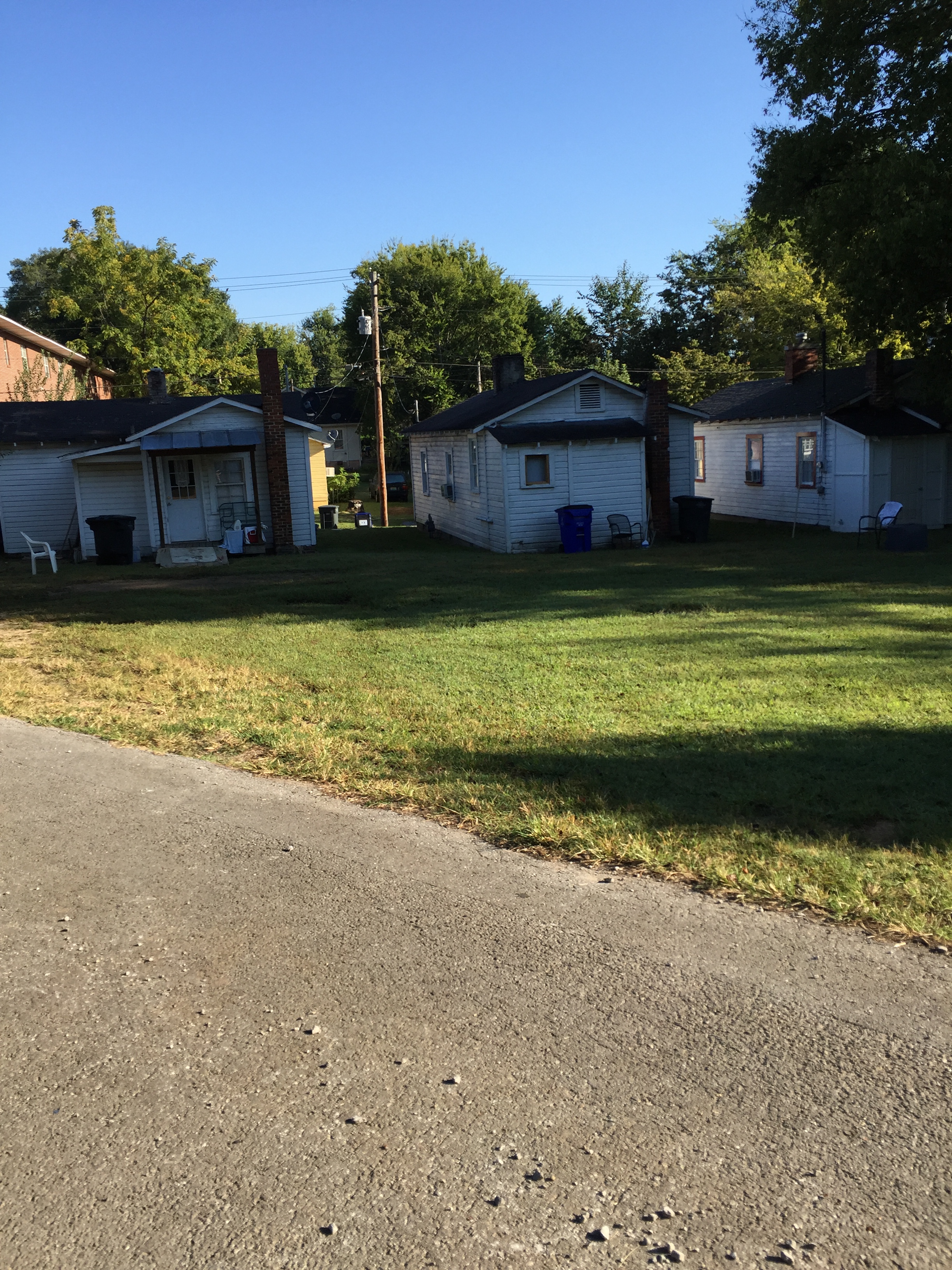
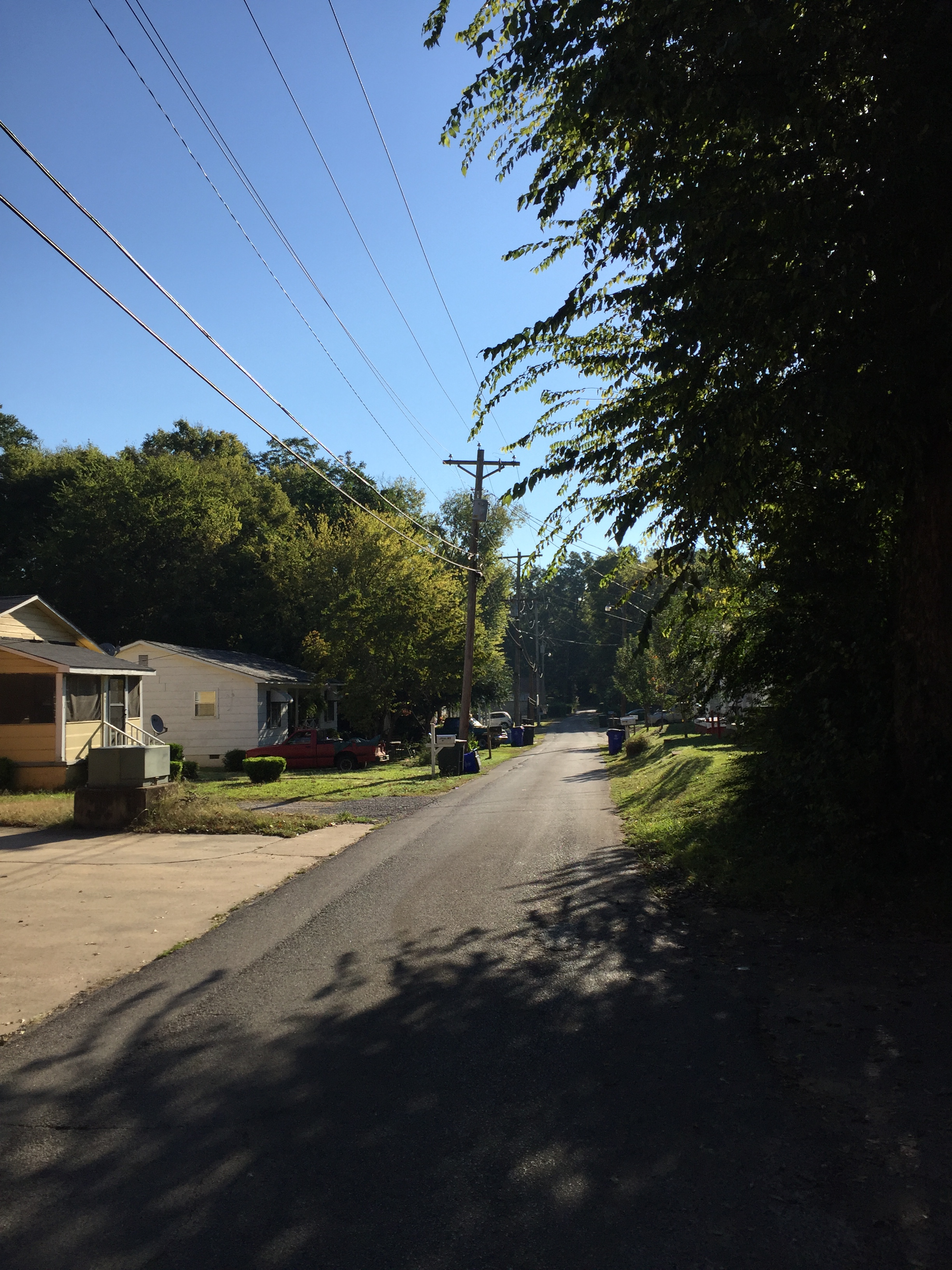

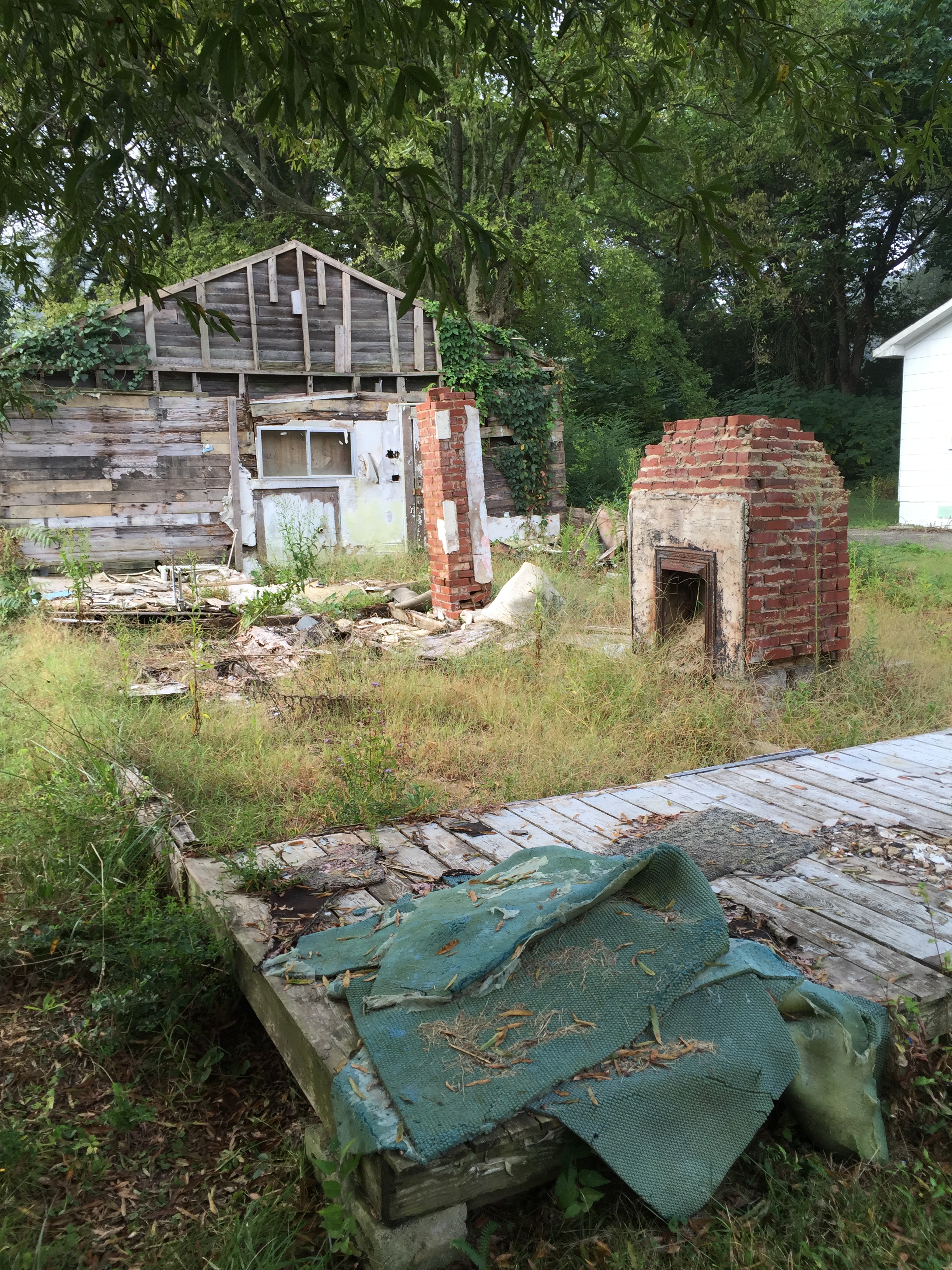 What is perhaps most shocking to me is how an apartment complex (which my neighbours all eye suspiciously) ensures this segregation with fencing designed to keep the riff raff out. To me, the very clear segregation of this block is shocking. Almost as surprising and shocking this block is in the midst of my neighbourhood. For example, the final photo is of the next block over from this street.
 Matthew Barlow