Nostalgia and Memory: The Long View
July 9, 2014 § 1 Comment
I was listening to Deltron 3030‘s recent album, Event II, the other day. Deltron is a project between producer Dan the Automator, rapper Del The Funky Homosapien and the turntablist, Kid Koala. Their first album, Deltron 3030, came out in 2000 and was a futuristic romp, whereas the new album is more of a dystopian view of the future. But. What struck me whilst listening to this and writing about nostalgia in Griffintown was, well, nostalgia. There is a funny skit in the midst of the album by the American comedy troupe, The Lonely Island, called “Back in the Day.” In it, two old men, “sitting on the stoop of the future” reminisce about how it was back in the day, a day that has yet to happen, I might add.
Nostalgia is a powerful force. I am also in the midst of reading Maria Rosa Menocal’s The Ornament of the World: How Muslims, Jews, and Christians Created a Culture of Tolerance in Medieval Spain. In it, she discusses the Ummayad founder of the Muslim state in Iberia in the 8th century, Abd al-Rahman. He was a rather singular figure, he was the sole survivor of the massacre of the Ummayad’s by the Abbasids in Syria when he was 20. He escaped across Northern Africa, eventually making it to Spain, where he settled in Córdoba. He was overtaken by nostalgia in his exile, however, and even the Great Mosque of Córdoba is an homage to his lost homeland. As he got older, he got more forlorn, writing poetry evoking Syria and he pined for his homeland, even going so far as to re-create his family’s Syrian estate outside Córdoba.
That Abd al-Rahman should be nostalgic for his homeland is not surprising, as any immigrant knows. But I always find it interesting to think of nostalgia and remembrances in ancient times. Nostalgic yearnings run all through the Ancient Greek, Roman, and Persian works that we have today. Carthage was the site of great museums and libraries before the Romans destroyed it in the 2nd century of the Common Era.
Sometimes it feels like we in Western Europe and North America in the late 20th/early 21st centuries invented nostalgia and yearning for an imagined past. Clearly, we did not.
On Privilege
June 25, 2014 § Leave a comment
I was recently in a situation where something blatantly both tasteless and racist occurred, through the actions of one individual. This individual apologised, heartfully and seriously. Most accepted his apology, including at least some of the aggrieved. But, in the aftermath of the apology, I overheard people complaining that “some people need to learn to take a joke” and so on. Oddly enough, it was always white, middle class people saying things like that.
In response to my previous posting on why we need feminism, I got trolled on Twitter, by men, telling me that women bring on rape, sexual assault, and other unwanted attention themselves. In the past, these kinds of trollings have also led to me being called names that challenge my manliness.
Racist jokes are not funny. Nor are threats of rape. Same for homophobic comments. And yet, some white people, some men, and some heterosexual people think they are. This, my friends, is privilege. The worst thing about privilege is that most people with it do not realise they have it. I don’t honestly think that many people who laugh at racist/misogynist/homophobic jokes are actually racist/misogynist/homophobic. They’re not trying to offend, oppress, or hurt other people. And yet, they do. Without realising it. And quite often, when they realise it, they get defensive and say things like “some people need to learn how to take a joke.”
Privilege is usually blind, those with it don’t see it, don’t understand all the advantages they’ve earned due to a calculus of skin colour, gender, sexuality, and class status. Take, for example, Julian Casablancas, the frontman of New York rock band The Strokes. Casablancas is the son of John Casablancas, a rich businessman and founder of the Elite Model Management group. Casablancas as a new solo project, called “Tyranny,” and in the press release, he says,
Tyranny has come in many forms throughout history. Now, the good of business is put above anything else, as corporations have become the new ruling body. Most decisions seem to be made like ones of a medieval king: whatever makes profit while ignoring and repressing the truth about whatever suffering it may cause (like pop music, for that matter).
Meanwhile, in England, comedian Russell Brand is trying to stir the people up against their government, to protest, to demand accountability. On the one hand, I admire Casablancas and Brand for their rabble-rousing, but both live incredibly privileged lives. Both are very wealthy men, and both of them have earned a lot of money due to the very things they are protesting, power relations and corporations. And they are apparently being unironic in their new stances.
Privilege is a funny thing. We live in a culture where some talk of “mindfulness”, and yet do not practice it. In order to be aware of privilege, we need to be aware of it. Be aware of the advantages we have gained in life due to that nexus of skin colour, gender, sexuality, and class. There are hierarchies all across society and there are hierarchies within sub-cultures. And we need to be aware of power and privilege.
Why We Need Feminism. Still.
June 23, 2014 § 5 Comments
I am blessed with three insanely wonderful, talented, beautiful nieces, they are really amazing, and I don’t get to spend enough time with them. The oldest of the three, Haley, is in a rock band in Norway, Slutface. The band just released a new single, “Angst,” which, aside from being catchy as all get out, struck me for its lyrical content. Haley sings about female objectification, dumb boys, and misogyny. It kind of took me by surprise, because you don’t really hear lyrical content of this sort in pop music today. Listening to the song, I thought back to a recent exchange I had on Twitter. I posted something hashtagged #yesallwomen, and a troll responded that it was campaigns and hashtags like this that led to women being sexually assaulted and raped. Yes, seriously. In his delusional little world, rape and sexual assault didn’t happen until social media appeared on the scene. He was, as you would imagine, hyper-aggressive about making his point, too.
When this current trend of feminist hashtags and campaigns on Twitter and social media exploded last year, I was kind of surprised. I came across the account @everydaysexism and was gobsmacked. Women were documenting their experiences of being catcalled and harassed walking down the street. I was shocked. I though this kind of shit ended thirty years ago. I asked the women in my life, and they confirmed that this was indeed their daily experience. It angered me.
Back in the day, every woman I knew had been raped or sexually assaulted, so perhaps I should not have been surprised. “The day” was the early 1990s. But I seriously thought things had got better since then. I’m not sure why I thought this. I am a professor, everyday in the hallways, across campus, and even in my classroom, I see examples of sexism and outright misogyny. Almost all advertising is based on the objectification of women to sell everything from cars to beer to razor blades to men. In the post-Britney Spears, “post-feminist” world, this kind of objectification has become part of the day-to-day. And for many of my female students, the very word “feminism” is a bad one. I can’t tell you how many times I’ve had a student say, “I’m not a feminist, but…” and then go on to make a very basic feminist point.
That depresses me. As does this picture.  We ALL need feminism, for the reasons outlined above, and for the reasons this woman points out in the picture.
Sexism and misogyny isn’t funny. Women don’t need to learn how to “take a joke” when men say stupid shit to them. Men need to stop being pigs. It’s that simple.
On Immigration, Redux
June 21, 2014 § 2 Comments
In response to my post on immigration and immigrants, my friends and I got into a discussion on Facebook, comparing the political rhetoric in the US, Canada, and the UK. Certainly, attitudes such as that expressed by my Dallas friend exist in Canada and the UK. And there are similarities and differences between the old Anglo-Atlantic triangle. Canada takes in more immigrants per capita than any other nation in the world (bet you didn’t know that) and the United States takes in more immigrants in absolute numbers than any other nation in the world (bet you did know that). Canada, however, while it does have some undocumented immigrants, does not have the same issues as the United States (which likely has the highest number of undocumented people in it) and the United Kingdom. The UK gets the undocumented through Europe and its former empire, as aspirants sneak into the nation, or overstay their visas (if you want a heartbreaking account of the undocumented in the UK, I point you to Chris Cleave’s Little Bee, or, as it’s called in Cleave’s native UK, The Other Hand).
But. There is one fundamental difference between the three nations. In Canada and the United Kingdom, the political parties that pander to racism and anti-immigration positions (and let’s leave the undocumented out of this for now, ok?) are not in the mainstream. Certainly, these types exist in Canada’s governing Conservative Party, but they are not in the centre of the party, at the cabinet table, etc. And in the UK, there are certainly a few in the governing Conservative Party that express these views, but they are also similarly on the margins, and the odious UKIP party is a fringe movement. Whereas, here in the United States, the Republican Party panders to this mindset. It doesn’t mean, of course, that the GOP does much about to tighten immigration laws when in power, but, it still gives credence to arguments such as my Dallas friend’s. It seeks the vote of the likes of him. So, ultimately, anti-immigration positions are very much nearer the mainstream in the United States than in Canada or the United Kingdom.
On Immigration
June 20, 2014 § 8 Comments
Earlier this week, I was told I shouldn’t be living in the United States because I don’t “love America.” Dismissing this comment was easy enough, it came in response to the fact I am not cheering for the US at the World Cup (France, Argentina, and then any underdog, if you must know). But. Yesterday, at the Dallas/Fort Worth airport, a wealthy-looking, white, middle-aged man went on a rant about immigrants (not knowing I am one, he assumed because I was also white and middle-class, I must be American). Something was on FoxNews on the TV in the lounge, I wasn’t paying attention. I presume that’s what set this guy off. He told me that immigrants do not belong in the United States, that they do not bring anything to the country, that they’re a drain on the resources of “this great nation.” He opined that no immigrants whatsoever should be let into the country. He didn’t go so far as to suggest they be rounded up and deported, though I have seen that opinion expressed on Twitter a few times. At any rate, when I told him I was an immigrant, he looked a little confused for a second and then said, “Oh, I don’t mean you.” I pointed out he clearly did, he said “all immigrants” are a drain and that “none” should be let in. I walked away, leaving him looking like the idiot he was.
This unsettled me. It’s one thing for an idiot to get mad at me for not cheering for the US in the World Cup. That’s just knee-jerk idiocy. It’s another for a guy to have a well-formulated, if ignorant, argument about the cost of immigration. And before someone dismisses this as “well, that’s Texas,” let me point out that Texas is an immigrant-rich society, and not just Mexicans and other Hispanics, but also South and South East Asians. And, for the most part, Texas, at least the cities, have integrated cultures.
At any rate, I stewed over this the rest of the day and on the flight home to Boston. And then I got a cab home. My cabbie was from Guinea. He couldn’t be much older than his early 30s, and he said he’s been in the US for 11 years, and made sure to note he has a Green Card. We talked about the heat (it was hot here yesterday), the World Cup, and Montréal, and we spoke some in French. I was his last fare of the day, the end of a 12-hour shift, 6am-6pm. The end of a 6-day run driving a cab around Boston and the North Shore. Today, he was up at 3am to get to work at 4am, at Dunkin’ Donuts, where he worked 4-12, as a baker. Tomorrow, he’s back in his cab, 6am-6pm, but he is off Monday. He works 60-70 hours a week driving a cab, and another 8-16 hours baking at Dunkin’ Donuts for a very simple reason: he needs to take care of his parents, his brother, his nieces and nephews back in Guinea. He hasn’t been home in four years, but he keeps working to send money home. Meanwhile, he’s also got a son here in the States, who he gets to see sometimes when he’s not working, though he supports his kid.
We often talk about how tired we are, because we’re always busy, working, etc. But this guy was exhaustion personified. He had dark rings under his eyes, and though he was at least pretending to be happy, his exhaustion came through. And I thought, well, here is the face of immigration to the United States (or Canada. Or Britain. Or France. Or Germany). A guy working himself to the bone at two jobs, partly to get himself ahead a little bit, but also to take care of his son, and to take care of his family back home. He estimated if he just had to worry about himself and his son, he could quit Dunkin’ Donuts and only work 3-4 days a week driving a cab. But, he has responsibilities and obligations.
I enjoyed talking to him, though I feel horrible for him. But I respected his attitude, that he had to do this, it was his responsibility to his son, his parents, his brother, his nieces and nephews. This is the immigrant life. It is not, as my Texan friend claims, collecting welfare (immigrants can’t, just so you know, though refugees are entitled to some support), procreating, and being drug dealers, prostitutes, and terrorists.
The Mormons and the Great Salt Lake
June 18, 2014 § Leave a comment
I’m in Salt Lake City, Utah, this week. This is the second time in two years I’ve been in the area. Last year on our cross-continental road trip, we passed through on our way from Idaho to Moab, Utah. We did, however, stop at Antelope Island State Park, just north of Salt Lake City, in Davis County. Antelope is on the Great Salt Lake. It was one of my favourite stops on the trip.

As I write this, I am looking out my hotel window, on the 12th floor, at the mountains to the north of downtown Salt Lake. As I’m sure everyone saw back during the 2002 Winter Olympics, this city is surrounded by some amazing landscape. But, last summer, standing on Antelope Island, I understood why the Mormons stopped here on their trek west.
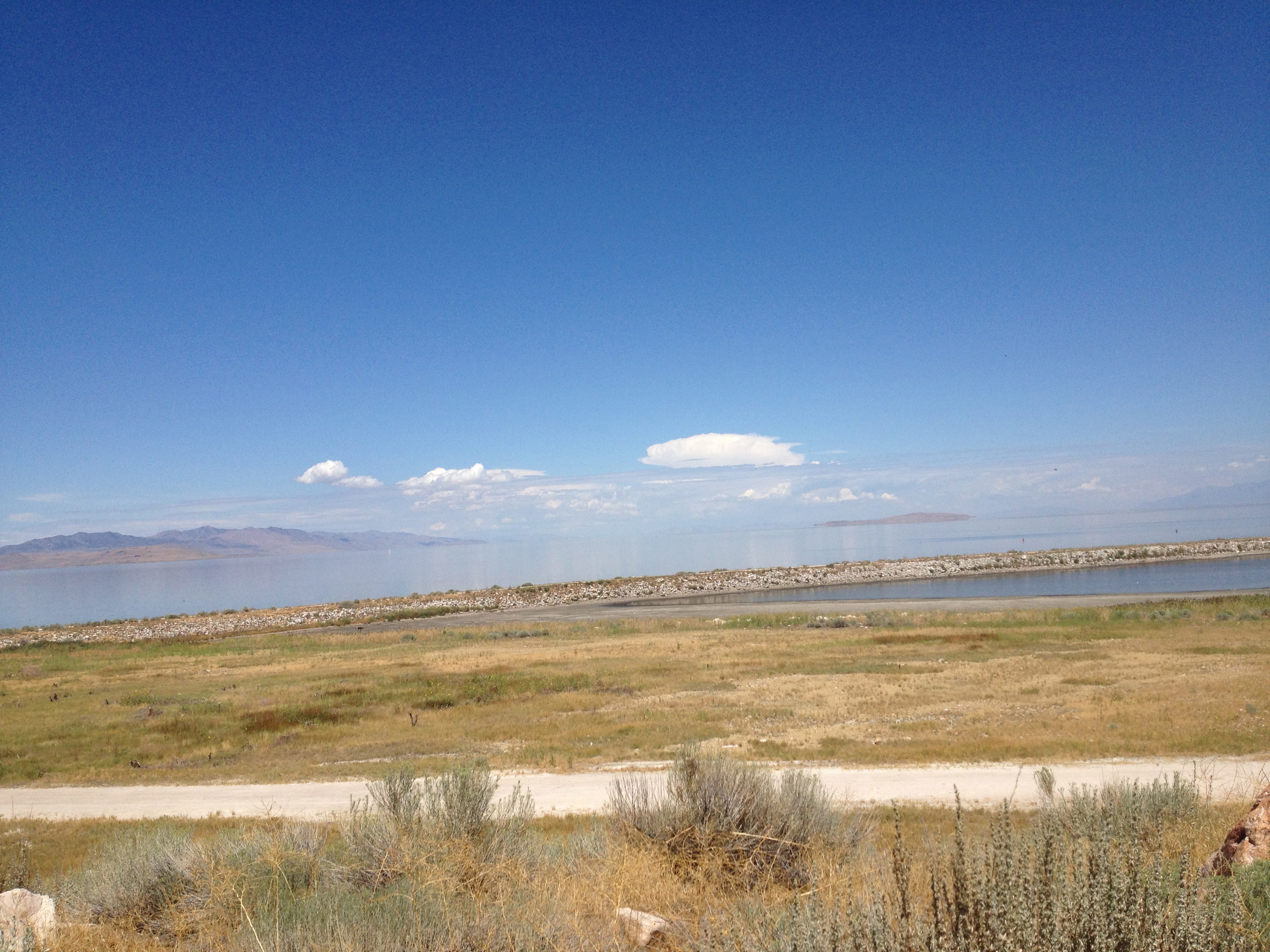 The Great Salt Lake is an amazing thing. It’s the largest salt lake in the western hemisphere, covering some 1,700 square miles. And it is almost spectral, with its lunar sheen to it. What amazed me on Antelope Island was watching a series of birds come to land on the lake. They just slid into place, there was no ripple effect, no wave action. People call the Great Salt Lake “America’s Dead Sea.” That’s completely wrong, but that’s beside the point. As I stood on Antelope Island, I looked at the desert landscape around me, I couldn’t see Salt Lake City or any other human settlement (though the park isn’t actually that far from suburbia), just the mountains around me, the desert, and the lake. And I thought, it kind of looks like the Holy Lands, or at least how I imagine the Holy Lands look. And, so, no kidding the Mormons stopped here to set up shop.
Research Note: Playing hockey against priests in Griffintown
June 6, 2014 § Leave a comment
As I noted in yesterday’s post on Frank Hanley, we really do live in a different era today. In one of the chapters of The House of the Irish, I talk about hockey in Griffintown in the 1950s and 60s. I interviewed Gordie Bernier, an old Griffintowner, a few summers ago about his life and growing up in Griff and his thoughts on it today. The previous weekend, he was playing in an old-timers hockey tournament in Pointe-Claire, so clearly it was a major part of his life. I can relate.
Bernier recalled playing with the Christian Brothers who ran the School for Boys in Griff and who liked to play hockey against the young men:
Keep your head up. But the league we had, we were only young…I was only, I think 17 or so, and we were playing against men, so some of the guys were older. It was a good experience….You keep your head up [laughs]. We used to go there, I think 8 in the morning to the rink on Basin, I lived other on Duke, we used to walk with our skates on, by the time we get over there if there was snow, give us the shovels, we had to clear off all the snow, and we’d play from 8 in the morning ‘til closing time, 10 at night. We were still there, play hockey all day at the weekend. Walk back, your ankles [were all swollen and sore].
Don Pidgeon, a man who has done more than anyone to create the memory of Griff as an Irish neighbourhood, also remembers playing the Brothers, and smashing one over the boards of the outdoor rink on Basin Street Park in Griffintown, with a hip check.
The Brothers, obviously, played hard, and they played to win. And the lads of Griffintown were not about to give any quarter, as David O’Neill recalls, the Brothers were
great athletes, and a lot of them liked the rough stuff just as much as the boys, and the older boys used to try to establish themselves among their own friends, and there were a few of the priests who used to give and take as good, or better. That generated the respect from the local community towards the priests, and a lot of people respected the priests for their ability to give and take without any complaining. No punishment, except that you got decked back when you weren’t looking.
Certainly, then, this was a different era, when decking a priest, or getting hit back as hard, if not harder, was a means by which the young men and priests earned each others respect, and that of their friends and colleagues, and the wider community.
Research Note: The Legend of “Banjo” Frank Hanley
June 5, 2014 § 1 Comment

Frank Hanley, 1909-2006, in 1942
I met Frank Hanley a couple of times back in the early aughts, including one afternoon in Grumpy’s on lower Crescent St. He was holding court, drinking, I think, a club soda. He was, at this point, already in his 90s. But he was irrepressible. Even though he was 96 or 97 when he died in 2006, I was still surprised to hear the news. He got the nickname sometime back in the 1920s or 30s when he was a minstrel player in Montreal, or so he told me. He didn’t know how to play the instrument. Hanley is the kind of guy that doesn’t exist anymore, which is kind of sad. He was the city councillor for St. Ann’s Ward from 1940 until 1970. He was also the MNA for St. Ann’s from 1948-70. He didn’t belong to any parties, he was always an independent. He tended to side with ‘Le Chef’, Maurice Duplessis, in the National Assembly during the 1950s. But I just never could hold that against him. He also despised Jean Drapeau, Mayor of Montreal from 1954-7 and from 1960-86.
Griffintown was left to die in the 1960s whilst the other neighbourhoods of the sud-ouest were given makeovers, mostly in the form of slum clearances and the building of housing projects in the Pointe, Burgundy, and Saint-Henri. Griff got the rénovations urbaines part, but that was it. Nothing was built to replace what was torn down. And it was not because of the 1963 re-zoning of the area as ‘light industrial.’ All of St. Ann’s Ward was, as were other parts of the sud-ouest. Griffintown, quite simply, did not attract the attention of hôtel de ville and Drapeau’s team of rénovationistes as a site of investment. The only voice demanding Griff get some love was its councillor: Hanley. Local legend has it that Griff was left to die to hurt Hanley’s re-election chances, such was Drapeau’s enmity for him.
Anyway. Hanley was an old school populist politicians, his first real concern was his constituents. And his constituents tended to be poor in Griffintown and the Pointe. He raised money for an emergency fund to help out his constituents when they ran into trouble. Most of this money was raised from other constituents. Occasionally, of course, a few dollars would fall into his own pocket. While today we would shake our heads at this or perhaps bring Hanley up on charges of corruption, in his era, no one had any problem with that.
In the summer of 1967, Hanley ran into trouble with Revenue Canada. He had been handing out over $150 per week to his constituents in trouble for much of the past decade, maybe longer. And, of course, he took a bit for himself. So Revenue Canada threatened to take his house at 500 Dublin St. in Pointe-Saint-Charles. His constituents from Griffintown and Pointe-Saint-Charles had other ideas, and they showed up one morning in Hanley’s yard and proclaimed the ‘Republic of Hanley’ in his front yard.
In the end, Hanley and Revenue Canada reached a settlement.
On the Radio: Boston College’s Belfast Project
June 4, 2014 § Leave a comment
Here is the podcast (you want to click on the 29 May show) of my appearance on CKUT’s O Stories show last Thursday. The show is an hour long, the first half of the show is en français and is, in part, a discussion about the Québécois chanteur Fred Pellerin. The Anglo half of the show begins, well, half-way through. The second half hour is myself and my good friend, film-maker G. Scott MacLeod. For the first bit, we talk about his excellent work on Griffintown. And then I discuss Boston College’s Belfast Project with host (and friend) Elena Razlagova. Happy listening.
Research Note: The Pont Champlain
June 4, 2014 § Leave a comment
 Nearly every time I drive over the Pont Champlain, I turn my brain off, and don’t think about the crumbling infrastructure of the bridge, I don’t think about how far it is down to the St. Lawrence. I don’t think about how deep the river is. I don’t think about the litres of ink spilled in the Montreal newspapers, in both official languages, about the bridge. I don’t think about the fact that god-knows-how-many billion dollars are being spent to fix a bridge that needs replacing whilst the politicians in Ottawa and Quebec City continue to argue about how best to replace the bridge. I don’t really think the bridge is going to fall down, of course. But.
So it was a nice change of pace to be finishing off a chapter of The House of the Irish on the dissolution of Griffntown in the 1960s, and to come across documents I’ve collected from the Library and Archives Canada in Ottawa, as well as newspaper articles from The Star, The Gazette and La Presse from the late 1950s and early 1960s, when the Pont Champlain was first opened, and it was a marvel of engineering, and then the city and federal government built the Autoroute Bonaventure into the city in preparation for Expo ’67.
The optimism! The excitement about a new bridge connecting Montreal to the South Shore! The excitement about the Bonaventure, which “sweeps majestically into the city, the river on one side, the skyline in front,” to quote one article from The Star. Next time I cross the Champlain, I’ll try to think of that.

 Matthew Barlow