Re-Manufacturing the War of 1812
April 30, 2013 § 2 Comments
Over at the National Council of Public History‘s (NCPH) blog, history@work (wherein public historians such as yours truly discuss issues related to history and the public and historical public memory), I have a new piece up on Canadian Prime Minister Stephen Harper’s delusional history of the War of 1812, entitled Re-manufacturing 1812: Stephen Harper’s Glorious Vision of Canada’s Past. From the title, you can probably guess my angle on Harper’s attempts to re-brand Canadian History through the War of 1812. Quite frankly, I find it disturbing. Let me know what you think.
Diaspora and Terrorism
April 24, 2013 § Leave a comment
Scholars studying diaspora and immigrant communities have noticed that there are some very general, very real trends amongst diasporic immigrant communities. The first generation, the immigrants, arrive in their new home, but find themselves caught between two worlds, struggling to fit into the new home, whilst still maintaining very real and very strong ties to the homeland. Their children, the second generation, are citizens of the new country by birth, and grow up in that host culture, and generally do not express a lot of interest in the culture of the homeland; they are fully integrated into the new homeland. It’s their children, the third generation, that begins to cast an eye back to the old homeland, curious about where their grandparents are from and the culture their grandparents carried with them in the new land until they died. These are trends that have existed in North America since the Irish began coming over here in the mid-19th century, and have been replicated time and again by pretty much every single group that has arrived in the United States and Canada in large numbers since.
Immigrants, their children, and grandchildren, of course, have greatly changed North American culture ever since the Irish. Take, for example, the city I live in now: Boston. Boston is the birthplace of the American independence movement in the 1770s, and was a tight-knit Anglo-Protestant city prior to the Irish arriving. Boston was never the same after the Irish arrived in huge numbers in the mid-19th century. And as the Irish infiltrated the city’s economy, culture, and politics, they left their mark. This can still be seen today: at present Stephen Lynch and Ed Markey are both attempting to gain the Democratic nomination for the special election to replace John Kerry in the US Senate. Both Lynch and Markey are currently Congressmen. Both are Irish Catholics, Markey’s from Malden and Lynch is from South Boston, aka: Southie. He grew up in the same housing projects as Whitey Bulger. The Irish still have their tentacles in the Democratic Party machinery in Boston today, 160-some odd years after they arrived.
Other cities are affected differently. Take, for example, my hometown of Montréal. Montréal has long been the recipient of immigrants, dating back to the Irish, who began arriving there in large numbers in the 1840s. The Irish completely changed the city, adding an Anglophone group that was Catholic to an already divided city. The Catholic Church was also massively changed in Montréal as the Irish muscled their way in. Indeed, they are largely to thank for the fact that there is an English-language Catholic Church in the city today. But Montréal is also being fundamentally changed by immigration from nations in the Francophonie in Africa and the Caribbean today. In the past decade or so, Montréal has undergone a fundamental cultural shift, as new French-speaking communities arrive. The consequences for French Canadian nationalism and separatism should be obvious.
But this process of acculturation may be now speeding up. Our cities have become faster, life is lived at a frenetic pace in our cities on this continent. Last week, two bombs went off at the Boston Marathon, killing 3 people and injuring over 200 more, some very seriously. The bombs were planted by Tamerlan Tsarneav, 26, and his younger brother Dzhokhar, who is 19. The Tsarneav brothers are immigrants, they came to the United States from Dagestan just over a decade ago. Tamerlan was here on a green card, whilst Dzhokhar became a citizen last year. Their parents have both returned to Russia in recent years, leaving them here. But they’ve been here a long time, Tamerlan was 14 or 15 when he arrived here, Dzhokhar was 8 or 9. They were both Americanised, and their brand of terrorism, experts have concluded is of the ‘home-grown’ variety.
Yesterday in the Boston Globe, Farah Stockman commented on this growth in homegrown terrorism, citing forensic psychiatrist Marc Sageman, who in 2008 predicted that terrorism in the West would increasingly be of this variety. Of course, by 2008, we had already seen the writing on the walls. On 7 July 2005, four terrorists detonated bombs during the morning commute in London. All four were homegrown terrorists, two were the sons of immigrants, a third was an immigrant himself, but had grown up in England. The bombing of Madrid’s transportation system in March 2004 was also of the homegrown variety.
This new generation of terrorists, the so-called 3rd wave, are younger than the Al Qaeda terrorists of the previous decade. According to Stockman, the average Al Qaeda terrorist in the 90s and early 00s was in his 30s. Today, the average age of these 3rd wavers is in his early 20s. The 2nd wave were devoutly religious and had grown up in devoutly religious homes. The 3rd wave grew up secular, as the brothers Tsarneav had. So, why the turn to radicalism and terrorism, she asks:
For some, it was out of a warped romanticism for a homeland they barely knew; an act of rebellion against hardworking immigrant parents who brought them to the West for “a better life.” Others were US-born converts to Islam who found in terrorism a sense of camaraderie and purpose that had eluded them all their lives. A few became terrorists after years of gang-banging and drug dealing. It was an ideology that transformed their violent tendencies into something heroic. It made them feel they were on the side of the angels.
Sagemean concludes that for some of these young men, ‘terrorism is a fad.’ This is an interesting thought. But if these young men are attracted, in part, by this romantic attachment to their parents’ homeland, or the homeland of their families, or to the religion that sustained their family generations ago, I’m not so sure that this is a fad. Scholars looking at notions of diaspora note the attachment 3rd generation children and those beyond have to the mythical homeland. Looking at my own community and what I study (the Irish), I would note that men and women whose families emigrated to North America 160 years ago remain curious and interested in the mythical homeland of Ireland. Ireland draws them in, they’re curious about the history, the culture, and some even the language. This becomes a life-long interest.
Maybe Sagemen is correct in that the violence of radicalism and terrorism is a fad of youth and some of these young men will eventually mellow out and choose to focus on aspects of their culture that do not lead to violence. Certainly there are echoes of this in the Irish diaspora, where many young men (and some young women) have been attracted to the glory of the violence in the North. This was certainly true when I was younger, before the establishment of peace following the Good Friday Accords in 1998. Young Irish-American and Irish-Canadian men would hold romanticised images of the IRA and the resistance “back home”. Most have long since grown out of this fascination with the IRA, of course. (This did, however, inspire Bono to go on a legendary rant during a performance of “Sunday, Bloody Sunday” during the 1987 Joshua Tree tour, which was released on the DVD of Rattle & Hum).
On Humanity and Empathy: Boston and Rehtaeh Parsons
April 18, 2013 § Leave a comment
Monday’s terrorist attack at the Boston Marathon was a little too close to home for my tastes. A few of my students were there, near the finish line. A couple had left by the time the bombs went off, a couple had not. They were unhurt, as they were far enough away from the bombs. I know Boylston Street well. A few days before the Marathon, I was there; I had dinner in the Irish pub in the Lenox Hotel, which is across the street from where the second bomb went off. In my mind’s eye, I can see exactly where those two bombs were.
Like most Canadians and Americans, for me terrorism happens in the abstract. It’s a news report on TV, it’s on our Twitter timelines, it’s pictures in a newspaper. Sometimes, it’s a movie. But we don’t experience it personally, and this is still true even after 9/11. I have not experienced terrorism personally, and yet, I have never been as close to a terrorism attack as I was on Monday. Not surprisingly, I feel unsettled.
But I have been shocked and dismayed by some of the responses to the bombs on Boylston Street. Aside from those on Twitter declaring this to be a “false flag” attack (in other words, a deliberate attack by the US government on its people), which is stupid to start with, there have also been those who have been declaring that this happens all the time in Kabul or Baghdad or Aleppo. That is very true, it does happen everyday in those places. Indeed, for far too many people around the world, terrorism is a daily fact of life. That is wrong. No one should live in terror. But by simply declaring that this happens all the time elsewhere, you are also saying that what happened in Boston doesn’t matter. And that is a response that lacks basic humanity.
This has been a week where I’ve been reminded too often about our lack of humanity. The inhumanity of the bombers, of the conspiracy theorists, and those who say this doesn’t matter because it happens all the time elsewhere.
News also broke this week about disgusting, inhumane behaviour surrounding the Rehtaeh Parsons case in Halifax. There, “friends, family, and supporters” (to quote the CBC) have taken to putting up posters in the neighbourhood around Parsons’ mother’s house supporting the boys who sexually assaulted her, declaring that the truth will come out. I’m sure those boys are living in a world of guilt and shame right now, as they should. But to continue to terrorise a woman whose daughter was sexually assaulted, and then teased, mocked, and bullied for two years until she took her life is inhumane. It is inhumane that those boys assaulted Rehteah in the first place. It is inhumane that her classmates harassed, mocked, and bullied her for two years for being a victim.
There has been plenty of positive, especially in response to the Boston bombings. As I write this, President Obama is at a memorial service in Boston for the victims of the bombing. There are plenty of stories of the humanity of the response of the runners of the marathon, the bystanders, and the first responders. #BostonStrong is a trending hashtag on Twitter. Jermichael Finley of the Green Bay Packers will be donating $500 for every dropped pass and touchdown to a Boston charity, and New England Patriots receiver will donate $100 for every reception and $200 for every dropped pass this season. Last night’s ceremony at the TD Garden before the Bruins game was intense. And so on and so forth. This is all very heartening. It shows that we are humane, that we can treat each other with empathy and sympathy and dignity.
But it doesn’t erase those who lack humanity. I had a Twitter discussion last night about this. About how this kind of inhumanity seems to be everywhere. This morning, I was talking to two students about this inhumanity and how it just makes us depressed and wanting to cry. I wish I could say that this is a new phenomenon in society. But it’s not. This is one of the (dis)advantages to being an historian. We have the long view of history, quite obviously. We have always been a vengeful, inhumane lot. We’ve used torture since we could walk on our hind legs. The Romans’ favourite past-time was gladiator fighting, where two men fought to the death. Public executions were big deals, social outings. All to watch a man (and occasionally a woman) die. What is different now is the Internet allows people to express their inhumanity so much easier and so much quicker, and to gain further exposure in so doing. And that is just unfortunate.
Wither the Working Classes?
April 7, 2013 § 3 Comments
South Boston is undergoing massive redevelopment these days, something I’ve already noted on this blog. Every North American city has a Southie, a former industrial working-class neighbourhood that is undergoing redevelopment in the wake of deindustrialisation and the gentrification of inner cities across the continent. In Montréal, the sud-ouest is ground zero of this process, something I got to watch from front-row seats. In Vancouver, it was Yaletown. Cities like Cleveland and Pittsburgh have done brilliant jobs in re-claiming these post-industrial sites. In Boston, however, Southie’s redevelopment has attracted the usual controversy and digging in by those working-class folk who remain there. It’s even the locale of a “reality” TV show that is more like working-class porn than anything else.
The same discourse always emerges around these post-industrial neighbourhoods under redevelopment, something I first noticed in my work on Griffintown in Montréal. Today, in the Boston Globe there is a big spread ostensibly about a sweet deal given to a Boston developer by City Hall, but is really more an examination of the redevelopment of Southie’s waterfront. In in, James Doolin, the chief development officer of the Port Authority of Massachusetts, one of the players in this redevelopment, reflects on the ‘new buzz’ surrounding the area, going to to talk about how this ‘speaks to a demographic that is young, employed, and looking for social spaces.”
Right. Because the Irish who lived and worked in Southie during its life as an industrial neighbourhood were really just bums, always unemployed and so on. And, of course, those unemployed yobs would never look for social spaces, all those little cretins hung out in back alleys and under expressways. This attitude is unfortunate and is part and parcel when it comes to the redevelopment of these neighbourhoods: the belief that the working classes never had jobs, had no social lives and were just drones. I’ve seen it in literature from developers in Griffintown and other parts of Montréal’s sud-ouest, so it’s no surprise to find this attitude in Boston. But it doesn’t make it right. In one sweeping, gross over-generalisation, Doolin (and the Boston Globe) sweep away centuries of history, of life in Southie, and the day-to-day struggles of the working classes in the neighbourhood to survive and live their lives on their terms.
Getting Redevelopment and Community Right
March 12, 2013 § 2 Comments
Yaletown in Vancouver has undergone massive redevelopment in the past two decades. It was once the site of Expo 86 along False Creek, and before that, an urban wasteland (actually, after Expo, too). But today, it is a sea of glass towers; one statistic I’ve seen said the population just in Yaletown approaches 30,000, though I find that hard to believe. All along False Creek is a string of residential condo towers; all along Pacific Boulevard, from Granville to Cambie streets there are towers and pied-à-terre condos. Some of them even look nice.
 As I went out for my morning run today (I’m staying with my sister here), I noticed something: this is actually a well-thought out urban redevelopment. There’s a billboard on Pacific Blvd that says that Concord, one of the developers is building community here. It’s easy to scoff at that claim. But it’s not a ridiculous claim. My sister knows her neighbours. More than that, she has friends amongst them. Dog owners around here have claimed a patch of Cooperage Park on False Creek as a dog run. They police each other, making sure nobody leaves their dog doo behind. They also police each other’s dogs, making sure they behave. There’s a bunch of cafés and restaurants along Marinaside Drive (I know, what a horrible name), and they’re populated with regulars, the neighbours around here. People nod and say hello to each other on the streets and along the path that goes along the bank of the water.

There’s more, though. There’s actual, real parks here. Cooperage stretches almost from the Plaza of Nations at the head of False Creek towards and under the Cambie Bridge. A few blocks on is David Lam Park, which lies between Pacific, Drake, and Homer streets. But it’s more than that. These parks are actually used. There’s basketball and tennis courts at David Lam, and a playground. An elementary school is on David Lam and the children can be seen playing in the park at recess and lunch and after school. The path along the water is almost always busy with joggers and cyclists, as well as roller-bladers and walkers (Vancouver was experiencing one of its trademark torrential downpours when I was out taking pictures today, thus, aside from one intrepid jogger, there was no one out playing).
When I lived in Vancouver in the late 90s, there was a lot of hand-wringing about the redevelopment of the old Expo site. The city was determined to increase density, to follow the model of the West End, which is apparently the densest neighbourhood of North America that’s not Manhattan. So the old Expo lands saw these condo towers grow out of the ground. The major difference between the West End, which lies on the other side of the Burrard and Granville Street bridges and this area, which is part of the larger Yaletown neighbourhood, is that Yaletown tends to be resident owners, whereas the West End is largely rental units (there are, of course, many exceptions to both).
 At the end of the day, however, Vancouver got it right. There is community here, the public spaces are widely used. The cafés and restaurants are, with the exception of one Starbucks (this IS Vancouver, after all) independent operators (this isn’t as true as Pacific Blvd., the main east/west thoroughfare, which has plenty of chains in between and around the indie stores). This also contributes to community, as the small business owners connect to their local community in a way that Starbucks and Quiznos can’t. And studies show that locals are more likely to patronise these small businesses than the chains. Indeed, this morning, Bojangles, the local indie café was busy, filled with both commuters on their way to work and those with more time to sit and enjoy their coffee. Whereas the Starbucks, while it got a fair amount of foot traffic from commuters, it doesn’t have the same community feel.
I fear, however, that Montréal is getting it wrong with Griffintown. The early plans for the massive redevelopment of Griff by Devimco called for massive shopping areas and big box stores. The commercial developments were supposed to pay for the residential developments. As for anything else that urban residents might need, well, “Whatever,” Devimco seemed to say. Of course, Devimco’s bold plans were thwarted somewhat by the recession. The redevelopment is now a mixture of Devimco’s big District Griffin (how tragic it would be to have that old English name on the neighbourhood, eh, OQLF?) and a smattering of smaller developments, with the massive redevelopment of the old Canada Post Lands at the other end of Griff at the foot of rue Guy.
Missing, though, from all these redevelopment plans in Griff was any idea of what residents were supposed to do. There still are no plans for schools in the neighbourhood. It wasn’t until early 2012 that the Ville de Montréal announced that it had earmarked some money to create public parks. It’s still not entirely clear where they’ll be, other than the already extant Parc St. Ann/Griffintown at the bottom of rue de la Montagne at Wellington. And given Montréal’s history of development and redevelopment, and the fact that the mayor, first Gérald Tremblay and now Michael Applebaum, just has dollar signs in his eyes when talking about Griffintown, I have zero hope of Griffintown being redeveloped right. In fact, I am almost positive it will be a disaster.
It’s tragic, as Montréal has a chance to redevelop a huge swath of valuable land at the foot of downtown, to emulate what Vancouver did with Yaletown in the 90s and 00s. But it has done nothing to suggest that it will get it right. And that’s trafic.
Ten Thousand Saints and the Nostalgia of the Record Store
March 12, 2013 § 2 Comments
Last week I read Eleanor Henderson‘s excellent début novel, Ten Thousand Saints. This was a book I randomly came across, and, like most books I randomly come across, I was lucky. Ten Thousand Saints tells the story of Jude, a disaffected teenager in Burlington, Vermont (disguised as Lintonburg, for reasons I don’t quite understand since the rest of Vermont gets to keep its names), a sad sack little city about two hours from Montréal on Lake Champlain. Jude, I should also point out, is about a year older than I am. His best friend, Teddy, dies of an overdose on New Year’s Eve 1987, after he and Jude huff pretty much everything, including freon from an air conditioner, but Teddy also did coke for the first time, introduced to him by Eliza, Jude’s step-sister, who’s in town for a few hours from NYC. Teddy’s older brother, Johnny, also lives in NYC.
The novel then follows Jude, Johnny, and Eliza through the hardcore scene in the NYC underground in the late 80s (looking at Henderson’s picture on her website, she does not look the sort who would). Jude transforms from a pothead huffing high school dropout in Burlington to a straight-edge hardcore punk in NYC, frontman of his own band, the Green Mountain Boys (a clever play on their Vermont roots and Ethan Allen during the War of Independence). Henderson does a great job of illuminating the culture of the hardcore scene of the late 80s, both in NYC and around the rest of the East Coast, as well as issues of gentrification on the Lower Eastside of Manhattan, especially around Tompkins Park in Alphabet City, where Johnny lives, and around St. Mark’s Place, where Jude sometimes lives with his father.
Ten Thousand Saints made me nostalgic. At the other end of the continent, in Vancouver, I was starting to get into some of this music, if not yet the scene. Many of the bands Henderson references were in my cassette collection by 1989-90, a couple of years after Jude and Johnny were rocking out in the Green Mountain Boys. Though I cannot, for the life of me, figure out why the standard bearers of the straight edge scene in the late 80s, Fugazi, are not mentioned, though Ian McKaye’s earlier band, Minor Threat, are the gods of Jude, Johnny, and their crowd. What made me nostalgic was record stores. This is how Jude got into the scene in NYC in the first place, hanging around the record stores of the Lower East Side.
As I mentioned in my last piece here, on the Minutemen, Track Records in Vancouver was where I began to discover all these punk and hardcore bands in my late teens. Track stood on Seymour Street, between Pender and Dunsmuir, and as you went up the block, there was an A&A Records and Tapes, then Track, then A&B Sound, and then Sam the Record Man. Two indies and two corporate stores. And between the four of them, you could find anything you wanted and at a reasonable price. Zulu Records also stood on West 4th Avenue in Kitsilano, a short bus ride from downtown on the Number 4 bus. Of those stores, only Zulu remains. I’m in Vancouver right now, and I think I’m going to make my way over there today.
But it was in record stores that kids like me learned about this entire universe of punk and alternative music in the late 80s. In places like Track and Zulu, we heard the likes of Fugazi and the Minutemen, as well as the Wonderstuff and Pop Will Eat Itself and the Stone Roses playing on the hi-fi. This is where we could find the alternative press and zines, I found out about all these British bands from the NME and Melody Maker. You’d talk to the guys working in the stores (and it was almost always guys, rarely were there women working in these stores), you’d talk to the older guys browsing the record collections about what was good. Some of these guys were assholes and too cool to impart their wisdom, but most of them weren’t. And then you’d rush home to the suburbs and listen to the new music, reading the liner notes and the lyrics as you did.
For the longest time, I held out against digital music. I liked the physical artefact of music. I liked the sleeve, the liner notes and the record/cassette/cd. In part, I liked it because of the act of buying it, of going into the record store, even the corporate ones, listening to what was playing in the store, looking around and finding something. There’s not many record stores left. The big Canadian chains are all dead and gone. Same with the big American ones. In Boston, the great indie chain, Newbury Comics, isn’t really a record store anymore. The flagship store on Newbury St. has more clothes, books, movies, and just general knick knacks than music. Montréal had a bunch of underground stores up rues Saint-Denis and Mont-Royal, but they’re slowly dying, too. And here in Vancouver, the only one I know of is Zulu (though I’m sure there’s more on the east side, on Main, Broadway or Commercial).
I miss the community of music, it just doesn’t exist anymore. I suppose if I wanted to, I could find it online, discussion groups and the like. But it’s not the same. There’s no physical artefact to compare and share. There’s just iTunes or Amazon.
“We Jam Econo” D Boon and the Minutemen
February 8, 2013 § 1 Comment
While laid up sick this week, I finally got to see “We Jam Econo: The Story of the Minutemen,” about the iconic punk band, the Minutemen. The Minutemen came to an untimely end on 22 December 1985 when frontman and guitarist, D Boon, was killed in a car accident just outside Tucson, Arizona, as he and his girlfriend made their way to visit her family for Christmas. The other two members of the Minutemen, bassist Mike Watt and drummer George Hurley, were devastated, of course. To this day, everything Watt produces is dedicated to D boon’s memory.
 I first got into the Minutemen a few years later, around 1990 or so when I got my hands on fIREHOSE’s 1989 album, fROMOHIO. This was the band that Watt and Hurley formed in the aftermath of D. Boon’s death with Ed Crawford. I was drawn to the mixture of Crawford’s jazzy guitar, combined with Watt’s amazing bass sounds. But, what attracted me the most was Hurley’s drumming. I honestly don’t think there’s another drummer I’ve ever heard that touched Hurley, except for maybe Jimmy Chamberlin in the Smashing Pumpkins. But as I obsessed about fIREHOSE, I was directed towards the Minutemen by one of the guys who worked at the old Track Records on Seymour Street in downtown Vancouver.
The Minutemen blew my mind. D. Boon’s was already legendary. Vancouver had been central to the development of North American punk in the late 70s, and the city’s biggest band, DOA, had shared several bills with the Minutemen down in California. Track Records even had a Minutemen poster on the wall. I quickly became obsessed with the Minutemen’s 1984 double album, Double Nickels on the Dime. I loved Watt’s explanation of how this title came about; it was a response to Sammy Hagar’s complaint that he couldn’t drive 55. Apparently ‘double nickels” means 55mph, the speed limit in those days.
Every time I listen to the Minutemen these days, I just get incredibly sad. D Boon has been dead for longer than he was alive by this point, he was 27 when he died 28 years ago. Watt has aged, he still makes incredible music. But, simply put, and as trite as it sounds, D Boon never got a chance to age. His music always had a sneer in it, but what I loved most was always his political bent. He was a good working class boy (as were Hurley and Watt), and the politics of the working classes pervade his music. I was always drawn to this as a working class kid myself. In fact, this is what drew me to punk in the first place, it was a working-class movement. D Boon sang about how the working classes got screwed, his music reflected his own values of hard work, something instilled in him by his mother, who had died young herself, in 1978. More than that, D Boon was articulate, he didn’t look like a dumb punk trying to find big words when he spoke, he sounded like a smart working class dude. I liked that most about him. Too many other working class punks sounded like stupid mooks when they spoke (I’m looking at you, Hank Rollins).
But the Minutemen weren’t just anger. Their music was smart, a mixture of punk, funk and jazz, anchored by the incredible skill of Hurley. This jazz and funk influence (especially through Watt’s bass) added a level of fun and bounce to the music that other punks lacked. And Watt and D Boon were also just as influenced by The Who and Credence as anything else. These influences made them probably the most musically and technically proficient punk band of the era. They also mellowed as they got older, as both D Boon and Watt grew into their talent. This is what makes Double Nickel so sad for me (to say nothing of Three Way Tie (For Last), their last album, which came out a week or two before D Boon died). The Minutemen were evolving away from punk, they still sounded so unlike anything else out there. They weren’t becoming a basic rock band, they were far too smart for that.
Watt carries this spirit on in everything he does. His bass guitar was instrumental to the Minutemen’s sound. This is precisely what makes it all so sad, I always imagine what Watt would sound like if he and D Boon and George Hurley were still making music together. The Rolling Stone review of Three Way Tie (For Last) prophecies that “You can bet that in ten years there’ll be groups who sound like the Minutemen — maybe they’ll even cover their songs.” In 1996, no one sounded like the Minutemen. In 2006, no one sounded like the Minutemen. And in 2016, no one will sound like the Minutemen. They were a unique, one of a kind band.
This last clip comes from an interview the Minutemen did in the early fall 1985, just a few months before D Boon checked out.
Boston’s Architectural Behemothology — UPDATED
February 5, 2013 § 3 Comments
 Government Center, downtown Boston. It is rare to see such a massive, overwhelming failure of this sort anywhere. Standing outside the T station last fall, I looked across the windswept brick City Hall Plaza, amazed that anyone ever thought this kind of brutalist behemethology was a good idea. Especially in a city like Boston that generally boasts beautiful architecture from the colonial era forward. Indeed, from Government Center, it’s just a few minutes’ walk to Faneuil Hall and the Old State House, or Beacon Hill, or the Common and Public Gardens. Boston’s public spaces are always full of people, tourists and Bostonians taking in the sights and the vibe. The city has even done a great job rehabilitating the old waterfront around Christopher Columbus Waterfront Park. Hell, even the park space over what was the Big Dig and the buried I-93 is used. But City Hall Plaza? There wasn’t a single soul on that desert of hideousness. Not a one. And, looking at this image, you can see why.

Government Center is, well, the centre of government in Boston, this perfect amalgam of city, county, and state government on one location. Government Center looms over downtown Boston like some horrible spaceship from the nightmares you have as a child. The New England Holocaust Memorial is just across Congress St. from Government Center. As I walked through the memorial, which is one of the most effective I’ve seen, I couldn’t help but feel the spectre of Government Center on me. Even as we walked on to Faneuil Hall, Government Center loomed above. It reminded me of that strange ball that followed No. 6 around in The Prisoner, keeping him from ever finding happiness or freedom.
Yes, Government Center is that bad. It sucks joy from the air around it. It stands as an insult against everything that surrounds it. It is, as a friend (an architect) would call it, an aesthetic insult. City Hall Plaza is bad, no doubt, but as that name indicates, there is a City Hall that comes with it. Boston’s City Hall is, not surprisingly, a horrible piece of brutalism, designed to intimidate the poor citizen standing outside of it. Every time I pass it, I imagine a cartoon of some poor, downtrodden sod standing in front of a faceless bureaucracy. Brutalist architecture is designed to be imposing and intimidating. And Boston is certainly not the only city to be marred by this abomination. University campuses are particularly good examples of brutalism, as I have noted elsewhere on this blog.
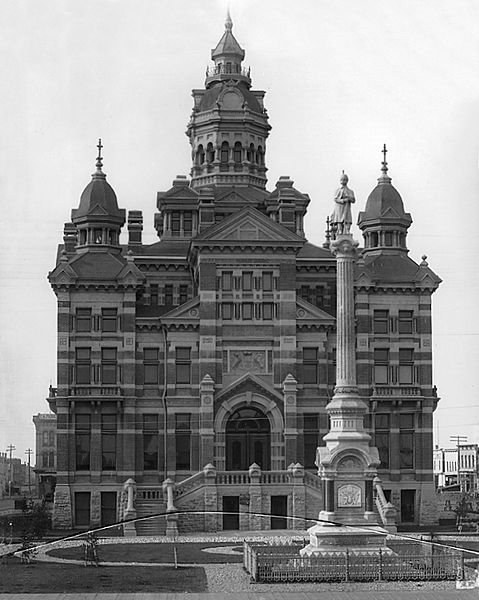 Winnipeg is a fine example of this. Its glorious initial City Hall, constructed in the late 19th century when Winnipeg was a boomtown, the laying of its cornerstone was a momentous occasion and a public holiday. Looking at the old building, it’s easy to see why Winnipeggers were so proud of it. It was a striking Victorian presence over the city. But, by the 1960s, it was antiquated and, like Boston, the ‘Peg choose to replace its City Hall with a new brutalist design.
However, unlike Boston, Winnipeg’s brutalist City Hall at least has greenspace around it. Interestingly, the introduction of greenery and foliage around brutalist architecture can go a long way to normalising it and reducing its imposition on the landscape. This is, I would think, why brutalist architecture on university campuses, as ugly as it is, doesn’t impose in the same way that Government Center does. Government Center is devoid of green space, there isn’t a single one anywhere on the massive, sprawling development. 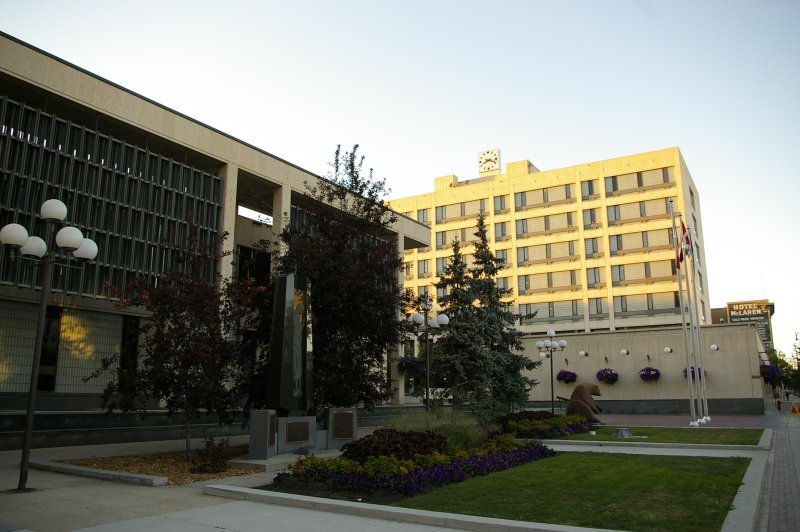
What Government Center replaced is Scollay Square, which was created officially in 1838, though the name dates back to the end of the 18th century; it was named for William Scollay, a local businessman. Scollay Square was the centre of downtown Boston throughout its existence. The problem was that by the Second World War, Scollay Square was getting seedy. One of its centrepieces was the Howard Theatre, and by this point, it was starting to slide downscale and attract a sleezy clientèle, mostly sailors on shore leave and, oh heavens!, students. Scollay Square was on the decline. And when the Howard was raided by the city’s vice squad in 1953 and shutdown due to a burlesque show, the writing was on the wall. The Howard eventually burned down in 1961. By the 1950s, Boston city officials were looking around for excuses to tear apart Scollay Square. The area was becoming home to too many flophouses and Boston’s rough waterfront had migrated too far inland. The Howard’s destruction by fire became the excuse to step into action, and it was torn down. Over 1,000 buildings were torn down and over 20,000 residents, most of whom were low income, were displaced.
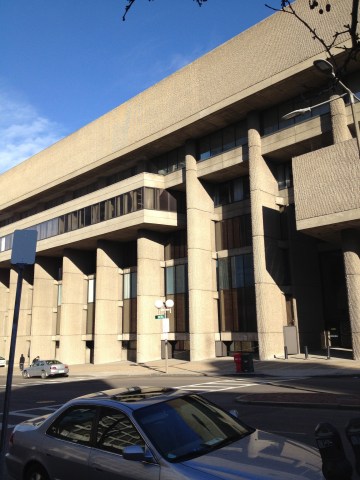
In many ways, Boston is no different than any other North American (or, for that matter, European) city in the 1960s, undergoing urban redevelopment. Montréal also underwent massive redevelopment in the 1960s and 70s, as a trip through the downtown core shows today. Place-des-Arts, Place Desjardins, Place Ville-Marie, the Palais de Justice and the Palais de Congrès all date from this period. It’s not even the scale of Government Center that sets it apart from other redevelopment. No, it’s simply the massive failure of it, and its horrid imposition on the landscape of downtown Boston. Certainly, breaking up the monotony of concrete and red brick with trees, grass, and other such things would help. But, at the end of the day, as ugly as brutalist architecture is elsewhere, nothing can quite touch the size and grandeur of the buildings in Government Center. Walking up Staniford Street, it’s impossible not to be overwhelmed (or maybe the proper term is underwhelmed) by the Government Service Center.
Boston’s mayor, Thomas Mennino, has mused several times in recent years about doing away with at least City Hall and re-locating to South Boston. Not surprisingly, this was met with controversy, as a group called “Citizens for City Hall,” professing to love the building, threatened all kinds of hellfire and damnation should Mennino think about destroying it. Fortunately for them, the recession got in the mayor’s plans. Citizens City Hall sought to have the location designated as a landmark, and also noted that re-locating the seat of city government to Southie, as Mennino planned, would also lead to the dislocation of thousands of residents (again, just as when Government Center was built). At any rate, by 2011, cooler heads prevailed and a new group, “Friends of City Hall” sought to improve the present location and do something to make both City Hall and the Plaza more user friendly. Part of this work will begin this summer, when the MBTA shuts down the Government Center T station to remodel it. Hopefully something can be done to improve Government Center as a whole, not just City Hall and its Plaza, to make this abomination more user-friendly and more aesthetically appealing.
 UPDATE: From personal friend and Tweep, John P. Fahey. who grew up in New Haven, CT: Agreed, Government Center suffers in comparison with the architecture in the surrounding area. Urban Renewal was a hot button topic in the 1960s. The idea was to sweep out the old neighborhoods and replace them with new buildings. New Haven did the exact same thing in the 1960s as part of the Model Cities initiative. It knocked down a narrow swathe of a neighborhood that ran from where I-91 starts about 3 miles to Route 34. The City put up an ugly Coliseum that has since been knocked down. When I was a kid I used to ask my mother when they were going to finish it because it never looked complete. New Haven ran out of Urban Renewal money and thus there is this long narrow strip of land extending from the center of New Haven that resembles Dresden after the fire bombing. There was enough Model Cities money to knock down the old neighborhood but not enough to put up the new buildings. If the New Haven Veterans Memorial Coliseum was an example of the type of the architecture that the Elm City would have received, then maybe it was lucky.
Writing Montréal
February 2, 2013 § 1 Comment
I am reading Kim Echlin’s beautiful novel, The Disappeared, right now. It was shortlisted for the Giller Prize in Canada, and it won a Barnes & Noble award down here in the States. The awards are very much deserved, Echlin’s prose is beautifully constructed; sparse, taut, sensual sentences follow the heroine, Anne Greves, from the cold streets of Montréal to the scarred streets of Phnom Penh in the wake of Pol Pot and genocide in Cambodia. It is compelling reading.
But (and you knew this but was coming), I find myself fascinated with the problems in writing Montréal, as The Disappeared is full of them. I have sometimes wondered if Montréal, being the complicated, chaotic, bizarre city it is, can even be successfully written, especially en Anglais. But, of course it can. Mordecai Richler. Rawi Hage. Occasionally, even we academic types get it right, most notably, Sherry Simon in her brilliant book, Translating Montreal: Episodes in the Life of a Divided City. Montréal is not your average city. Your average city is a huge, complicated, seething multitude of humanity. Your average city is complicated, it is corrupt, it is beautiful and it is dirty and savage. Montréal is all that and more, in large part because it is, as Simon argues, a divided city. Divided cities, of which there are many in the world, are necessarily more complex and complicated. There are competing historical narratives and political realities battling for space on the cultural and political landscape of the city. Derry, Northern Ireland, is a small divided city, but the city is caught between two competing narratives of the city’s past, one Catholic, one Protestant, fighting for dominance.
Montréal, of course, is rent between the francophone version of the past and vision of the present and the anglophone equivalent. Historically, the city is split down the middle, blvd. Saint-Laurent, the Main. To the east, francophone and Catholic, to the west, Anglophone and Protestant. But this dichotomy doesn’t really work in reality, as the Irish complicated it, they were Catholic and lived in the west end, they were English-speaking and lived in the east end. Then the Jews came around the turn of the last century and settled in between the French- and English- speakers. And then the rest of the world came, and the city became multicultural in the last third of the 20th century. Then there’s the question of class. Montréal today is a city that holds a history for all these diverse populations, speaking their own languages, going to their own houses of worship, patronising their own businesses. But Montréal also holds a history of these people crossing their divides, and working together, shopping together, sharing their food and their language across these divides. We historians are left to find all these disparate strands of Montréal and attempt to unravel the complications, to look at how the complications arose, to see how all these peoples co-operated, and how they conflicted.
To return to The Disappeared, Echlin gets caught up in all of these complications. For example, the main character, Anne Greves, an Anglophone teenager in the 1970s, whose father teaches at McGill, lives on avenue du Parc. Anglos in Montréal today tend to call it Park Ave. Even bilingual ones. In the 1970s, Anglos did not call it av du Parc. But Anne also uses the English names for nearly everything else in the city. Bleury Street. The Oratory. Mount Royal. Old Montréal. And of course Anne would, all my cousins who are Anne’s age, who still live in Montréal, use the Anglo names. The only other locale in Montréal that gets called by its French name by Anne is the bishop’s cathedral downtown, Marie-Reigne-du-Monde. Being the Montréal purist and historian, I find these kinds of misnomers distracting. Perhaps it’s because Anne is caught between these various Montréals, perhaps it’s because she came of age in the late 1970s and the 1980s, when we fought about all of this, what to call things, what language we must speak and so on. And maybe it’s because Montréal is just here in passing, it’s where Anne is from. Soon, we are in Phnom Penh with her, sifting through the aftermath of Pol Pot’s psychotic reign.
But Echlin’s problems with nomenclature in Montréal really only speak to the general day-to-day issues on the street there. What you call av du Parc (OK, I admit, I’m an Anglophone who tends to use the French names) reflects a lot on who you are, where you’re from in the city, what your politics are. The same is true of Saint-Viateur, Mary Queen of the World, the Oratory and so on and so forth. And it is exactly this nature of the divided city I adore about my hometown. And I have to admit, I kind of miss it.
The Working-Class and Community, Griffintown and Beyond
February 1, 2013 § 6 Comments
Almost to a person, every former Griffintowner I talked to over a decade of working on the neighbourhood commented on the sense of community they felt in living there, how it was a place where people took care of their neighbours. David O’Neill, who helped me extensively during the research and who put in me in contact with many former Griffintowners, commented that when he was growing up there in the 1940s and 50s, it was like having a community of parents, everyone watched out for each other’s children on the streets. And if O’Neill and his friends got up to something they shouldn’t have, by the time they returned home, their parents would be waiting for them with the intelligence, ready to punish the kids.
But Griffintown was never unique for this characteristic, this is a commonality to nearly all former working-class neighbourhoods I’ve ever read about, on both sides of the Atlantic Ocean. It is also a way that is lost today. People who grew up in close-knit working-class communities are almost always nostalgic for what has been lost. They miss the community and comaraderie they experienced in those communities. They miss what kept them in line, be it the Church or work, or just the simple existence of real and authentic community.
The universality of this mindset hit home the other day in Salem, MA, at the National Park Service’s Custom House site. When the Park Service created the site, they removed a set of derelict buildings that had popped up in an alleyway behind the old Customs House on Derby Street. In the early 20th century, an entire working-class immigrant community existed along Derby Street, and in the alleys behind the Customs House. Here there were tenement houses of varying quality and shops and services that served, first, Irish immigrants, and then, in the 20th century, Poles and Russians and Ukrainians. Taking aside the question of the authenticity of the Customs House site given the destruction of the homes of this long-gone working-class community, what struck me the most was the description of what was once there, including a quotation from a former resident, Dorothy Philip, as seen in the photo here.

 Matthew Barlow