On Missing Home
July 26, 2018 § 4 Comments

Riding the metro in Beijing the other day, listening to Wolf Parade’s track ‘Valley Boy,’ I suddenly had this moment of vertigo as my mind was riding the 55 bus up blvd. St-Laurent back home in Montreal. ‘Valley Boy’ is a tribute to Leonard Cohen, our city’s patron saint of letters. Wolf Parade, though from Vancouver Island, are also a Montreal band. A few minutes later, my friend, Darryl, who is in Montreal from Alberta this week, sent me this photo.
There is nothing more alienating than to feel yourself in a city over 11,000km away from where you are. But I was in Montreal. But not the shiny Montreal of 2017, the grittier Montreal of the early 2000s, when the Main was half dug up in construction, and the rest was littered with discarded coffee cups and remnants of the weekend’s detritus. In those days, it wasn’t uncommon to see Cohen wandering around, visiting his favourite haunts, talking to the occasional person brave enough to actually approach him.
I never did. He was Leonard Cohen, He wasn’t a man for small talk, or pointless conversation. I did, though, meet Cohen once, a long time ago. It was the early 90s, he was touring behind The Future, and in a laundromat in Calgary, there he was folding his laundry as I was putting mine in the dryer. It was a random meeting and he dropped a sock, I picked it up for him. We talked for a bit, about nothing and everything and then he went on his way. I still don’t know why he was doing his own laundry on tour.
Montreal is changing, soon it have the newest infrastructure of any city that matters in North America. Every time I go home, I hear more and more English, and not just downtown, but on the Plateau, in the Mile End and in my old haunts in Saint-Henri and Pointe-Saint-Charles. But even worse is the creep of major chain retailers. It used to be that Montreal was a holdout against this invasion. It was a city of small shops, mom and pop outfits, all up and down the Plateau, even downtown and in the other boroughs. I bought a stereo at a small store on Sainte-Catherine near MusiquePlus that has been shuttered for over a decade now, killed off by the Best Buy.
Montreal is losing its soul, I’m afraid. I take no pleasure in saying this, in fact, it hurts my own soul to say so. But there is a deep and dangerous cost of the gentrification of the city. My buddy Steve is a New Yorker at core, even if he long ago escaped. Each time he goes home to Queens, he is more and more appalled by what he sees in Harlem and Brooklyn and even Queens. Sure, it was a safer city and all that, but it was losing its soul. I always felt smug in the belief my city couldn’t do that. And better yet, my city was never crazy violent and it had, by the early 2010s, appeared to have recovered from the economic uncertainty of the separatist era. Hell, for a few years at the turn of the century, Montreal was actually the fastest growing city in Canada.
And so Leonard Cohen has been dead for almost two years. In ‘Valley Boy,’ Spencer Krug, one of the frontmen of the band, sings:
The radio has been playing all your songs
And talking about the way your slipped away up the stairs
Did you know it was all going to go wrong?
Did you know it would be more than you could bear?
In interviews, Wolf Parade have hinted this was about the larger geopolitical shitstorm that was engulfing the world when Cohen went to his great reward. As I was riding up the Main on the 55 bus in my head the other day, I thought differently. This was about Montreal, a city they and I have all moved on from, and one that Cohen left many times. Of course, Cohen also said that you can never leave Montreal, as it travels with you wherever you go and it calls you home. Later on the album, Krug sings, ‘Take me in time/Back to Montreal.’ And so we never do really fully leave.
Political Tribalism
July 24, 2018 § 2 Comments
There has been a lot of hand-wringing about the election of Donald Trump to the US presidency. This began the night of the election and shows no signs of abating. The current issue of Foreign Affairs, the august publication dedicated to the impact of the world on the US and vice versa, is dedicated to unraveling this question from the point-of-view of foreign affairs and policy.
In the issue is an article from Amy Chua, John M. Duff, Jr., Professor of Law at Yale, adapted from her new book, Political Tribes: Group Instinct and the Fate of Nations. In it, Chua argues that tribalism explains not just messy American involvements in Vietnam, Iraq, and Afghanistan, but Trump. In the case of those three messy wars, she notes that American policy makers failed to recognize questions of ethnic or national identity in those three countries, hence the quagmires. Her argument is compelling and well argued.
But when it comes to Trump, it seems to me she is on much shakier ground. She argues that tribalism is what led to white voters to elect him. She notes that the white majority in the United States is shrinking and Trump capitalized on that. So far, so good. She goes on to discuss classism and the plight of the (white) poor in the country. Again, so far, so good. But it’s when she gets into unpacking this argument, I begin to wonder about it.
She argues, as many others have, that due to the widening gulf between rich and poor, it is now harder for the poor to escape poverty and attain middle class standing. I have yet to see compelling data on this (though it is entirely possible it exists). But, allow me to be the historian here and point out that this so-called American Dream is more a dream than a reality. The United States, like any other culture or nation, is based on inequality. And it has been since the birth of the patriot movement in Boston in the early 1770s. In those days, the élites of the city used the working classes to engage with the British, from the Boston Massacre to the outbreak of violence. As with all other armies in history, the infantry of George Washington’s nascent Continental Army was from the lower reaches of society (for a very good analysis of the plight of the white poor in American history, you can do worse than Nancy Izenberg’s White Trash).
Inequality has always been the norm here, and it remains so today. Sociologists and political analysts have been wringing their hands over the white working classes and the white poor who voted for Trump in various parts of the nation (together with continuing with the canard that Hillary Clinton did not visit key parts of the country where such folk live). But the white working classes and the poor have been here for a long time. I lived in Appalachia in Tennessee when Trump was elected. My neighbours voted for him, as they voted for Republicans in 2012, 2008, 2004, 2000, and 1996 (it is possible they voted for their fellow Southerner Bill Clinton in 1992) and before that too. The people where I lived were poor then, too, and they were poor when they helped elect Ronald Reagan in 1980, too. And so on.
Chua argues, though, that tribalism is emerging amongst the white working classes and the poor. But, my historian’s training tells me this is nothing new, either. In fact, this was how the planter élite in the antebellum and Civil War South convinced the poor white farmers that ethnic/racial lines mattered more than class lines. The historian Noel Ignatiev argued in 1997 in his ridiculous How the Irish Became White that had the Irish, the most downtrodden of the downtrodden white people in the antebellum United States pitched their lot with African Americans, then slavery would’ve ended a generation or two earlier. There is no universe I can see where that would’ve happened. The Irish were never going to cast their lot with African Americans in the United States, in the North, the black population was their closest economic rival. In Canada, it was the French Canadians with whom the Irish shared the lowest rung of the ladder. And the Irish and French Canadians did fight, literally. But they also intermarried and socialized together. But, of course, in the antebellum North, so did the Irish and free black populations, from both vicious racial attacks in Manhattan’s Five Points by the Irish, to intermarriage and socialization.
But the larger point is that the way in which capitalism is organized is to exploit differences and tribalism at base levels. In other words, the second lowest group on a totem pole is never going to side with the group below it. That’s not how it works. And in the United States, as David Roediger argued, questions of whiteness were exploited by the capitalists and planter class to get the poor people to authenticate a form of shared whiteness. Roediger made the argument that what sociologists called ‘ethnic brokers’ encouraged the white working classes (a large segment of which was Irish) to side with their (white) social betters against African Americans.
In other words, what Chua is identifying is not new. Tribalism on the part of the white working classes was part and parcel of the American experience in the 19th century, and it was in the 20th, too. And not just in the example of the Ku Klux Klan. The Klan, of course, in all of its manifestations, may have been led by élites, but it was the poor and the working classes and farmers who engaged in the racist behaviour and violence (with some help, of course). But the white working-, middle-, and poor classes during the Civil Rights Era were the resistance to the work of Dr. King, Malcolm X, Rosa Parks, and others.
So, ultimately, Chua’s argument (at least in the Foreign Affairs August issue, I haven’t read her new book yet) falls on its face here. Identifying an old standing behaviour and calling it new and exceptional to explain something surprising does not hold water.
Child Spies
July 20, 2018 § 4 Comments
News has erupted in the United Kingdom that Scotland Yard has been using children as spies for criminal cases. Not surprisingly, most British are sickened and appalled by this, as are the usual array of human rights groups. There can be no defence of this. None. This is one of the most morally repugnant things I have ever come across in my life.
The children are pulled from a database about gang members, apparently. And certainly, some have already decided that they’re criminals and therefore forfeit their civil rights. It’s not that simple. First, they’re children. Second, being in this database is not necessarily an indication of criminality. Third, even if they are, that is not an excuse to curtail someone’s civil rights. To do so is inhumane. It says that someone is less of a human due to past behaviour.
The House of Lords committee that revealed the existence of this programme is sickened. Even David Davis, one of the most self-serving British politicians of our era (he resigned from PM Theresa May’s cabinet a couple of weeks ago) is appalled. I wonder what Boris Johnson thinks?
And yet, here is May’s spokesperson defending this practice:
Juvenile covert human intelligence sources are used very rarely and they’re only used when it is very necessary and proportionate, for example helping to prevent gang violence, drug dealing and the ‘county lines’ phenomenon. The use is governed by a very strict legal framework.
In other words, we don’t care about the rights of children, we think they are there to serve the needs of the police, and if you’ve got a problem with this, it is frankly because you are a bleeding heart. This is disgusting. And immoral.
And this is moral relativism at the root. Doing something immoral, disgusting, and wrong can be explained away as just another policy in the Met’s crime-fighting tool kit. We have reached the point where in one of the wealthiest, most powerful Western democracies in the world, exploiting children is seen as an acceptable practice by a circle of the government and the police.
Merci Beaucoup and Thank You
June 14, 2018 § 1 Comment
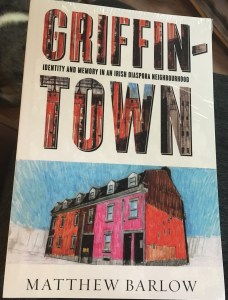 At the end of May, at the annual Congress for the Humanities and Social Sciences in Regina, SK, my book, Griffintown: Identity & Memory in an Irish Diaspora Neighbourhood, won a CLIO Award from the Canadian Historical Association. I wrote the best book in Québec history last year. I was stunned and surprised when I found out about this award in early April and I remain just as gobsmacked today.
It is very humbling to be recognized by your peers for your work, I have to say. It has also been humbling to see the response to the book as a whole. Last September, I hosted a book launch back home in Montreal at Hurley’s Irish Pub. It was an amazing night, as new and old friends came out, well over 100 people in all, spilling out of our main room into the bar area. In April, to celebrate the American launch of the book, I hosted another launch at Amherst Books in Amherst, MA. It was another gratifying evening, as more people than I could count came out, including friends, colleagues, and even students. We sold out the stock of the book in short order.
I am proud of this book. I think it’s a good book. But that’s only part of the story. The book is also beautifully packaged, designed by the team at University of British Columbia Press, using the art of my good friend and colleague, G. Scott MacLeod. Scott’s art makes my book cover look so stunning.
Working with UBC Press was wonderful. I had excellent editors in Darcy Cullen, the acquisitions editor, and Ann Macklem, the production editor. I enjoyed working with Darcy so much that I was sad when she passed me off to Ann. But Ann was also amazing to work with. Darcy and Ann made the often Byzantine process of academic publishing easier and more sensible to me.
And my anonymous reviewers; I know who they are now. But I will respect their anonymity. All I can say is that they both were incredibly encouraging. They found the holes in the manuscript I knew existed, they found some I didn’t realize. But they both also offered many options and possibilities to fill those gaps in the research, the theory, and so on. I learned a lot about writing a book and about history, theory, and method from them.
My book is, obviously, better for the experience with UBC Press, and my anonymous reviewers. And for that, I am eternally grateful. I am also grateful to the committee that determined the CLIO Awards, and to everyone else along the way, both before and after publication, who was supportive and encouraging.
Doug Ford: Ontario’s Populist
June 11, 2018 § 2 Comments
Canada is beside itself with the election of Doug Ford as the Premier of Ontario. Ford, the leader of the Progressive Conservative Party of Ontario, is not really all that qualified to be premier, I must say. The lynchpin of his campaign was a promise of $1 beer, and the rest was based on a basic message that the government of Liberal leader Kathleen Wynne was stupid. Well, he didn’t exactly say that, but it was pretty much his message. The centre and left in Ontario and around Canada has been wringing its hands as Donald Trump Lite™ has been elected to lead the largest province in Canada.
It is impossible to deny Ontario’s importance to Canada, it is the most populous province, home to the largest city in the country. And Ontario’s economy is the 8th largest in North America. And, of course, Toronto is also the most diverse city in the world.
Ford, for the most part, did not run on a racist campaign, like the American president, and he has generally not uttered racist comments. But, while he hasn’t, his supporters have. Like everywhere else in the Western world, racism is on the rise in Ontario, and Canada as a whole. The reasons for this are for another post.
The commentariat in Canada has been aghast, rightly so, at Doug Ford’s election. He is a classic populist, a multi-millionaire who pretends to be for the little guy, and mocks the élites for being, well, élites.
But, ultimately, Doug Ford’s election isn’t a rupture with Ontario’s political past. It is also not necessarily a sign of Trumpism coming to Canada. Ontario has a long history with populist premiers, dating back to the Depression-era leadership of Mitch Hepburn. But, also more recently, with the government of Mike Harris in the 1990s.
Mike Harris was elected premier in 1995. In a lot of ways, I think commentators have seen his election as a correction of sorts, after the province had shocked the rest of Canada in electing the NDP government of Bob Rae in 1990. Rae’s time as premier did not go smoothly, and so Harris’ election must be seen in that light. Harris, like Ford, was a populist, and ran on something he called the Common Sense Revolution. Harris sought to bring common sense to Ontario politics. This went about as well as you’d imagine.
Harris’ government cut the social safety net of Ontario something fierce. He also tried to introduce boot camps for juvenile offenders. Harris rode the crest of the 1990s economic boom, and once the economy crashed with the dotcom bubble, he resigned as premier (for personal reasons, I might add) in 2002 and the PC government of Ontario stumbled along with Ernie Eves as premier before getting trounced by the Liberals of Dalton McGuinty in 2003.
Harris’ policies led indirectly to people dying in Ontario. The most obvious example is during the horrible Walkerton e-coli crisis in 2000. There, due to the bumbling incompetence of the Koebel brothers, who operated the Walkerton water supply without any actual training, e-coli entered the supply system. Over 2,000 people fell ill, and 6 people died. Harris’ government was blamed for 1) Refusing to regulate water quality around the province via some form of supervision; 2) Related to 1), not enforcing the rules and guidelines pertaining to water quality; and, 3) the privatization of water supply testing in 1996.
And then there was Kimberly Rogers. Rogers was a single mother and was convicted of welfare fraud. Rogers had collected both student loans and welfare whilst going to school. This had been legal when she began her studies in 1996, but Harris’ government had put an end to that the same year. Rogers plead guilty to the fraud in 2001 and was sentenced to house arrest. And ordered to pay back the welfare payments she had received, over $13,000. She was also pregnant at the time. Her welfare benefits were also suspended; she was on welfare because she couldn’t find employment, even with her degree. The summer of 2001 was brutally hot in Sudbury, her home town, and she was trapped in her apartment with no air conditioning as the temperature outside crested 30C, plus humidity. She committed suicide in August 2001.
An inquest found fault with the government, noting that someone sentenced to house arrest should be provided with adequate shelter, food, medications. Rogers had the first, but not the other two. And while Rogers did break the law, the punishment handed out did not necessarily fit the crime, especially insofar as the house arrest went. And this was due to Harris’ reforms. Upon delivery of the inquest report, Eves’ government refused to implement any reforms, complaining to do so would be to tinker with an effective system.
Meanwhile, Toronto, the self-proclaimed Centre of the Universe, has embarrassed itself with its mayoral choices. The first time was when it elected Mel Lastman mayor in 1997. Lastman had been mayor of the suburb, North York, but Harris’ government had amalgamated Toronto with its suburbs, and so Lastman was now mayor of the new city. Lastman did a lot of good as mayor, that cannot be denied.
But. There was the time when his wife got caught shoplifting in 1999, and Lastman threatened to kill a City-TV reporter. Yes, the mayor of the largest city in Canada threatened to kill someone. He also cozied up to Hells Angels when they held a gathering in Toronto. During the 2003 SARS crisis, he groused on CNN about the World Health Organization, claiming the WHO didn’t know what it was doing and that Lastman had never even heard of them (as an aside, due to the WHO’s work, SARS didn’t become an epidemic). And then there was his trip to Mombassa, Kenya, in 2001 in support of Toronto’s bid to host the 2008 Olympics. Lastman told a reporter:
What the hell do I want to go to a place like Mombasa?… I’m sort of scared about going out there, but the wife is really nervous. I just see myself in a pot of boiling water with all these natives dancing around me.
Lastman, though, was just the precursor to Rob Ford, Doug Ford’s younger brother. Rob Ford ran on a similar campaign of populism. He wasn’t qualified for the job. But it was the larger circus of his life that was concerning. The police were called to his house several times on suspicions of domestic abuse. He also had problems with drugs and alcohol that included an addiction to crack cocaine. He had a habit of getting drunk at Toronto Maple Leafs games and yelling and threatening and abusing people around him. And he, of course, appears to have smoked crack whilst mayor with some gang members. Ford’s larger run as mayor was on the basis of populism, and attacking transportation infrastructure projects, as well as privatizing garbage pickup.
So, as we can see from the past 3 decades of life in Ontario, Doug Ford isn’t exactly the horrible rupture many wish to see him as. He is, instead, a horrible continuity of populism and dangerous politics.
Wither Nos Amours
March 30, 2018 § 1 Comment
Rusty Staub died yesterday. ‘Le Grand Orange’ was the first franchise icon for the Montreal Expos. The Expos, in hindsight, were a star-crossed franchise from the getgo. Staub arrived in Montreal in the winter of 1969, just before the Expos inaugural season. He was dealt away in 1972, to the New York Mets. Social media today in the United States remembers Staub as a long-time Met. In Canada, he is an Expo.
Staub was before my time, he was traded away before I was born. But I grew up knowing the story of Le Grand Orange, the greatest player in franchise history when I was a kid. He did return to the ‘Spos, as we called them, in 1979, though he left again in 1980 for Texas. His #10 was the first number retired by the Expos.
His death got me to thinking about the sad history of my first baseball team. The Expos lasted from 1969-2004, before moving to Washington. They weren’t a great team, to be honest. They had their ups, but had more downs, and they left town with an historic losing record. They won the NL East once, during the 1981 strike season, but then they lost a playoff to the Los Angeles Dodgers. Rick Monday hit the homer that crushed my childhood dreams of a World Series for the ‘Spos. That day is still called Blue Monday in Montreal.
The Expos were a decent team in the early 1980s. But they peaked in the mid-90s. In 1992 and 1993, the Toronto Blue Jays won back-to-back World Series. In 1994, the Montreal Expos were the best team in baseball, with a 74-40 record on 12 August 1994, when the players went on strike, and were well ahead of the Atlanta Braves in the NL East. The Expos were the favourites for the 1994 World Series. Alas, it was not to be. The 1994 players’ strike was disastrous for Nos Amours, as the Expos were called in French. And over the next 10 years, they died a slow and painful death due to a horrible stadium, worse ownership and MLB.
In thinking about Staub yesterday and today, I realized that the Expos do not even own their own franchise icons. All of the icons of the Montreal Expos are famous for, or even more famous for, their play in other cities. Like Staub, Gary ‘The Kid’ Carter went to the Mets, where he also won a World Series. André ‘The Hawk’ Dawson (my childhood favourite player) went onto Chicago, which had a grass field, easier on the Hawk’s knees. Tim Raines went on to play for a handful of teams, winning two World Series with the Yankees. Pedro Martinez, perhaps the Expos’ greatest pitcher, is more famous for his exploits in ending the Boston Red Sox’ long World Series drought. Larry Walker, Canada’s first superstar, became a batting champion in Denver. And the Expos’ last great player, Vladimir Guerrero, is more famous for playing for the California/Anaheim/Los Angeles Angels.
It’s a depressing tale. Of these greats, all but Walker and Staub are in the Hall of Fame. The only consolation is that Carter, Raines, and Dawson went in wearing their Expos caps.
Stupid Season in Montreal
March 26, 2018 § Leave a comment
Last Thursday night, the Montreal Canadiens hosted the Pittsburgh Penguins. They lost 5-3. The Canadiens are having a miserable year, this loss, their 48th of the year (including regulation and overtime losses), officially eliminated them from playoff contention. The mood in the city is dour and angry. Fans are upset at management for mismanaging the Franchise, Carey Price. He had some mystery ailment he said was Chronic Fatigue Syndrome bothering him earlier in the year. It wasn’t team doctors who noticed it; it was his wife, Angela. Big defenceman Shea Weber played through a nasty foot injury before being shut down for the season and having surgery.
Then there’s the mistakes General Manager Marc Bergevin made in the off-season. He traded away promising defenceman Mikhail Sergachev for moody, sulky, but very talented forward Jonathan Drouin. And then the team put Drouin at centre, a position he hadn’t played for years. Why? Because the Habs haven’t had a #1 centre since the peak of Saku Koivu’s career in the late 90s/early 00s. Drouin, not surprisingly, has been a bust. Bergevin also let iconic defenceman Andrei Markov walk after he insulted Markov in contract negotiations. Bergevin then had the gall to tell us that the defence was better this year than last. I could go on and on.
Something stinks in the City of Montreal and it is the hockey team. It is a laughing stock.
And, not surprisingly, the Twitter wars have been epic. During last Thursday’s game, a prominent Montreal sportswriter made an idiot of himself. This is also not an uncommon occurrence when it comes to the Habs. He was in a discussion with a blogger, who noted that we Habs fans forget that the team has had 3-100 point seasons in the past 5. This sportswriter noted in response that “Germany had three really strong military years in WWII.”
And then all hell broke loose, as it should. When his interlocutor noted this stupidity, he dug in deeper, noting that “They [meaning Nazi Germany] were winning until they weren’t. It’s not that deep.” Another Twitter user called him out, and our intrepid journalist got his shovel out again: “Notice I said military. Only an idiot would stretch that into anything more.”
Well, maybe I am an idiot. As the second interlocutor noted, this is Nazi Germany we’re talking about. Not some random war. This is a régime that murdered 6 million Jews in cold blood, to say nothing of Roma, LGBT, and disabled victims. The Holocaust is, to paraphrase Elie Weisel, an event that cannot be understood, but must be remembered. There have been other genocides, particularly in the last half of the 20th century (after we, the West, declared “Never Again!”). But, the Holocaust remains beyond the pale in our collective consciousness.
And when this was pointed out to our journalist, that he essentially compared the management of the Montreal Canadiens to the Nazis, he got out his shovel and kept on digging: “No, not every soldier was a Nazi, not every German believed the Nazi ideology. But that’s beside the point, because we all know what I was saying, and it had nothing to do with Nazis.”
To put it bluntly, this is epic stupidity. According to the United States Holocaust Museum,
The German military participated in many aspects of the Holocaust: in supporting Hitler, in the use of forced labor, and in the mass murder of Jews and other groups targeted by the Nazis.
The military’s complicity extended not only to the generals and upper leadership but also to the rank and file. In addition, the war and genocidal policy were inextricably linked. The German army (or Heer) was the most complicit as a result of being on the ground in Germany’s eastern campaigns, but all branches participated.
And sure, maybe the journalist didn’t mean to bring up the Nazis. But words have meanings, and someone who works with words on a daily basis should know better. The Wehrmacht was by-and-large Nazified. Period. And his comparison of the Habs 3-100 point seasons with the Wehrmacht includes the Nazis, whether he meant it or not. And he should know better. I did hit the unfollow button, by the way.
The History of the Gerrymander
February 5, 2018 § Leave a comment
We live in an era in the United States where, in many states, politicians are picking their voters, not the other way around. This is because in most states, the boundaries of congressional districts are in the hands of politicians, and the majority of the party in the state house has more or less carte blanche to manipulated these boundaries as they see fit. In most democracies, this is handled by an independent commission to avoid just this kind of silliness. When left in the hands of politicians, I can see how the temptation to gerrymander is too great to resist. The logic is simple: If we gerrymander the boundaries of congressional districts, we can not only perpetuate our control of the state house, we can also manipulate and control the congressional party from our state, and if others in other states do it, preferably in our political party, then we can control government.
Of course, this is not how it’s supposed to work. And yet, we end up with congressional districts like these two, from California. We tend to hear in the news that Republicans are the ones who gerrymander. But they’re not alone. Democrats do, too. But, without question, Republicans do it more often. Anyway, look at these two congressional districts. One is the 11th District in California, the other is the 38th. One was Republican, one was Democratic. Both images are from c. 2004, and both districts have been re-drawn.
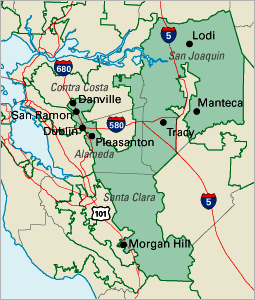
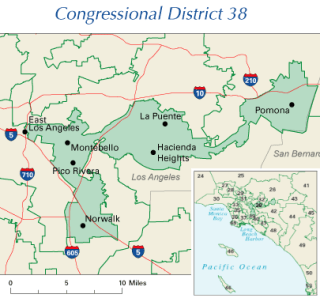
The gerrymander has been used in nearly every democracy, and is one of the many dirty tricks politicians have used to maintain power. That the gerrymander is, by definition, anti-democratic is another matter. The first time the word was used was in the Boston Herald, in March 1812.
That year, Massachusetts state senate districts had been redrawn at the behest of Governor Eldridge Gerry. Not surprisingly, Gerry’s gerrymander benefited his party, the Democratic-Republicans. The Herald’s editorial cartoonist was not impressed with the re-drawing of the South Essex district:
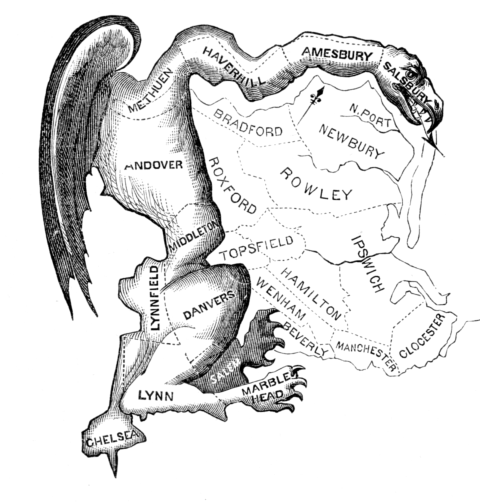
The Herald charged that the district looked like a mythical salamander, hence we get gerry-mander. It’s worth noting, though, that Gerry’s name wasn’t pronounced ‘Jerry’, but, rather, ‘Geary,’ so, in early 19th century Boston, it was supposed to be pronounced ‘Gearymander’. One theory I’ve read is that the Boston accent re-appropriated the word to ‘Jerrymander.’ More likely, though, something else happened: In the rest of the nascent United States, the name Gerry was likely to be pronounced ‘Jerry,’ not ‘Geary.’ And there we go.
For the remainder of 1812, Federalist newspapers and commentators around the country made use of the term to mock the Democratic-Republican party, which was then in the ascendancy. The Democratic-Republicans were Thomas Jefferson’s party, and it controlled the White House from his election in 1800 until the party split in 1824, largely due to Andrew Jackson. His branch eventually became the Democratic Party we have today. The other branch eventually became the Whigs. Together, the Democrats and Whigs were the core of the Second Party System of the United States, c. 1824-54.
The term also travelled out of the United States, crossing the Atlantic Ocean to the United Kingdom, and north to Canada. To be fair, the coining of the term in March 1812, came on the brink of the outbreak of the War of 1812 in June of that year. So, for the British, this was just another way to mock the Americans. But, either way, the term became an accepted term in the English language by 1847, according to the Oxford English Dictionary.
The Halifax Explosions?
February 1, 2018 § 4 Comments
The Canadian Football League has long sought to add a 10th team in the Maritimes. To do so would be to make the CFL actually national. But, the CFL has also had to deal with some serious instability with its franchises in Montreal, Toronto, and Ottawa, especially, over the past 30 years. Ottawa is currently on its third (as far as I can count) franchise since the 1980s. The Rough Riders folded in 1996. They were replaced by Ottawa Renegades; this franchise only lasted from 2002 to 2006. Currently, the REDBLACKS play in the nation’s capital. Meanwhile, down the 417 in Montreal, the original Alouettes folded in 1982; they were replaced by the Concordes, who only lasted until 1986. After that, Montreal was devoid of Canadian football until the Baltimore Stallions were forced out of that city by the relocation of the original Cleveland Browns to Baltimore in 1995. The Baltimore team moved to Montreal. Meanwhile, the Argonauts have never ceased operations, but they have been a basket case in terms of stability and presence in the city most of my adult life. So, in other words, expansion to the Maritimes has not exactly been on the front burner. But that’s changed recently, and reports state that not only is there an ownership group in Halifax, but there is will at CFL headquarters.
Personally, I’d love to see a Halifax CFL team. This would both make the league truly national, it would also speak to the deep popularity of Canadian football in the Maritimes. The universities of the Maritimes have a long and deep tradition of Canadian football. And just like the Alouettes and the REDBLACKS (in French, the ROUGENOIRS) have offered a professional career to many French-Canadian football players emerging from Quebec’s college teams, a Halifax team could do the same.
It is unclear what the team would be called, and so, social media (as well as Halifax’s media in general) is full of speculation, and a bevy of names have been proposed. Last week, a fan art Twitter account, dedicated to this proposed team, suggested that perhaps the team could be called the Explosions, in a tweet:
Uh, yeah. No. The Halifax Explosion occurred on the morning of 6 December 1917, when a Norwegian ship collided with a French cargo ship, the Mont-Blanc, in the Halifax Harbour. The French ship was carrying explosives and war munitions (this was the middle of the First World War, after all) and caught fire after the collision. The fire ignited the cargo, which then exploded. It devastated a large chunk of Halifax. Nearly every building within a kilometre radius was destroyed. A pressure wave accompanying the explosion snapped tress, grounded vessels in the harbour, and devastated iron rails. The remnants of the Mont-Blanc were found several kilometres away. Nearly every window in the city was broken. The city of Dartmouth lies across the harbour from Halifax. It suffered extensive damage. The Mi’kmaq First Nation, near Dartmouth, was destroyed by a tsunami caused by the explosion.
The blast was the largest human-made explosion prior to the advent of nuclear weapons. It released the equivalent of 2.9 kilotons of TNT. Think about that for a second. Of all the blasts of bombs and munitions in war prior to 6 and 9 August 1945, the Halifax Explosion was the greatest one ever caused by humans. It killed over 2,000 people and injured nearly 10,000 more, out of a population of around 95,000.
In short, the Halifax Explosion destroyed the City of Halifax. So suggesting a CFL team be called the Explosions is flat out disrespectful and idiotic. Shame on @CFLinHalifax for even suggesting it. Since this initial tweet on Monday, the people behind the account have doubled down in their idiocy.
Meanwhile, the CFL and the proposed Halifax ownership group have had to put out press releases distancing themselves from @CFLinHalifax.
The (Sort of) End of Chief Wahoo
January 30, 2018 § Leave a comment
The Cleveland baseball team took a positive step this week. It announced on Monday that it was going to remove the deeply offensive Chief Wahoo from its caps and jerseys for the 2019 season. This is an important start. Chief Wahoo is an offensive caricature of an indigenous chief, drawn in a cartoonish, stereotypical manner. Note that not only is he grinning, he is actually red. Like, you know, ‘redskin’. (The Washington football team is a whole other problem, for another day).

Chief Wahoo.
Chief Wahoo has a long genesis. The Cleveland baseball team was originally founded in Grand Rapids, MI, in 1894, and known as the Rustlers. It moved to Cleveland in 1900, calling itself the Lake Shores. Seems pretty obvious how that name didn’t stick. Up to that point, the Grand Rapids/Cleveland team was a minor league team, in the Western League. In 1900, the Western League evolved into a major league, rebranded as the American League (the National League dates back to 1876, hence, it is sometimes called ‘the senior circuit’). The Cleveland baseball team is a charter member of the AL, and for the launch of the new league in 1901, it also rebranded itself as the Bluebirds. In 1902, they were the Barons (this name was revived by the sad sack NHL team based in Cleveland from 1976-78; they didn’t last long, in 1978, they merged with the Minnesota North Stars, which is now the Dallas Stars franchise). From 1903 to 1914, they were named after their star player, Nap Lajoie. But, in 1914, Lajoie left Cleveland to go play for the Philadelphia (now Oakland) Athletics. So, the Naps needed a new name.
And so, we ended up with the Indians. This was meant to be a nod to Cleveland baseball history. The original major league team in town was the Cleveland Spiders of the National League; they folded in 1899, precipitating the Rustlers’ move to the big city. The Spiders had had an indigenous player, Louis Sockalexis, who played his whole career with the team Thus, the Indians. So, in a way, the name came about as a tribute both to the defunct baseball team and to one of its star players. But, of course, this is one of those historical obscurities that got lost, it has become anachronistic over time.
In 1932, the Cleveland Plain Dealer used a cartoon precursor of Chief Wahoo as a logo to stand in for actually using the full name of the team. This version became known as ‘the little Indian,’ and the Plain Dealer used the logo in its coverage for the next several years. In 1947, the team’s owner, Bill Veeck hired a graphic design firm to create a new logo for his team. And thus, we got the original Chief Wahoo. He wasn’t called that at the outset, in fact, he had no name. Also, while a cartoon stereotype, he wasn’t red-skinned. A red-skinned version appeared in 1948, but was not the official logo of the team until 1951.

Cleveland BasebalL Team logo, 1947-50
The name Chief Wahoo eventually came from Cleveland sports writers. The guy who created the original, in 1947, Walter Goldbach, was only 17 years old at the time. Goldbach has noted several times since that he didn’t mean to offend anyone, and that he actually had a hard time to render an indigenous man as a cartoon. He also has argued that Chief Wahoo isn’t actually a chief, he’s a brave. He only has one feather. (That of course, brings us to the Atlanta baseball team, another issue for another day).
Chief Wahoo remained the primary logo of the Cleveland baseball team until 2013, when it decided that perhaps it was time to start rethinking Chief Wahoo. At that time, the team unveiled a new logo, a stylized C, for Cleveland. It’s actually the superior logo. I much prefer it.

The Cleveland Baseball Team logo, 2013-present
The Clevelands have not, of course, won a World Series since 1954, the longest running drought in professional sports (now that the Chicago Cubs have won the World Series). Cleveland sports writers have wondered if Chief Wahoo is actually a curse.
So the announcement this week that Chief Wahoo is being retired next year is welcome. Except that’s not entirely the case. You can believe there will be a run on this offensive cartoon logo as this season and year progresses. And, in order to maintain the trademark, the team will continue to sell Chief Wahoo-branded gear in the Cleveland region after banishing the logo from the uniform.
So this isn’t a total victory. But it’s an important start. The next thing is to get the Cleveland baseball team to change its name, perhaps to the Spiders. And then there’s the Washington football team, and the Atlanta baseball team. But, baby steps?

 Matthew Barlow