Canada and the North American Triangle
January 5, 2013 § 3 Comments
 Twice in the past few weeks, I have been caught up in discussions about the role of the monarchy in Canada with Americans. These discussions rather astounded me, I have to say. In all my years, I have never really thought all that much about the role of the Queen and her representatives in Canada. Sure, Her Majesty Queen Elizabeth II is the head of state in Canada (as well as everywhere else in the Commonwealth), but her actual role in Canadian politics is close to nil. Governors-General have been little more than figureheads, responding to the whims of Prime Ministers since the 19th century, not the Queen.
For my American interlocutors, however, the Queen was a big deal for Canada. They’ve all spent a fair amount of time north of the 49th parallel, and they’re all insightful people. The argument goes something like this: Canada has been prohibited from achieving a full sense of independence of its own because of the on-going association with the former colonial parent through the person of the Queen. Because Canada is not completely sovereign, it cannot be a fully independent nation. It will always be beholden to the United Kingdom. To a person, they all argued that Canadians (at least Anglo Canadians) are very British, in all manners, from our dry sense of humour to our stiff upper lips, and even down to our accents. I was dumbfounded.
I argued that the Queen means very little to Canadians. Aside from the hardcore monarchists, she’s just this grandmotherly woman who pops up on TV now and then. I pointed out that Americans are actually more obsessed with the royal family than Canadians, as evidenced by the marriage of Prince Receding Hairline to whatshername last summer. Sure, the Queen is on our money, but how is that different from Washington and Lincoln being on American money? And certainly Washington has reached the status of a monarchal icon in the USA by now. I argued that, despite the fact that the Queen is the head of state, the Prime Minister is the one who wields power, and quite a lot of it. The Prime Minister decides when elections are to be held, what the policies of government are, etc. In short, sovereignty lies in the Canadian people as expressed through our elected representatives and the Prime Minister; the Queen has nothing to do with this.
But then one of them brought up Prime Minister Harper’s underhanded attempt in 2010 to avoid an election by asking Governor General Michaëlle Jean to prorogue Parliament. He argued that we had an unelected representative of the Queen deciding the fate of the Canadian government. Good point, I conceded, but, the Governor General in 2010 acted in accordance with established constitutional law in Canada and the entire Commonwealth; she acceded to the wishes of the Prime Minister. This wasn’t good enough, the fact remained that the Governor General is unelected. Full stop. And this is proof of Canada’s lack of full sovereignty.
 Now I certainly do not buy into the argument that Canada was born on 1 July 1867. As far as I’m concerned the date that we chose to celebrate the birth of our nation is entirely arbitrary and artificial. I have also argued on this blog that Canadian independence has been achieved piecemeal. From the granting of responsible government in 1848 to the patriation of our Constitution in 1982, Canada has inched towards independence. I’d go so far as to argue that in many ways, 1982 is the true date of Canadian independence, as finally our Constitution was an Act of our own Parliament. I certainly do not buy the argument that Canada is doomed because the nation wasn’t born in violence and a war of independence like our American neighbours.
There is also the argument that Canadian unity can never be, due to the fact that upwards of 40% of the population of the second largest province (at any given time) wish to separate from the nation. And, for this reason, Canada is an artificial nation. I think this is a simplistic, and even stupid, argument. It assumes that all nations were born of the nationalist movements that swept across the world from the early 19th to the late 20th centuries. The continued existence of massive multi-ethnic nations such as Russia and China bely this. So, too, does the on-going persistence of the United Kingdom of Great Britain and Northern Ireland, despite the continued threat of the Scots nationalist movement. Instead, I argue, Canada is successful precisely because it is not a national nation, it is post-national and can house more than a single nation. Indeed, this is what makes Canada not just bi-cultural, but multi-cultural, as we learned in the 1960s, whatever government policies of the day might be.
So I’ve been left stewing over the role of the monarchy in Canada, thanks to my American interlocutors. I’ve also been stewing over different conceptions of democracy. Britain is the modern birthplace of democracy. It is where the people slowly gained control over their nation from the monarchy. At one point, the House of Commons was filled with men hand-picked by the king and his minions, true. But by the 19th century, this was no longer the case. In the UK, the Queen is little more than a figurehead, just like in Canada. But, of course, Elizabeth is English, she’s not Canadian. Thus, she is a foreign queen, according to my American friends. But it’s not that simple. That is an American argument. American democracy works very differently than British or Canadian democracy. And notions of what democracy mean differ as well.
To wit, a few weeks months ago in the Boston Globe, the resident conservative columnist, Jeff Jacoby, was making the argument that the best way to determine whether or not gays and lesbians should be granted rights was through referenda. Only by giving voice to the majority could we determine whether or not a minority should be granted civil rights. That, concluded Jacoby, is how democracy works. To my Canadian mindset, this idea was shocking and appalling. Pierre Trudeau once opined something along the lines that the best determinant of a free and open society is how that society protects its minorities. In short, the rights of minorities should never be left up to majorities. That is what democracy is.
And maybe that’s what this argument boils down to: Canadians and Americans have very different ideas of what democracy is. And for that reason, whilst my American conversants were appalled that Canada would have an unelected, foreign queen, I, a Canadian, could care less. The Queen has no real impact on Canadian life and politics. Her “representative” in Canada, the Governor General, is appointed by and serves at the pleasure of the Prime Minister. And the Governor General has, since 1848, deferred to the wishes of the Canadian Prime Minister. Canada is no less a sovereign nation for this.
And Canada’s inferiority complex has nothing to do with this relationship to the UK, it has everything to do with being the junior partner in North America with the United States and Mexico. Canada is the smallest of the three countries in terms of population, and ranks only slightly higher than Mexico in terms of the size of its economy. The only way in which the colonial relationship with the UK actually does matter is in the sense that Canada has never had the chance to fully stand on its own. It WAS a British colony. And today, it is by and large an American colony. I mean this in terms of the economy, Americans own more of Canada’s economy than Canadians themselves do. And we currently have a governing party, the Conservative Party of Canada, that acts like a branch plant of the American Republican Party.
On Canadian Anti-Americanism
December 18, 2012 § 7 Comments
Sometimes there are few things as depressing as Canadian anti-Americanism. We Canadians are a smug lot, we think we’re smarter, more cosmopolitan, less racist, less sexist, more everything that’s good, less everything that’s bad than Americans. And yet we’re obsessed with Americans. For many of us, our self-identity as a nation is simple: we’re not American. Years ago, even the Canadian Football League fell for this with an ad that asked “WHAT’S THE DEFINITION OF CANADIAN?!? NOT AMERICAN!!!” Yeah, great, thanks for that. I find few things as sad, pathetic, and limiting as we Canadians identifying ourselves in the negative, as in NOT American, NOT British, NOT French.
But it appears that this means of self-definition still appeals to and obsesses too many of my fellow citizens. And this leads to this sad anti-Americanism. The kind that leads Canadians to proudly declare we live in a paradise of non-existant crime, racism, homophobia, etc. And sometimes, it leads to leftist Americans fetishising Canada. Think, for example, of Michael Moore’s fatuous claim in Bowling for Columbine that Canadians don’t lock their doors at night because there’s no crime. I have never, ever, ever left my door unlocked living in Vancouver, Ottawa, and Montréal. Not once. Ever. You think I’m nuts?!?
Canadian anti-Americanism is quite the phenomenon in social media right now. All kinds of Canadians lecturing, hectoring, and badgering Americans (not that they’re paying attention) about guns in the wake of the Newtown massacre (and let’s not forget the mall shooting in Oregon last week) (if you’d really like to depress yourself about mass shootings in the United States over the past thirty years, I have this for you). The script of this particular anti-Americanism is consistent: “You Americans are dumb. You have guns. And you shoot each other and yourselves with them. We Canadians are smart. We don’t shoot ourselves and each other.” And so and so forth. To that, my fellow Canadians, I will remind you of the rash of shootings in Toronto last summer. As for mass shootings, I present École Polytechnique; Concordia University; Taber, AB; Dawson College. You want a closer look at mass shootings in Canada? Go here. But this kind of anti-Americanism is predictable. But it’s not like Americans aren’t upset and distressed by these goings-on. It’s not like Americans aren’t trying to have this very same discussion.
But there’s also the more prosaic kind of anti-Americanism. Since I re-located to Boston this summer, I’ve had a few choice comments directed my way on Twitter and in real life. Comments like “I could NEVER live in the States, it’s so violent,” “Ha! Better get a gun!” and “Americans are dumb” (yes, seriously), and so on and so forth. A couple of weeks ago on Twitter, one numbskull went crazy on me in response to a tweet about the subtle difference I have noticed between the two nations: Canadians have social programmes, Americans have entitlements. This now-former tweep went on a tirade about Americans and war, suggesting that the American entry into the Second World War had nothing to do with the Allies winning the war. But it got better. Apparently the only thing Americans can do is fight, they can’t do diplomacy, and they can’t innovate unless it’s war. Cars, electricity, nope, none of that comes from the United States. Certainly, this kind of irrational anti-Americanism is not the norm in Canada, but it is still symptomatic of the larger problem.
I don’t see how this kind of irrational anti-Americanism can square with our self-image as more erudite, more intelligent, etc. than Americans. For that matter, I can’t see why this comparison even exists in the first place. I am Canadian. Full stop. I am not not-American. I don’t care what Americans are or do. That’s for Americans to decide. As Canadians, we need to get over our inferiority complex.
The Strange Anglo Fascination with Québécois Anti-Semitism
December 13, 2012 § Leave a comment
I am a reader. I read pretty much anything, fiction and non-fiction. As I have argued for approximately forever, reading, and especially, literature, is what keeps me sane. So I read. It’s also the end of the semester, so what I read devolves in many ways from lofty literature to murder-mysteries. I would argue, though, that a good murder-mystery is full of the basic questions of humanity, right down to the endless push/pull of good v. evil. I came to this conclusion when someone once tried to convince me that Dostoyevsky’s Crime And Punishment was, at the core, a murder-mystery.
So, it is that I came to find myself reading the third in John Farrow’s so-far excellent series of murder mysteries set in my home town, Montréal, and featuring the crusty old detective, Émile Cinq-Mars. The third novel, however, centres around Cinq-Mars’ early career in the late 60s/early 70s. And Farrow, who is really the esteemed Canadian novelist, Trevor Ferguson, took the opportunity to write an epic, historical novel. It’s also massively overambitious and falls under its own weight oftentimes in the first half of the book. The novel opens on the night of the Richard Riot in Montréal, 17 March 1955, with the theft of the Cartier Dagger, a relic of Jacques Cartier’s arrival at Hochelaga in the 16th century. The dagger, made of stone and gifted to Cartier by Donnacona, the chief of Stadacona, which is today’s Québec City, has been central to the development of Canada. It has ended up in the hands of Samuel de Champlain, Étienne Brulé, Paul de Chomedy, sieur de Maisonneuve, Dollard des Ormeux, Médard Chouart des Groselliers, Pierre Esprit Radisson, and so on. But it has ended up in the hands of the Sun Life Assurance Company, the very simple of les maudits Anglais in mid-20th century Montréal. Worse for the québécois, Sun Life has lent it to that mandarin of ‘les maudits anglais,” Clarence Campbell, president of the National Hockey League, and the man responsible for the lengthy suspension to Maurice “The Rocket” Richard. Clearly, Farrow subscribes to the theory that the Quiet Revolution really began in March 1955 (I do not agree with this one bit, thank you very much).
Farrow then takes us through the history of the dagger, from Cartier until it ends up in the hands of Campbell, to its theft on St. Patrick’s Day 1955. And from there, we move through the next sixteen years, through the Quiet Revolution, Trudeaumania, and the FLQ, as Cinq-Mars finally solves the mystery of the theft of the Cartier Dagger in 1971 (which was also the year that an unknown goalie came out of nowhere to backstop the Habs to the Stanley Cup).
All throughout the story, Farrow, in true Anglo-Montréal style, is obsessed with franco-québécois anti-semitism. This is especially the case from the late 19th century onwards. We are brought into the shadowy underworld of the Order of Jacques Cartier, a secret society hell-bent on defending French, Catholic Québec against les Anglais and the Jews. Characters real and fictive are in the Order, including legendary Montréal Mayor Camillien Houde, and Camille Laurin, the father of Bill 101, and others. And then there’s the Nazi on the run after the Second World War, Jacques Dugé de Bernonville. We also meet Pierre Elliott Trudeau and his nemesis, René Levésque.
Outed as anti-semites are the usual characters: Maurice Duplessis, Abbé Lionel Groulx, Houde, Laurin, and, obviously, de Bernonville. Also, Henri Bourassa and Louis-Hippolyte Lafontaine. And so on and so forth. And, ok, fair enough, they WERE anti-semites (though I’m not sure you can call Bourassa and Lafontaine that). Québec, and Montréal in particular, was the home of Adrien Arcand, the self-proclaimed fuhrer of Canada. These are disgusting, dirty men.
But all throughout the novel, only French Canadian anti-semitism matters. This reminds me of a listserv of policy wonks, academics, and journalists I’ve been a member of for a decade-and-a-half. Years ago, we had one member who liked to rail against the sovereigntists in Québec, accusing them of being vile anti-semites (sometimes he was right). But, whenever evidence of wider Canadian anti-semitism was pointed out, he dismissed it out of hand. In his mind, only the French are anti-semites (to the point where he often pointed to the Affair Dreyfus in late 19th century France as proof the québécois are anti-semites to the core).
I am not suggesting that anti-semitism should not be called out for what it is: racism. It must and should be. But whenever we get this reactionary Anglophone obsession with Franco-québécois anti-semitism, I get uncomfortable. This is a bad case of the pot calling the kettle black. Anti-semitism has been prevalent in Canada since the get go, in both official languages. The first Jew to be elected to public office in the entire British Empire was Ezekiel Hart, elected to the Lower Canadian legislature in 1807. But he was ejected from the House almost immediately upon taking his seat because he was Jewish. The objections to Hart taking his oath of office on the Jewish Bible (which was standard practice in the court system for Jews) were led the Attorney-General, Jonathan Sewell. But the people of Trois-Rivières returned him to office nonetheless. He was again refused his seat. Opposition came from both sides of the linguistic divide in Lower Canada, and you will surely note Sewell is not a French name. Lower Canada, however, was the first jurisdiction in the British Empire to emancipate Jews, in 1833. The leader of the House, and the Parti patriote? Louis-Joseph Papineau.
At any rate, this isn’t a defence of the franco-québécois record on anti-semitism. It’s not good. But it is to point out that Anglo Canada isn’t exactly pristine. Irving Abella and and Harold Troper’s book, None is Too Many: Canada and the Jews of Europe, 1933-1948 makes that point clear. Prime Minister William Lyon Mackenzie King’s immigration chief, Frederick Blair, made sure that Jews fleeing Nazi Germany weren’t allowed into Canada. Jews had been coming to Canada since the late 19th century, and there, they met an anti-semitic response, whether it was Montréal, Toronto, or Winnipeg. Even one of our great Canadian heroes, Lester Bowles Pearson, Nobel Prize-winner for inventing UN Peacekeepers and Prime Minister from 1965-7, was an anti-semite, at least as a young man before the Second World War.
And anti-semitism has remained a problem in Canada ever since. While anti-semitism is relatively rare in Canada, B’Nai Brith estimates that, in 2010, upwards of 475 incidents of anti-semitism happened in Toronto alone.
So clearly Canadian anti-semitism isn’t a uniquely franco-québécois matter. Indeed, one of the few Anglos to feature in Farrow’s book, Sir Herbert Holt, was himself somewhat of an anti-semite himself. And I am left feeling rather uncomfortable with this strange Anglo Québec fascination with the anti-semitism of francophone québécois, especially when it’s presented out of the context of the late 19th/early 20th centuries. This was a period of pretty much worldwide anti-semitism. It was “in fashion,” so to speak, in the Euro-North American world, from actual pogroms in Russia to the Affaire Dreyfus, to the US and Canada refusing to accept refugees from Nazi Germany thirty years later.
Canada and Empire
December 12, 2012 § 3 Comments
I often amuse myself with the attempts of Canadian historians to try to explain how, in the years leading up to the First World War, Anglo Canadians could alternately view themselves as Canadians, English, British, and as citizens of the greatest empire the world had ever seen (that would be the British, if you’re wondering). They tend to see this as a contradiction, a confusion, and get themselves twisted into knots in explaining this phenomenon. It just seems so contradictory to them. Here, for example, is Ian McKay, one of Canada’s greatest historians, with Jamie Stairs in their excellent new book, Warrior Nation: Rebranding Canada in an Age of Anxiety:
Many Anglo Canadians like [Bill Stairs, a Canadian hero of Empire] believed that a good British subject could and should simultaneously be loyal to Nova Scotia [Stairs’ home], Canada, and the Empire, and in doing so experience no contradiction.
To our 21st century Canadian identity, it is anathema that one could see oneself as more than just Canadian. And I just don’t get this. I really don’t. In the late 19th/early 20th centuries, Canada was a colony. It was not an independent nation, no matter what the politicians of the era, the Jack Granatsteins and Stephen Harper’s of today tell you. Canadian independence is a slippery concept, there is no exact moment that Canada gained its independence. For example, it could be 1848, when the Canadas gained responsible government. Or it could be 1867, when three colonies came together to form a united whole (Canada, Nova Scotia, New Brunswick). It could also be 1931, when the Statute of Westminster gave Canada (and all the other white Dominions: South Africa, Australia, and New Zealand) control over their foreign affairs. But, there was still no such thing as “Canadian” citizenship. That came on the 1st of January 1947. The following year, the Supreme Court of Canada became the highest court of appeal in the land. Prior to that, it was the Judicial Committee of the Privy Council in London (not Ontario, the UK one) that held that position. In 1982, our constitution was patriated from Mother Britain and made an act of our own Parliament. If you want to go all republican on the matter, I’d note that the head of state today is Queen Elizabeth II of England. So, politically, declaring the date of Canadian independence is difficult.
But the long and short of it is that 100 years ago, Canada was not an independent nation. It was also part of this massive Empire. The British Empire controlled something like 20% of the world’s land and 25% of the world’s population at the dawn of the 20th century. Think about that for a second. I mean it, just imagine the globe, imagine 20% of that land coloured the pink of the British Empire. Or just look at this map (and imagine the red as pink).
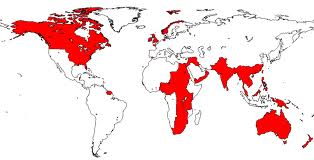
Empire was a very powerful concept in that Canada (and if Stephen Harper has his way, we’ll be thinking this way again soon). It was not incongruous for the average Canadian of Scots, English, or even Irish, stock to see him or herself as both Canadian and British at the same time. For being Canadian made one British, such was the nature of citizenship laws, and such was the fact that the monarch of the United Kingdom of Great Britain and Ireland was (and remains) the head of state in Canada.
Thus, the simple fact of the matter is that Canadians 100 years ago were both/and, not either/or. They were both Canadian and British, not Canadian or British. That was the way they rolled, so to speak. The same was true for other subjects of the British Empire throughout the Dominions. It might be time for Canadian historians to recognise this simple fact, and to stop twisting them like Mike Palmateer trying to bail out his woeful hockey team in trying to explain this. Joy Parr long ago instructed we Canadian historians that identities are not sequential, they are multiple and simultaneous. And the average Anglo Canadian’s identification with Canada, Britain, and Empire is just that: the simultaneous identities of an ambivalent population. No more, no less.
Why We Need Feminism
December 11, 2012 § Leave a comment
Last week was the 23rd anniversary of the Montréal Massacre. On 6 December 1989, a deranged man wandered into the École Polytechnique de Montréal, the engineering school of the Université de Montréal. After clearing the men from a classroom, he opened fire. He killed six women and injured three more before leaving the classroom and wandering the halls, where he wounded three more before he made a failed attempt to enter a locked classroom, wounding another woman in the hallway, before killing a support worker in her office. Upon reaching the cafeteria, he continued shooting. By the time he turned the gun on himself twenty minutes later, he had killed fourteen women, as well as wounding another thirteen, as well as one man.
I was 16 at the time, still in high school, at the other end of the country, in Vancouver. I remember coming home from school and being glued to the TV that night, shocked, amazed, dismayed, and depressed this could happen. Not that it could happen in Canada. Of course it could. But that it could happen. Period. This deranged man shot and killed these women because he hated feminists. To this day, 23 years and 5 days later, I refuse to utter his name.
But I know his name. It’s seared into my memory. This is true for pretty much all Canadians old enough to be cognisant of the massacre in 1989. But we don’t necessarily know the dead women’s names. There are:
- Geneviève Bergeron, 21, civil engineering student
- Hélène Colgan, 23, mechanical engineering student
- Nathalie Croteau, 23, mechanical engineering student
- Barbara Daigneault, 22, mechanical engineering student
- Anne-Marie Edward, 21, chemical engineering student
- Maud Haviernick, 29, materials engineering student
- Maryse Laganière, 25, budget clerk in the École Polytechnique’s finance department
- Maryse Leclair, 23, materials engineering student
- Anne-Marie Lemay, 22, mechanical engineering student
- Sonia Pelletier, 28, mechanical engineering student
- Michèle Richard, 21, materials engineering student
- Annie St-Arneault, 23, mechanical engineering student
- Annie Turcotte, 20, materials engineering student
- Barbara Klucznik-Widajewicz, 31, nursing student
Each year, as we get further and further away from 6 December, we forget the importance of the event just a little bit more. And each year we get further and further away from 6 December, we lose the shock and dismay we felt that day.
That same week, there was a meme on Twitter, We Need Feminism because. One of the images that came through my timeline struck me.
 Her words say it all. And so I thought back to my frosh week in 1991 at Carleton University in Ottawa. We were taught that “No Means No.” Full stop. Period. No does not mean “maybe later,” or “not now,” or “maybe.” It means “NO.” Very simple. That phrase was beaten into our heads, not even two full years since the Massacre.
But reading the words in this image, I realised I haven’t heard the phrase “No Means No” in a long time. At least a decade. And I spend a lot of time on university campuses. In fact, I have been on a college or university campus every academic year since my first year undergrad in 1991-2 every year except two in the late 90s.
And now, apparently young women are taught to avoid being raped. Men are not taught not to rape. One would think that teaching “No Means No” would have benefited the women at Amherst College who were raped. One would think that all young women on all university campuses would benefit. As would all young men. “No means no” taught us to respect words. And we all, men and women, need that respect.
Certainly, I would much prefer to live in a world where sexual assault and rape did not occur. But I don’t see that happening, unfortunately. But I would also much prefer it if universities did their part and taught young men and women that No means no. That simple. Three little words.
And for that reason, we need feminism.
The “Curation” of Southie and the General Over Use of the Term
December 10, 2012 § 4 Comments
We were in Southie yesterday, the former Irish-Catholic working-class neighbourhood of Boston. Southie is undergoing massive yuppification these days. The working classes are being squeezed out, and the yuppies are moving in. This was clear as we took the #9 Broadway bus from Copley Square into Southie. The bus is the great equaliser of Boston society; in some parts of the city, it’s the only time one sees large numbers of minorities. We got off the bus at the corner of West Broadway and A Street, on our way to a yuppified Christmas foodie craft fair at Artists for Humanity on West 2nd Street. In a lot of ways, Southie looked to me like a combination of parts of the Plateau Mont-Royal and Pointe-Saint-Charles back home in Montréal. The architecture was Plateau-like in terms of post-industrial spaces and housing, but the people looked like they could be in the Pointe. There was a curious mixture of the down and out, the working-classes, hipsters, and yuppies of every skin colour.
Gentrification is a creeping problem in pretty much every North American and European city, and much has been written about this, including on this very blog (like, here, here, here, here, here, here, and here, for starters). But what struck me the most was Social Wines, a wine and beer emporium in a spanking new building on West Broadway at A Street. Social Wines offers its clientele “Curated Craft Beer and Spirits.” Now, I must confess, this is my kind of store: it focuses on smaller, indie breweries and vineyards. I like giving my money to these kinds of companies, rather than the Molsons, Budweisers, and massive vineyard conglomerates of the world. But curated? What the hell does that mean?
According to the Meriam-Webster dictionary on-line, a “curator” is “one who has the care and superintendence of something; especially : one in charge of a museum, zoo, or other place of exhibit. To “curate” is: “to act as curator of a museum or exhibit curated by the museum’s director.”
Of late, hipsters and academics have abused the term “curate” like it’s nobody’s business. It is one thing, in the field of Public History and its corollaries, to write of the ways in which museums and the like have “curated” items. That is the proper use of the term. But when editors of edited collections of academic papers start referring to themselves as “curators” and not “editors,” well, then we have a problem. Meanwhile. Hipsters. On any given day, one can go to PitchforkMedia and see articles about this or that music festival that has been “curated” by someone. The most egregious example of this is the All Tomorrow’s Parties festival, which takes place in merry olde England, with branches occurring in the US, too. Each year, ATP is “curated” by a guest musician, one of stature and great fame. What that means is that someone is in charge of deciding who should play, and the list of artists reflects the curator’s tastes. Yup, deciding who should play a music festival is curation.
And so now we have a hipster beer and wine store in Southie that offers us “curated” booze. What, exactly is curated? The collection of booze on sale. See, the old ma and pop liquor store down the street just orders in booze that they figure their clientele will enjoy. But, not hipsters, they lovingly and carefully “curate” the collection of booze on sale at Social Wines. I don’t know about you, but I feel a lot better knowing that rather than having some old geezer just randomly order wines and beers that may or may not be any good, we have the fine folk at Social Wines to very carefully curate their collection.
My problem with the use of this term? It’s very simple. It’s pretentious. And nothing quite says “I’m a wanker” like declaring that you curated your liquor store. I applaud Social Wines’ mission. Hell, next time I’m in Southie, I may even stop in and peruse their collection of wines. But the use of this term by book editors, musicians, and liquor store owners also seriously devalues the meaning of the word in its true professional sense.
Professional curators, those who work in museums and art galleries, do not just collect stuff they like to display. They are responsible for the content of exhibits, and they are required to carefully make decisions on what is appropriate and what is not, to carefully arrange the displays, to negotiate with sponsors, and so on and so forth. There is a reason why curators go to school to learn how to properly curate. Musicians and liquor store owners do not.
Arrival Cities: The Book
December 10, 2012 § Leave a comment
I have touched on Doug Saunders’ Arrival City previously on this blog here and here. This review was also in the works with Current Intelligence before I left back in 2011. So, I am sticking it here for my own purposes.
Doug Saunders. Arrival City: The Final Migration and Our Next World. London: William Heinemann, 2010. ISBN: 9780307396891. 356pp.
Doug Saunders’ Arrival City was published to almost universal acclaim last fall. The Guardian nearly fell over itself hailing it as “the perfect antidote to the doom-laden determinism of the last popular book on urbanisation, Mike Davis’s Planet of Slums” and declaring it “the best popular book on cities since Jane Jacobs’s The Death and Life of Great American Cities half a century ago.” Saunders’ own newspaper, The Globe & Mail hails his calming certitude on the wonderful nature of progress that the city provides us. And the Wall Street Journal praises Arrival Cities for its optimistic view of globalisation.
Certainly, Arrival Cities is an important book, its well-written and is clearly and cogently argued. It is also somewhat of a disappointment, at least in the first half of the book. Saunders is the European Bureau Chief for The Globe & Mail and his reportage and columns generally provide a balanced view of the world; his is one of the few columns in that newspaper I actively seek out. Thus, I expected more from Arrival Cities. I did not get it. While Saunders does give us a counter-narrative to Davis’ doom and gloom, it occasionally reads Pollyana-ish. And at times, Saunders’ journalistic eye overwhelms his argument. Indeed, Dwight Garner in The New York Times notes this problem: his lengthy quotes from the people he talked to in arrival cities around the world sound formulaic and too easy.
Certainly, Planet of Slums was an overly statistical analysis, and statistics are on the aggregate level, they do not always us to view the micro- and quotidian levels. But Arrival City is plagued by the opposite problem: in focusing on a success story or two from each of the arrival cities he visits around the world (and Saunders has certainly been travelling the world), he over-personalises his arguments, which gives the impression that he’s choosing to extrapolate the success stories he saw, not the marginalised. Certainly, all of the people in arrival cities are marginalised in the larger sense of the word, but within the poor, there are class/caste divisions.
More fundamental, though, is Saunders’ reliance on Hernando de Soto’s arguments that all people need in the slums and favellas of the world is security of tenure, if they owned their own homes, all would be good. As Davis notes, the problem with titling in the slums is that it perpetuates the problem of class, in that the wealthier squatters win and the poorer lose, or continue to lose. And de Soto has also been criticised for over-estimating the amount of wealth land titling would create. The other problem of de Soto’s claims is the very notion of property: generally speaking, slums and favellas work due to the co-operation between residents. The creation of private property is at diametrical odds to this economic system. Saunders parrots de Soto throughout large part of Arrival City, arguing that private ownership of homes and security of tenure would encourage slum-dwellers to, essentially, take pride in their homes and communities and would give them a base of capital to invest in the economy. This is not to suggest that de Soto and Saunders are all wrong and their critics all right, but it is to suggest that life does not work quite as neatly and systematically as de Soto and Saunders would hope.
The first five chapters of the book are also plagued by an alarming ahistoricism as Saunders takes us on a tour of arrival cities across the globe from London to Dhaka, Nairobi, Los Angeles, and Shenzhen. In Chapter 5, he looks a the historical growth of cities in the west, focussing specifically on Paris, London, Toronto, and Chicago. Oddly enough, even in a historical chapter, one is left alarmed at Saunders’ ahistoricism. In discussing the differences between urbanisation rates in the United Kingdom and France in the mid-19th century, Saunders somehow manages to overlook the major impetus behind urbanisation in that century: the Industrial Revolution. The Industrial Revolution is the determinative factor behind the wildly different rates of urbanisation in France and Britain in the 19th century, plain and simple.
Also, a cardinal crime to an entire generation of historians, Saunders attempts to take on E.P. Thompson and The Making of the English Working Class. The problem is that he seems not to have read the book. He says that Thompson sees his working class heroes as “passive victims.” This is just plain wrong, the key argument that emerges from The Making is that the working classes were not just passive victims, that they employed agency in agitating for their rights through corresponding societies, proto-unions, and through the church.
In addition, one is left rather flummoxed by Saunders’ apparent naïveté in looking at housing projects in Paris. He criticises the project builders for not soliciting input from those who were to be the future residents of the projects. Seriously. Nonetheless, he does make the point that the lack of accountability on the part of both the authorities and residents in the projects, to say nothing of their discombobulating impact on community.
Following this, however, Arrival City improves exponentially, in the final five chapters. In this sense, it is as if the book is split in two. In the second half of the book, Saunders seems to adopt a more complicated approach to the arrival cities of the world. This includes pointing out the ridiculousness of immigration policies in Canada and the United States. Canada and the United States take in the largest number of immigrants in the world, at least on a per capita basis for Canada, a relatively tiny (population-wise) country.
But it is Saunders’ chapter on the geçekondus that surround Istanbul that really shines. Here, we get a detailed, excellent study of the politics of the geçekondus from the 1970s to today and the struggle of the resident of the slums to attain regularisation and integration into Istanbul. Istanbul, of course, is one of the fastest growing cities in the world. In 1950, Istanbul’s population was 983,000; today, over 13,000,000 call the city home. The slums on the Asian side of the Bosporus grew up in the 70s as impoverished rural Turks migrated to the great city. They established their slum housing outside the boundaries of the city and then agitated for the right to have such luxuries as running water and sewers. The organisers of the 70s and 80s were almost all radical lefties and, during the military dictatorship and its aftermath in Turkey, many spent time in jail and saw their homes routinely torn down. By the turn of the millennium, their geçekondus had been integrated into Istanbul (a large part of what saw the city’s population triple in the past thirty years). Today, these old geçekondus are now part of the inner ring of Istanbul suburbs, fully integrated into the city, and the children of these old radicals are Istanbullus. However, the geçekondus aren’t simply a case of de Soto’s economic theories being put into practice, the regularisation of the geçekondus and their residents, the geçekondullus, required state assistance.
In the second half of the book, Saunders also goes beyond the role of banks and business in the regularisation of the arrival cities. He also notes that the state needs to take an activist role, whether of its own accord or spurred on by the arrival city residents. In order to do this, however, the state needs to have the resources to do so. This is simply not possible in many impoverished and/or corrupt developing world nations, like Bangladesh. Instead, it requires the intervention of richer nations like Turkey, which could afford for Istanbul to absorb and regularise its geçekondus. But more than this, the integration and regularisation of these arrival cities is necessary for local schools, jobs, health care facilities, water and sewer services, and transportation. And then, finally, Saunders strikes a balance between the de Soto right and the Davis left:
What comes from this work, and form the experiences of families like the Magalhãeses in Brazil and the Parabs in India, is a conclusion that is unlikely to please the ideologues on the socialist left or the free-market right: to achieve social mobility and a way into the middle class for the rural-migrant poor, you need to have both a free market in widely held private property and a strong assertive government willing to spend heavily on this transition. When both are present, change will happen [p. 288].
What we are left with then, is half a great book. The first half of Arrival City is done in by its overly simplistic and journalistic approach, its lack of historicity and its over-reliance on de Soto. In the second half, though, Saunders finds his feet, and finds his own original argument that more than splits the difference between de Soto and Davis. I remain unconvinced that the urbanisation of humanity on such a level as we are seeing today is a good thing, but it is also a truism throughout history, at least in the West, that periods of urbanisation have spurred on trade, the economy, and general human progress. And during periods of de-urbanisation, such as in the Dark Ages following the fall of the Roman Empire in the West, Europeans were only slightly more evolved than cavemen, at least in relation to the rest of the Mediterranean world and the Middle East, as David Levewing Lewis points out in God’s Crucible: Islam and the Making of Europe, 579-1215. Either way, there is no simple answer to the question of the massive urbanisation of the globe today, despite what the Mike Davises and Doug Saunderses of the world would have us believe.
Montréal’s Anglo Mayor: Dr. JJ Guerin
November 16, 2012 § Leave a comment
So Montréal got itself a new mayor today, Michael Applebaum. He wasn’t democratically elected, but given the sudden resignation of the scandal-plagued Gérald Tremblay on 5 November, he has to be an improvement. The big woopedy-do about Applebaum is that he’s Anglophone (he’s also the metropole’s very first Jewish mayor). Montréal hasn’t had an Anglo mayor since 1910, when James John Guerin sat in the mayor’s chair.
Guerin, despite the last name, was Irish Catholic. He was also a central player in one of the most vicious election campaigns in Canadian history. In 1917, at the height of the First World War, Prime Minister Sir Robert Borden called an election over the issue of conscription. Borden had invited the Liberal Party, under Sir Wilfrid Laurier (Prime Minister of Canada, 1896-1911), into his government to form a Union government for Canada for the duration of the war. Laurier, however, could not countenance conscription nor could his Québec powerbase. He refused. Borden called an election for 17 December.
By 1917, voluntary enlistments into the Canadian Expeditionary Force (CEF) was pretty much drying up. The war had been going on for three years. And the Great War was little more than a killing field. Mechanised warfare wreaked havoc on the soldiers. Casualty rates were enormous. Canada, with a population of little more than 7 million, lost 65,000 men, with another 150,000 wounded. Many of those who were wounded and survived were never the same again. They lost their eyesight, their hearing, limbs; their lungs were destroyed by the Germans’ poisonous gas; they were shell-shocked. It wasn’t just in Canada that enlistments were drying up by 1917, the same was true in England, Scotland, and Wales. Thus, conscription was needed to compel young Canadian men to fight. Conscription was made palpable in the rest of Canada, in part, due to exemptions. The most famous case was that of farmboys, whose labour was needed on the farms of the Prairies (and Ontario). (Not that Borden kept this promise). But, in Québec, nationalists failed to see why Canada should be wrapped up in an imperialist war that had nothing to do with Canada’s interests. Indeed, Henri Bourassa, the most influential nationalist leader of the day, and founding editor of Le Devoir, argued in that paper’s pages
Le Canada aurait pu intervenir comme nation, lié a l’Angleterre par des attaches politiquées, et à la France par des motifs de sentiment et d’intérêt, sans compromettre en rien son état politique…[and that Canada had] aucune sort d’obligation morale ou légale de participer à la guerre et tenir compte des conditions particulières, des intérêts vitaux qu’il doit sauvegarder comme pays d’Amérique avant lier sont à celui des nations d’Europe.
Bourassa wasn’t entirely correct, Canada did have a legal obligation to participate. Britain still controlled Canada’s foreign affairs, and would continue to do so until the Statute of Westminster in 1931. Thus, when Britain went to war, Canada went to war.
At any rate, the Liberal Party of Canada split over conscription in 1917. Most Liberals outside of Québec took Borden up on his offer; most Liberals in Québec stood behind Laurier. The outcome of the election was a foregone conclusion, of course. But that didn’t stop the Bordenites from engaging in some skeezy politics. They enfranchised women who had sons or husbands in the military, calculating that they would vote for the Bordenites. They gerrymandered ridings to ensure the best possible outcome for the Unionists.
One of the gerrymandered ridings was St. Ann’s, in Montréal’s west end. Prior to the 1917 election, the riding was comprised of Griffintown, Little Burgundy, and Pointe-Saint-Charles, a working-class industrial slum. The sitting member was Charles J. Doherty, a Conservative and the Minister of Justice in Borden’s government. He was initially election to represent St. Ann’s in 1917. He was also Irish-Catholic, so, in essence, the Irish of Griffintown (and Pointe-Saint-Charles) had elected one of their own. Again. St. Ann’s was one of those ridings where the outcome was not a foregone conclusion. It could just as easily go Liberal. Thus, the gerrymander. Conservative, non-Irish, neighbourhoods including the western part of Pointe-Saint-Charles and all of Verdun, were added to the riding.
The Irish were an issue in 1917 because of the effect of the 1916 Easter Rising in Dublin on the Irish diaspora. The 1916 Rising, and the brutality of the British response, served to radicalise the Irish, both in Ireland and the diaspora, including and perhaps especially, Griffintown. Griffintown was home of the most radical republican Irish nationalists in Canada in the 1910s, mostly centred on the Ancient Order of Hibernians (AOH). Thus, for the Bordenites, it was essential that Doherty, who was responsible for conscription, be protected at all costs. Hence, the gerrymander.
Borden was opposed in the riding by two Liberals at the outset. Daniel Gallery, the former Liberal member (and city councillor) for St. Ann’s, as well as Dr. J.J. Guerin, a long-time city councillor and former mayor of Montréal. Gallery, though, ultimately lost the Liberal Party’s endorsement and was left to run as an independent against the Liberal Guerin and the Conservative Doherty. The election was vicious in Griffintown. Goon squads intimidated followers of all three candidates. All three were heckled mercilessly on the campaign trail. Threats were made.
Doherty won the election handily. Indeed, he won with the largest margin of his career. But he also won in large part due to the gerrymander. In Griffintown, the heart of St. Ann’s, Guerin walked away with the vote, outpolling Doherty by an almost 2-1 margin. Gallery, despite a long career in service of Griffintown, was never a credible candidate. He spent most of his time denying that the Unionists were paying him to split the Liberal vote with Guerin. He garnered fewer than 1000 votes. Guerin may have lost the election, but he won Griffintown. And he eventually succeeded in representing St. Ann’s in Parliament; he was elected the Liberal member in the 1925 election and held the seat until his death five years later.
On Regulating Economies v. Free Market Economies
November 9, 2012 § Leave a comment
I am reading a fascinating book right now, as I plan for my courses next semester, David J. Bodenhamer’s The Revolutionary Constitution, an history of the US Constitution. Bodenhamer does a brilliant job, I think, of tracing the history of the US Constitution and its uses in American history, politics, law, culture, and life.
One thing that is continually striking me is the on-going public argument in the United States and elsewhere between regulated v. free market economies. Maybe this is just the echo of the US election in my head. Or it could also be a reflection of all the info I have inhaled since the economy went kaputski in 2008. When FDR was elected in 1933, he sought to expand the state, based on Keynesian economies, to attempt to get the United States out of the Depression. FDR felt that free market economics were what got the United States into the mess of the Depression in the first place. And this has long been clear to me as an historian, but it is put in stark relief in Bodenhamer’s new book.
Fast forward to the present day. The recession of 2008 and beyond was caused, to a large degree, by unregulated economies. And yet, the right continues to argue that the free market will right all wrongs. Turns out we didn’t learn from the Depression. We let it all happen again in the 1990s and early 2000s. And this isn’t simply a right/left argument, either, as plenty on the left fell into this trap in the past two decades.
The problem with the free market economy is simple. Bodenhamer writes:
In recent years a conservative attack on this New Deal constitutionalism has emerged among scholars who asserted the superiority of a private market and sought to apply a cost-benefit analysis to public regulation. According to proponents of the so-called law and economics school, all people voluntarily make rational decisions to further their self-interest.
The problem is that people do not make rational decisions economically-speaking. If people did, the sub-prime mortgage meltdown would never have happened. If people did, I wouldn’t insist on drinking a latté in the morning instead of a cheaper coffee when my budget requires restructuring. If people did, we wouldn’t be carrying around crippling amounts of debt. The entire Enlightenment ideal of the rational behaviour of human beings has clearly been debunked. Ideally, we act rationally in matters of economics, politics, and so on. But clearly, in reality, we do not. If we did, the working-classes would always vote for the Democrats in the States and the NDP in Canada and Labour in England. But they don’t. They usually vote Republican and Conservative in Canada and England. That is not in their rational self-interest.
Indeed, as Canada’s Prime Minister, of whom I am no fan, likes to crow: Canada survived the meltdown to a large degree due to the strict regulation of Canada’s banking industry.
So why we continue to have this argument baffles me. In fact, I’d even go so far as to suggest that believing in the rational behaviour of the free market is, in fact, a completely irrational position and actually serves to de-bunk the arguments of these free market fantastists.
Le Reigne Elizabeth
October 19, 2012 § Leave a comment
The Queen Elizabeth Hotel on blvd. René-Lévesque has fascinated me ever since I was a kid. Structurally and aesthetically, it is one of the ugliest buildings in the downtown core of Montréal. Built in a neo-brutalist style usually reserved for university campuses, the Queen Elizabeth is nonetheless the swishest hotel in Montréal. It is also the largest hotel in Montréal and Québec, with over 1,000 rooms. The other thing that has fascinated me since the mid-70s is the name of the hotel. How does a hotel in the middle of Montréal, the metropole of Québec, end up being named after the Queen? Better yet, what’s with the incongruity of the name in French, Le Reigne Elizabeth, with the masculine article there before the feminine monarch?
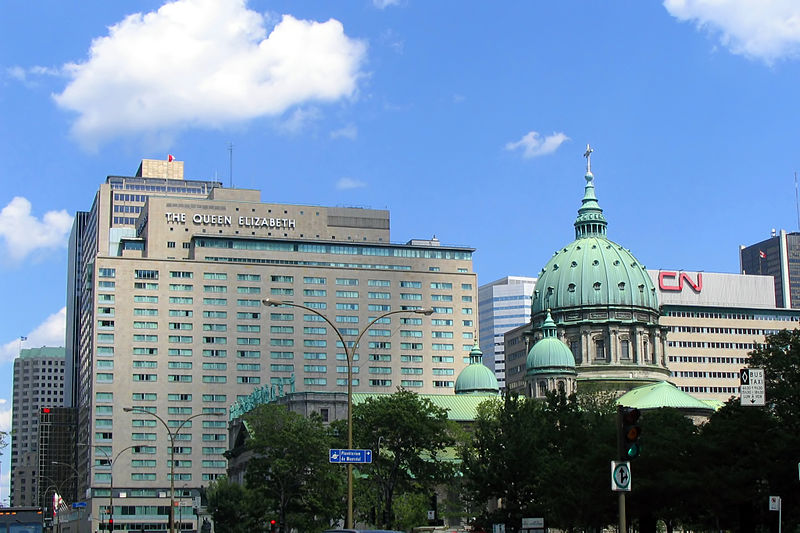
When the hotel was first proposed back in 1952, there was an upsurge of love for the monarch in English Canada. Queen Elizabeth II had just ascended the throne, and around the former British Empire, people were gaga over the queen, somewhat like people are currently in a tizzy over the former Kate Middleton. However, the 1950s also saw the rumblings that led to the eruption of the Quiet Revolution in Québec in 1960. There was an upsurge of québécois nationalism in the city and province as well. Indeed, nationalists argued that the Canadian National Railways should name the new hotel after the founder of Montréal, Paul de Chomedy, sieur de Maisonneuve. Nonsense, responded the CNR’s president, Donald Gordon: Canada is a Commonwealth nation, and the head of the Commonwealth is Queen Elizabeth II. Since he was the one building the hotel, he won the debate.
As for the masculine article in the hotel’s French name, well, it turns out that refers to the implied ‘hotel’ in the name, and hotel is masculine. There you have it.
 The Queen Elizabeth Hotel, of course, has lived up to its reputation. The Queen herself has rested her head on its pillows four times, and her son, Prince Charles, has also visited. The NHL entry draft was held there pretty much every year until 1979. But, of course, the most famous event to have occurred in the Queen Elizabeth is the “bed-in” of John Lennon and Yoko Ono, 26 May-2 June 1969. Lennon and Ono had been denied entry to the United States, because Lennon had a cannabis conviction from 1968. A bed-in was planned for New York City. So now the plan had to be changed, and so Lennon and Ono bedded down in the Queen Elizabeth for their second Bed In for Peace (the first had been in Amsterdam 25-31 March). During the Montreal bed-in, the anthem “Give Peace a Chance” was recorded by André Perry.

 Matthew Barlow