The True North Strong and Free
November 6, 2017 § 2 Comments
Last week, Canadian Governor General Julie Payette gave a speech at what the Canadian Broadcast Corporation calls ‘a science conference‘ in Ottawa. There, she expressed incredulity in creationism and climate change denial, and called for a greater acceptance of scientific fact in Canada. Payette is a former astronaut, holds an MSc in computer engineering, and has worked in the field of Artificial Intelligence. In other words, when she speaks on this matter, we should listen.
Her comments ignited a storm of controversy in Canada. Some people are upset at her comments. Some people are upset the Governor General has an opinion on something. With respect to the first, Payette spoke to scientific fact. Full stop. Not opinion. Fact. With respect to the second, Governors General and opinions, I will point out that our former Governor General, David Johnston, also freely expressed his opinions. But, oddly, this did not lead to massive controversy. What is the difference between Payette and Johnston? I’ll let one of my tweeps, author Shireen Jeejeebhoy answer:
But then I found a particularly interesting tweet. The tweet claimed that for the very reason that Canada has the monarchy, the country cannot have democratic elections.
Um, what? There is no logic to this tweet. I asked the author of the tweet what he meant. In between a series of insults, he said that he thinks the Governor General, which he mistakenly called an ‘important position,’ should be an elected post. That gives some clarity to his original post, but he’s still wrong.
Canada is a democracy, full stop. Elections in Canada are democratic, full stop.
Canada is a constitutional monarchy. Queen Elizabeth II is the Head of State. The Governor General is her representative in Canada (each province also has a Lieutenant-Governor, the Queen’s representatives in the provincial capitals). The Queen does appoint the GG (and Lt-Govs), but she does so after the prime minister (or provincial premiers) tell her who is going to be appointed. In other words, Payette has her position because Prime Minister Justin Trudeau selected her.
Canada, unlike the United States, did not gain ‘independence’ in one fell swoop. In 1848, Queen Victoria granted the United Province of Canada, then a colony, responsible government. This gave it (present-day Ontario and Québec) control over its internal affairs. All legislation passed by the colonial assembly would gain royal assent via the Governor General. Following Confederation in 1867, the new Dominion of Canada enjoyed responsible government (which the other colonies that became Canada also had). But Canada did not control its external affairs, the United Kingdom of Great Britain and (Northern) Ireland did. In 1931, the British Parliament passed the Statute of Westminster, which granted control over foreign affairs to the Dominions (Canada, South Africa, Australia, and New Zealand). In 1947, Canadian citizenship was created. Prior to that, Canadians were subjects of the monarchy. In 1949, the Supreme Court of Canada became the highest court in the land. Prior to that, the Judicial Committee of the Privy Council in London was. In 1982, the Canadian Constitution, which had been an act of the London Parliament (the British North America Act, 1867) was patriated and became an act of the Parliament in Ottawa. So, choosing when Canada became independent is dicey. You can pick anyone of 1848, 1931, 1947, 1949, or 1982 and be correct, at least in part. We tend to celebrate 1867, our national holiday, July 1, marks the day the BNA Act came into affect. That is the day Canada became a nation, but it is not the date of independence.
Either way, Canada is an independent nation. Lamarche’s claim that, because we are a constitutional monarchy, we do not have free elections is ridiculous. The role of the monarchy in Canada is entirely symbolic. The Queen (or the Governor General or Lieutenants Governors) have absolutely no policy input. They have no role in Canadian government beyond the symbolic. None.
I’m not even sure how someone could come to this conclusion other than through sheer ignorance.
A History of Globalization
October 31, 2017 § Leave a comment
I read Susan Sontag’s Regarding the Pain of Others last week. For some reason, Sontag has always loomed on the fringes of my cultural radar, but I had never read anything by her, other than a few essays or excerpts over the years. In some ways, I found her glib and in others, profound. But I also found her presentist.
At the start of the second chapter, she quotes Gustave Moynier, who in 1899, wrote that “We know what happens every day throughout the whole world,” as he goes onto discuss the news of war and calamity and chaos in the newspapers of the day. Sontag takes issue with this: “[I]t was obviously an exaggeration, in 1899, to say that one knew what happened ‘every day throughout the whole world.'”
We like to think globalization is a new phenomenon, that it was invented in the past 30 years or so and sped up with the advent of the internet and, especially social media, as we began to wear clothes made in China, rather than the US or Canada or Europe. Balderdash. Globalization has been underway since approximately forever. Europeans in the Ancient World had a fascination with the Far East, and trade goods slowly made their way across the Eurasian landmass from China to Italy and Greece. Similarly, the Chinese knew vaguely of the faraway Europeans. In the Americas, archaeological evidence shows that trade goods made their way from what is now Canada to South America, and vice versa. Homer describes a United Nations amassing to fight for the Persian Empire against the Greeks.
Trade has always existed, it has always shrunk the world. Even the manner in which we think of globalization today, based on the trade of goods and ideas, became common place by the 18th century through the great European empires (meanwhile, in Asia, this process had long been underway, given the cultural connections between China and all the smaller nations around it from Japan to Vietnam).
For Sontag, though, her issue is with photographs. Throughout Regarding the Pain of Others, she keeps returning to photographs. She is, of course, one of the foremost thinkers when it comes to photographs, her landmark On Photography (1977) is still highly regarded. In many ways, Sontag seems to believe in the credo ‘pics or it didn’t happen.’
Thus, we return to Moynier and his claim to know what was going on in the four corners of the world in 1899. Sontag, besides taking issue with the lack of photographs, also calls on the fact that ‘the world’ Moynier spoke of, or we see in the news today, is a curated world. No kidding. But that doesn’t make Moynier’s claim any less valid than the New York Times’ claim to ‘print all the news that’s fit to print.’ That is also a carefully curated news source.
In Moynier’s era, Europeans and North Americans, at least the literate class, did know what was happening throughout the world. The columns of newspapers were full of international, national, and local news, just like today. And certainly, this news was curated. And certainly, the news tended to be from the great European empires. And that news about war tended to be about war between the great European empires and the colonized peoples, or occasionally between those great European empires. But that doesn’t make Moynier’s claim any less valid. He did know what was going on around the world. He just didn’t know all that was going on. Nor do I today in 2017, despite the multitude of news sources available for me. The totality of goings on world wide is unknowable.
And Sontag’s issue with Moynier is both a strawman and hair-splitting.
Staging the Civil War
October 26, 2017 § Leave a comment
‘Everyone is a literalist when it comes to photographs,’ Susan Sontag wrote in Regarding the Pain of Others. She has a point, sort of. We expect photographs to represent reality back to us. But they don’t, of course, or they don’t necessarily. For example, she discusses an exhibit of photographs of September 11, 2001, that opened in Manhattan in late September of that year, Here is New York. The exhibit was a wall of photographs showing the atrocity of that day. The organizers received thousands of submissions, and at least one photo from each was included. Visitors could chose and purchase a laser printed version of a photo, but only then did they learn whether it was a photo from a professional or an amateur hanging out their window as the atrocity occurred. Sontag talks about the fact that none of these photos required captions, the visitors will have known exactly what they depicted. But she also notes that one day, the photos will require captions. Because the cultural knowledge of that morning will disappear. 9/11 is already a historical event for today’s young adults.
So we return to the veracity of photos, our expectation of a documentary image of the past. For me, the first time I was seriously arrested by a photograph was in my Grade 12 history textbook, in the section on the Second World War. There was a photograph of an American soldier lying dead on a beach somewhere in the Pacific. I don’t remember where or which battle. I don’t remember the image all that well, actually, I don’t think the viewer could see the soldier’s face. I remember just a crumpled body, in black and white. And for the first time, I understood the devastating power of war and the fragility of the human body.
Later, in grad school, I read Ian McKay’s The Quest of the Folk, about how Nova Scotia’s Scottish history was carefully constructed and curated by folklorists at the turn of the 20th century. At the start of the book is a photograph of a family next to their cottage on a hard scrabble stretch of land on the Cape Breton coast. McKay plays around with captions of the photo, both the official one in the Nova Scotia archives in Halifax, and alternative ones. I realized that photographs are not really necessarily a true and authentic vision of the past.
And so, in reading Sontag’s words I opened this essay with, I thought of the fact that we do like to think of ourselves as literalists when it comes to photography, we expect a ‘picture to say a thousand words,’ and so on. Just prior to this comment, Sontag discussed Francisco Goya’s Disasters of War, a series of plates that weren’t published until several decades after Goya’s death. The disasters were the Napoléonic invasion of the Iberian Peninsula in 1808. These plates are vicious. And Goya narrates each, claiming each one is worse than the other, and so on. He also claims that this is the truth, he saw it. Of course, they aren’t the documentary truth, they instead represent the kinds of events that happened. That does not, however, lessen their power and brutality. But they are also not photographs.
This led me to Alexander Gardner, the pre-eminint photographer of the US Civil War. In fact, war photography in general owes a huge debt to Gardner. Gardner worked for the more famous Mathew B. Brady, but it was Gardner who took the majority of the more famous photographer’s photos. Gardner shot some of the most iconic images of the Civil War, including the dead at Gettysburg. His most famous is this one:
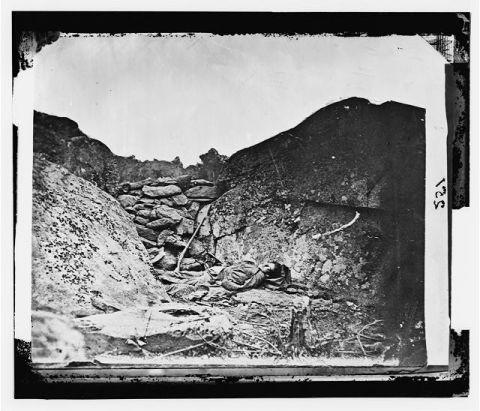
Photo taken from the Library of Congress’s website
This photograph is staged. Gardner and his assistants dragged the body of this dead Confederate soldier from where he fell to this more photogenic locale. They also staged his body. And yet, given our insistence on literalism in photography, the viewing public took this photo for what it’s worth and accepted it as a literal representation of the Battle of Gettysburg.
It was over 100 years later, in 1975, when a historian, Willian Frassantino, realized that all was not as it seems. Of course, what Gardner, et al. did in staging the photos of the Civil War seems abhorrent to us, unethical, even. But it was not so in the mid-19th century at the literal birth of this new medium of representation.
Nonetheless, what is the lesson from Gardner’s photograph? Do we dismiss it for its staginess? Do we thus conclude that the photos of the Civil War are fake? Of course not. Gardner’s photos, like Goya’s Disasters of War, are representations of what happened. They are signifiers that things like this happened (I am paraphrasing Sontag here). It does not make these representations any less valuable. Young men did die by the thousands in the Civil War. They died at places like Gettysburg, and they died like the staged body of this unfortunate soul. The horrors of war remain intact in our minds. We have a representation of what happened, and this one in particular (like Goya’s Disasters) has been replicated countless times since 1863, we have seen countless other images like this, including for me, the one in my Grade 12 history textbook when I was all of 17 years of age. The image is still real.
Fiddler’s Green: RIP Gord Downie
October 18, 2017 § 33 Comments
Gord Downie is dead. This is a sad day. For better or worse, the Tragically Hip have been the soundtrack of my life. They have been the soundtrack for almost all Canadians’ lives.
In 1989, I worked as a line cook at an IHOP in suburban Vancouver. There was this dishwasher there, Greg. He was around my age, maybe a bit older. But he got me onto the Hip. I had seen the video for ‘New Orleans is Sinking‘, of course, it was on heavy rotation on MuchMusic. But Greg got me into the band, and that brilliant début album, Up To Here.
Downie’s lyrics were what kept me hooked on the Hip. Sure, the music was great, but Downie’s lyrics. He wrote songs that seethed and snarled with energy. He and his band also wrote some pretty ballads, one of which is the title of this post.
Live, Gord Downie was something else entirely. He was a madman. All this energy, whirling about the stage, singing and screaming and moaning his lyrics out. In between songs, he told us, the audience, weird things. He told us stories. At Another Roadside Attraction, on Seabird Island in the Fraser Valley of British Columbia, he stopped in between songs. He stopped still on the stage, crouched, looking out at the audience, his hand shielding his eyes from the light. It was hot in the crowd, I was right down front with my man, Mike. And Downie looked at us and said, ‘You’re a fine looking crowd. But I wouldn’t get up in the air on any airplanes with any politicians if I were you. Because if that plane goes down, YOU’RE the first ones they’re gonna eat.’ I have no idea what he meant. But that was the point.
Gord Downie was the front man of a pretty straight-ahead rock’n’roll band. And yet, he was a mystic, a poet, a shaman in front of us. He sang Canada back to us. He told us of cheap beer and highballs in a bar. He told us of lake fevers. He told us about the Legend of Bill Barilko. We learned stories of the North from him.
I’ve never been able to explain what it was about the Hip that made them so important to Canada. I’ve never been able to put my finger on what it was that made them our rock band. It wasn’t the time they told fellow Canadian Lorne Michaels that they wouldn’t shorten their song ‘Nautical Disaster’ for Saturday Night Live. It wasn’t the fact that they could fill hockey arenas and football stadia in Canada, but played bars and concert halls in the US. It was none of that.
I have been thinking about this since the night of the Hip’s last concert in Kingston, ON, last summer. The CBC broadcast and streamed it around the world. And so we were able to watch it in our living room in the mountains of Tennessee, where we lived at the time. Today, with Downie’s death, I realized what it was that made the Hip so quintessentially Canadian in a way other Canadian artists aren’t: They made us proud to be Canadian. We are not a proud nation, we are rather humble (and occasionally annoyingly smug). We don’t really do patriotism, and when we do, it’s kind of sad and forced. We don’t have the great stories of nation formation other countries have. No ‘Chanson de Roland.’ No King Arthur. No Paul Revere. We just kind of evolved into place. But, in telling us our stories back to us in a way no one ever had, Gord Downie and the Tragically Hip made us proud to be Canadian.
At that Hip-curated travelling festival, Another Roadside Attraction, in 1993, they picked some pretty incendiary live bands to play with them. Pere Ubu were absolutely nuts on stage. And then Midnight Oil were the penultimate band. The Oils might be the greatest live band in the history of rock’n’roll. Frontman Peter Garrett is something like 6’7″, rail thin, and a wild man on the stage. And his band are louder, more aggressive, more prone to shrieking feedback and punk speeds live than on record. I remember the end of their gig, the audience was exhausted. We were spent. Surely no band in the world could ever top that.
And then, the Tragically Hip wandered on stage. And let ‘er rip. I could see Peter Garrett in the wings stage right. At first he looked shocked and then he had a big grin on his face. The Oils had been blown off the stage by the Hip.
The early 90s were my hardcore punk days. And yet, the Hip was something even us punks could agree on. Our allegiance to the Tragically Hip was manifest at that festival. Me and my main man Mike went. But in the crowd, we came across all kinds of our people from Vancouver.
Losing Gord Downie hurts in a way that losing Leonard Cohen last year hurt. Like Cohen, Downie and his band were the stars of my firmament. They were the nighttime sky and the lights, distant in the darkness.
Unlike Cohen, whom I met, I never met Downie. I did see him once on a streetcar in Toronto, though. And this is what I always loved about Canada. And still do. I met Leonard Cohen in a laundromat in Calgary. I saw Downie on a streetcar. I talked to Dave Bidini of the Rheostatics once on a downtown street in Ottawa. When he was the Leader of the Official Opposition, I saw Stéphane Dion walking down the rue Saint-Denis with his wife, shopping, one Sunday morning. Our stars are our own, they live and work amongst us.
The sky is going to be a bit dimmer tonight.
#MeToo: A Public Service Announcement
October 17, 2017 § Leave a comment
Since around Sunday afternoon, women have been posting on social media that they have been victims of sexual assault and/or sexual harassment. My Twitter and Facebook feeds are full of these brave posts, with the hashtag #MeToo. But, almost immediately, the backlash came. From men.
Yes, men are the victims of sexual assault, too. Around 10% of rape victims are male, and around 3% of men in the United States have been sexually assaulted. This is a very real problem. And the sexual assault of men does not get much coverage in our world. To be a male survivor of sexual assault is alienating and lonely. In fact, many of the same things women experience, men experience in the aftermath of being sexually assaulted.
But. This male backlash to #MeToo smacks of an attempt to deny women their experiences. It also smacks of ‘All Lives Matter.’
A couple of years ago, at the height of the Black Lives Matter movement, white conservatives began the counterpoint: All Lives Matter. Well, duh. Of course all lives matter. That was never open for debate. No one ever said that because Black Lives Matter, other lives don’t. But the simple fact was that the discussion was about black lives, which were much more likely to be terminated at the hands of the police than other types of lives.
In effect, saying ‘All Lives Matter’ was an attempt to equate the African American experience with the white American experience, and to say they were both equal. They’re not. This nation was founded upon exploiting the labour and bodies of African Americans, and even though slavery ended 152 years ago, the cost for black bodies has not ended. And even though the Civil Rights Era was half a century ago, the cost for black bodies has not ended. To suggest the white and black experience is the same is a false equivalence.
Not all men who are speaking out right now are attempting to deny women’s experiences. They are speaking out of of the same, or similar place. But, this is already being used to silence women. Some men are using these men’s experiences to claim an equivalence of the male and female experience. This is already being used to deny the experience of women. A few years ago, during another heightened consciousness over the experience of women, #YesAllWomen was a social media activist campaign. Because almost all women have experienced this. So, to claim that the male and female experience of sexual violence is the same is wrong. It is not. It is a false equivalence.
Double Standards and False Equivalencies
October 12, 2017 § 1 Comment
Harvey Weinstein is disgusting. At the very least, he is guilty of being a lecherous, disgusting man. At the worst, he’s a rapist. His defence of coming-of-age in the licentious 1960s and 70s is bullshit. Many men came of age then, and they don’t commit sexual assault. Nor is Weinstein alone, I’m sure. As my friend Matthew Friedman noted, he is certainly not the only Hollywood mogul who used his power to bully young women into places they didn’t want to go, to use his power to sexually abuse them. Think of the long-standing and endless jokes about casting couches and the like. Weinstein just got caught. After 40 years. In many ways, Weinstein is like the president, who, of course, boasted on tape for Access Hollywood, how he commits sexual assault. As Marina Fung noted in the Huffington Post, the Weinstein tape is the sequel to the Trump tape. And, of course, let us not forget last year’s scandal in Canada, where Jian Ghomeshi was accused of similar things as Weinstein and walked. And then, of course, there is Bill Cosby.
Make no mistake, Weinstein, Trump, Ghomeshi, and Cosby are just the tip of the iceberg. And thus far, there have been no criminal consequences for any of these men. Hell, Donald Trump was elected president. Weinsten, Ghomeshi, and Cosby have lost their good reputations, so there’s that. But that doesn’t really amount to much.
Republicans, of course, are having a field day with Weinstein, especially because he is such a huge donor to Democratic Party causes. And he donated to Hillary Clinton’s campaign last year (and Barack Obama’s in 2008 and 2012, and John Kerry’s in 2004, and Al Gore’s in 2000, and Bill Clinton’s in 1992 and 1996, and so on). A lot of conservatives are calling Hillary Clinton to account for Weinstein (and her husband, and Anthony Weiner). And even some progressives are calling on her to account for Weinstein (and her husband and Anthony Weiner, and Donald Trump).
This is also bullshit. It is also creating a false equivalence. Hillary Clinton has nothing to account for when it comes to Weinstein, nor do Democrats in general. What Weinstein did is downright reprehensible, as I’ve made clear. But he is one (formerly powerful) man. She has nothing to do with what he did. Nor does she have anything to do with what Anthony Weiner did.
We can start with the hypocrisy of conservatives demanding Hillary Clinton account for Weiner when they refuse to for Donald Trump. But we can go further. Calling out Hillary Clinton is just further proof of the sexism and misogyny in our culture. It is further proof of the way in which our culture (and I mean the totality of our culture, progressives, centrists, and conservatives) holds women to a double standard.
It is bad enough that Harvey Weinstein violated countless young women. It is worse that our culture expects the female Democratic Party candidate for President in 2016 to account for this disgustingness.
Erasing the Indigenous
October 10, 2017 § 7 Comments
In 2015, then-new Canadian Prime Minister Justin Trudeau justified appointing women to half of his cabinet posts with ‘It’s 2015.’ And we all applauded. He was elected largely because he wasn’t the incumbent Prime Minister, Stephen Harper. But he also won based on election promises of gender equality, LGBTQ equality, as well as a ‘new deal’ for the indigenous population.
But here we are two years on, and the plight of the indigenous population of Canada remains the same as it ever was. Trudeau has not exactly lived up to his campaign pledges to re-set the relationship between First Nations and the Canadian state. This is not all Trudeau’s fault in the sense that he reflects a deeply racist Canadian society. I have written about this numerous times (here, here, here, and here, for example).
Last week in my Twitter feed, I was gobsmacked to come across this:
This couldn’t be real, could it? It had to be another bit of Twitter and untruths. But, no, it’s real:
Even Global News picked it the story today. So, let’s think about the history presented in this Grade 3 workbook. According to it, the indigenous population of Canada agreed to simply pick up stakes and move to allow nice European colonists to settle the land. Nevermind the centuries of occupation, and all of those things. Nope, the very nice Indians agreed to move.
I wish I could say I was shocked by this. I’m not. This is pretty much part and parcel of how Euro-Canadian culture thinks about the indigenous population, if it thinks about the indigenous population at all. Or, when Euro-Canadians think about the indigenous population, it’s in entirely negative ways; I don’t think I need to get into the stereotypes here.
I tried to do some research on this workbook and the company that published it, Popular Book Company. My web sleuthing turned up next to nothing. If I Google the book itself, all I get are links to Amazon.com, Amazon.ca, and Indigo.ca (Indigo is Canada’s largest bookseller). Finally, I discovered that this series is popular amongst homeschoolers in Canada, and, as of 2015, over 2 million copies were in circulation. My attempts to find anything out about Popular Book Company came to nothing; all I could find out is that it’s a subsidiary of a Singapore-based company, PopularWorld.
I suppose the actual damage done by this outright stupidity is limited. Nonetheless, it exists. But how this stupidity occurred is another thing. From what I learned on the interwebs, this edition of the Grade 3 curriculum was published in 2015, the previous edition in 2007. I can’t tell if this stupidity was in the 2007 version, but it is certainly in the 2015 edition.
I have experience working in textbook publication. I have written copy for textbooks, I have edited textbook copy. And I have reviewed textbooks before publication. And this is for textbooks at the primary, secondary, and post-secondary education. To get to publication, textbooks go through rounds of edits and expert review. My guess is this didn’t happen here. I have also worked with provincial boards in Canada to revise curriculum, including textbooks. Deep thought and careful consideration goes into this process. And I have friends who work with homeschoolers, at least in Québec, to ensure that the textbooks and curriculum homeschoolers use and follow is appropriate. And they take their job seriously.
So how did this happen? Who wrote this stupidity? Who allowed it to go to publication? And why did it take two years for anything to happen? Initially, Popular said it would revise future editions of the workbook. Eventually, however, it agreed to recall already extant versions and make sure that this is edited when the book is re-printed.
Great. But how did this happen in the first place?
Even the Losers
October 6, 2017 § Leave a comment
Tom Petty died this week. He was young, too, only 66. Massive heart attack. Like many other people, the soundtrack of my life has been peppered by Tom Petty, both with the Heartbreakers and solo. I remember his single with Stevie Nicks, ‘Stop Dragging My Heart Around,’ in 1981. It was an almost total radio presence as I sat in the backseat of my mom’s car driving around Victoria, BC. ‘Don’t Come Around Here No More’ was a staple of MuchMusic (Canada’s MTV) in the mid-1980s, and remains one of my favourite videos of all-time. ‘Mary Jane’s Last Dance’ was on constant play in the jukebox of the restaurant I worked at in the spring of 1994. And while I haven’t followed his more recent music, his Greatest Hits package is in rotation in our house.
I can think of no greater tribute I can pay to Tom Petty than the fact that even in my hardest of hardcore days, in the early 1990s, I still dug on his music. Of course, I got gently mocked by my friends and roommates for my insistence on melody in my music. But I remained unapologetic.
In the wake of his death, I keep reading how he embodied Americana in the stories he told in his songs. I’m not so sure about that. Tom Petty’s lyrics always seemed to me to be kind of out there, the characters of his songs out of some alternative universe. He didn’t sing of white picket fences and apple pie. He didn’t sing about Ford pickups and football. In a lot of ways, he mocked this America. His songs were about the underdogs, I always thought. Like Eddie in ‘Into the Great Wide Open,’ which in many ways is a typical Hollywood success story, except for the dark undertones of the lyrics. Hell, one of his biggest hits was called ‘Even the Losers,’ and it was them that Petty seemed to champion to me.
It’s a fact of life that people get old and they die. But sometimes, the death of celebrities hits hard. Last year, it was David Bowie and Leonard Cohen whose deaths left me reeling (especially Cohen’s, I don’t like a universe without Montréal’s favourite son in it). This year, it’s Petty’s. I guess this happens when the soundtrack to our lives gets suddenly muted.
The Death of Language
October 4, 2017 § 1 Comment
We live in an era where the President of the United States labels anything he doesn’t like as #FAKENEWS. Last year, we watched Brexit succeed (at least in a referendum) where the Leave side was guilty of inventing several truths that were actually lies. And one of the President’s surrogates has coined the term ‘alternative facts’ to describe lies. I wrote about this last year in the wake of the Presidential Election.
The damage to public discourse and the use of language through politicians who lie nearly every time they open their mouth is obvious. But there is another source of danger when it comes to the actual meaning of words and their usage: sports journalism.
As my friend John likes to note, nothing should ever get in the way of ESPN’s ‘hot take’ on any and all, most notably language and truth. But it’s not just ESPN. Take, for example, Canada’s TSN (for those who don’t know, The Sports Network is the largest sports network in Canada, with a monopoly on broadcasting the Canadian Football League; it also holds regional marketing rights to NHL games, as well as Major League Baseball, and various other sports. It is also 20% owned by ESPN). A headline earlier this week on TSN.ca states, that “Pens, Lightning Battle It Out in First 7-Eleven Power Rankings of 2017-18.”
Um, no. The Penguins and Lightning are not battling it out to top the power rankings. Why? Because these are entirely subjective rankings created by TSN. The Lightning and Penguins did not play a game, a play off series or anything for this honour. TSN’s staff just ranked them as the two best teams in the game.
And so you may not think this a big deal, TSN’s headline writers are just looking for attention to encourage people to click on the story. Sure they are. But in so doing, they are messing with the meaning of words. They are cheapening the meaning of the verb ‘to battle.’
This kind of thing is pretty common in sports journalism, whether through laziness or incompetence, I can’t tell. But you will notice that around trade deadlines or amateur drafts or free agency periods, sports journalists will tell you about the ‘names’ being thrown around. Sure, they are names being bandied about (mostly by these very same journalists, who get to make up the news and then report on it). But names don’t get signed, trades, or claimed in drafts. Players do.
Maybe you think I’m just a crank for being worried about language. Good for you. You’re wrong.
Of course language is mutable, of course meanings of words change over time, and the way we speak changes. Ever heard someone speak 18th century English? Or how about the word ‘awful’? Initially, the word meant ‘full of awe,’ or something that was truly awesome (to use a word that has developed to fill the void caused by awful’s evolution), as in the ‘awful power of nature.’ Today, we would say the ‘awesome power of nature.’ And awful means something that sucks. But these are changes that have occurred over centuries, and occurred due to colonization, and the like (want to have some fun? Compare the meaning of English words in the UK and the US).
The mis-use of words like ‘battle’ to describe an artificial power ranking that actually has nothing to do with the teams allegedly in this battle is something else entirely. So is discussing the ‘names’ that were traded. It’s a mixture of exaggeration and laziness. And, ultimately, this kind, I don’t know, laziness or idiocy like this renders language meaningless.

 Matthew Barlow
On Photography and Filtering
October 24, 2017 § 5 Comments
A few weeks ago, I posted this picture on Instagram. Immediately, my more smart-arsed friends began to chatter. I used the hashtag #nofilter, meaning that I did not use an Instagram filter. Not good enough for the commentariat, though. They commented on the mental filters, frame filters, and so on as I framed the photo and so on. They’re not wrong. (The photo, if you are wondering, is of a creek about a mile from my home in Western Massachusetts).
Of course this photo was filtered, from the way the creek caught my eye as I walked the dogs, to the way I framed the photo as I took it, choosing what to get into the photo and what to leave out. All photos are filtered and framed. Duh. I’ve been mulling over this since.
Then I saw the obligatory article in the Washington Post about where to go to see fall foliage colours. The first photograph in the article is from another locale in New England, Albany, NH. It’s a stunning photo of rushing water and brilliant reds. Meanwhile, my friend Matthew Friedman has been running around New York and New Jersey with a real camera of late, taking some absolutely stunning photos that he develops himself, as he is a man of many skills. Taken together with my apparent addiction to Instagram, a lightbulb went off in my head when I posted this picture in my feed:
This is a heavily filtered and edited photo showing the brilliant autumn colours on my street. But notice how the oranges and yellows and greens, and the auburn of the dead leaves, pop in this photo. Not unlike the reds of the leaves and the white of the rushing waters in the photo from Albany, NH, in the Post article.
The differences between the heavily edited and filtered photo I posted and the original are striking, I think.
This is still a beautiful shot, I think. But the colours aren’t as gripping, they don’t pop. And the lighting is much darker than in my Instagram post. So what did the original of the Albany, NH, photo in The Post look like? I presume Jim Cole, the AP photographer, shot it with a digital camera and ended up with an original that looks like mine. But then he edited it with editing software until the reds and yellows of the leaves and the white of the rushing water and the blacks of the stones in the river popped like that. The photo is glossy. And it’s beautiful. It’s an arresting image, and it is no surprise it is the lead photo in the article.
Photography as we think about it is filtered and edited, oftentimes heavily. It is often also staged. Or consider the fact that Robert Doisneau’s famous photos of lovers kissing outside Hôtel de Ville in Paris was staged. This is one of the most iconic photos of all-time, and has been used for any range of purposes, almost all of which have to deal with the romanticization of Paris. But these were not two lovers. They were two models Doisneau hired for the day. Does that lessen the impact of the photo? No. It doesn’t. In fact, Doinseau was unapologetic, noting that he did not photograph life as it is, but as we wish it to be.
So, yes. Almost ALL photos are filtered, beyond the mental filters and the framing of the photo. They are filtered via the production process, whether in a darkroom as Doisneau and Friedman work, or digitally, as Cole and I have done.
Kind of obvious, no?